 |
PDBsum entry 1mjs

|
|
|
|
|
|

|

|

|

|
|

|
|

|
|
|
 |

|

|
|
|
|
|
|
|
|
|
|
|
|
|
|
|
|
|
|
|
|
|
|
|
|
|
|
|
|
|
|
|
Transcription
|
PDB id
|
|
|
|
1mjs
|
|
|
|
|
|
|
|
|
|
|
|
|
|
|

|

|

|
|
|
|
|
|
|
|
 |
Contents |
 |
|
|
|
|
|
|
|
|
|
|
* Residue conservation analysis
|
|
|
|
|
|
PDB id:
|
|
|
|
| Name: |
|
Transcription
|
|
|
Title:
|
|
Mh2 domain of transcriptional factor smad3
|
|
Structure:
|
|
Smad 3. Chain: a. Fragment: mh2 domain, residues 229-425. Synonym: mad3, hmad-3, mmad3, jv15-2, hsmad3. Engineered: yes
|
|
Source:
|
|
Homo sapiens. Human. Organism_taxid: 9606. Gene: smad3. Expressed in: escherichia coli. Expression_system_taxid: 562
|
|
Resolution:
|
|
|
1.91Å
|
R-factor:
|
0.196
|
R-free:
|
0.199
|
|
|
Authors:
|
|
B.Y.Qin,S.S.Lam,J.J.Correia,K.Lin
|
|
Key ref:
|
|
B.Y.Qin
et al.
(2002).
Smad3 allostery links TGF-beta receptor kinase activation to transcriptional control.
Genes Dev,
16,
1950-1963.
PubMed id:
|
|
|
Date:
|
|
|
28-Aug-02
|
Release date:
|
16-Oct-02
|
|
|
|
|
|
|
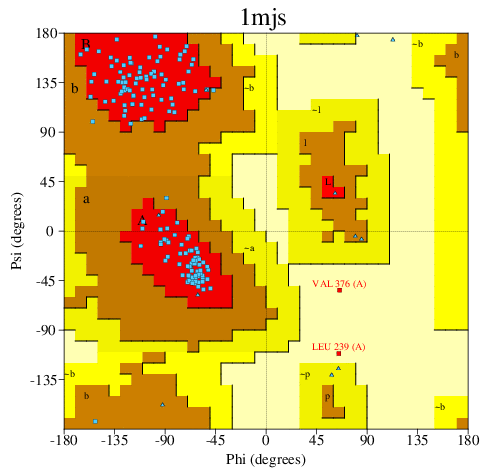
PROCHECK
|
|
|
|
|
|
Headers
|
|
|
|
References
|
|
|
|
|
|

|
|
P84022
(SMAD3_HUMAN) -
Mothers against decapentaplegic homolog 3 from Homo sapiens
|
|
|
|
Seq:
Struc:
|
|
|
|
425 a.a.
178 a.a.
|
|

|

|

|
|
|
|
|
|
|
|
|
|
|
Key: |
 |
PfamA domain |
|
|
 |
Secondary structure |
|
 |
CATH domain |
|
|
|
|
|
|
|
|
|
|
|
|
|
|
|
|
|
 |
|
|
|
|
|
|
| |
|
|
Genes Dev
16:1950-1963
(2002)
|
|
PubMed id:
|
|
|
|
|
|
| |
|
Smad3 allostery links TGF-beta receptor kinase activation to transcriptional control.
|
|
B.Y.Qin,
S.S.Lam,
J.J.Correia,
K.Lin.
|
|
|
|
|
| |
ABSTRACT
|
|
|
|
| |
|
|
Smad3 transduces the signals of TGF-betas, coupling transmembrane receptor
kinase activation to transcriptional control. The membrane-associated molecule
SARA (Smad Anchor for Receptor Activation) recruits Smad3 for phosphorylation by
the receptor kinase. Upon phosphorylation, Smad3 dissociates from SARA and
enters the nucleus, in which its transcriptional activity can be repressed by
Ski. Here, we show that SARA and Ski recognize specifically the monomeric and
trimeric forms of Smad3, respectively. Thus, trimerization of Smad3, induced by
phosphorylation, simultaneously activates the TGF-beta signal by driving Smad3
dissociation from SARA and sets up the negative feedback mechanism by Ski.
Structural models of the Smad3/SARA/receptor kinase complex and Smad3/Ski
complex provide insights into the molecular basis of regulation.
|
|
|
|
|
|
|
|
|
|
|
|
|
|
|
|
|
|
 |
 |
 |
|
Literature references that cite this PDB file's key reference
|
|
|
| |
PubMed id
|
|
Reference
|
|
|
|
|
|
A.J.Doyle,
J.J.Doyle,
S.L.Bessling,
S.Maragh,
M.E.Lindsay,
D.Schepers,
E.Gillis,
G.Mortier,
T.Homfray,
K.Sauls,
R.A.Norris,
N.D.Huso,
D.Leahy,
D.W.Mohr,
M.J.Caulfield,
A.F.Scott,
A.Destrée,
R.C.Hennekam,
P.H.Arn,
C.J.Curry,
L.Van Laer,
A.S.McCallion,
B.L.Loeys,
and
H.C.Dietz
(2012).
Mutations in the TGF-β repressor SKI cause Shprintzen-Goldberg syndrome with aortic aneurysm.
|
| |
Nat Genet,
44,
1249-1254.
|
|
|
|
|
|
|
C.Huang,
R.Du,
P.Zhang,
H.Meng,
H.Jia,
Y.Song,
M.Li,
Y.Zhang,
and
S.Sun
(2011).
Expression, purification, and functional characterization of recombinant PTD-SARA.
|
| |
Acta Biochim Biophys Sin (Shanghai),
43,
110-117.
|
|
|
|
|
|
|
E.Wywial,
and
S.M.Singh
(2010).
Identification and structural characterization of FYVE domain-containing proteins of Arabidopsis thaliana.
|
| |
BMC Plant Biol,
10,
157.
|
|
|
|
|
|
|
K.Miyazono,
Y.Kamiya,
and
M.Morikawa
(2010).
Bone morphogenetic protein receptors and signal transduction.
|
| |
J Biochem,
147,
35-51.
|
|
|
|
|
|
|
C.Wang,
L.Chen,
L.Wang,
and
J.Wu
(2009).
Crystal structure of the MH2 domain of Drosophila Mad.
|
| |
Sci China C Life Sci,
52,
539-544.
|
|
|
PDB code:
|
|
|
|
|
|
|
|
O.A.Gressner
(2009).
Less Smad2 is good for you! A scientific update on coffee's liver benefits.
|
| |
Hepatology,
50,
970-978.
|
|
|
|
|
|
|
Y.Pan,
and
R.Nussinov
(2009).
Cooperativity dominates the genomic organization of p53-response elements: a mechanistic view.
|
| |
PLoS Comput Biol,
5,
e1000448.
|
|
|
|
|
|
|
K.A.Brown,
J.A.Pietenpol,
and
H.L.Moses
(2007).
A tale of two proteins: differential roles and regulation of Smad2 and Smad3 in TGF-beta signaling.
|
| |
J Cell Biochem,
101,
9.
|
|
|
|
|
|
|
K.Pardali,
and
A.Moustakas
(2007).
Actions of TGF-beta as tumor suppressor and pro-metastatic factor in human cancer.
|
| |
Biochim Biophys Acta,
1775,
21-62.
|
|
|
|
|
|
|
K.V.Gromova,
M.Friedrich,
A.Noskov,
and
G.S.Harms
(2007).
Visualizing Smad1/4 signaling response to bone morphogenetic protein-4 activation by FRET biosensors.
|
| |
Biochim Biophys Acta,
1773,
1759-1773.
|
|
|
|
|
|
|
N.J.Samani,
J.Erdmann,
A.S.Hall,
C.Hengstenberg,
M.Mangino,
B.Mayer,
R.J.Dixon,
T.Meitinger,
P.Braund,
H.E.Wichmann,
J.H.Barrett,
I.R.König,
S.E.Stevens,
S.Szymczak,
D.A.Tregouet,
M.M.Iles,
F.Pahlke,
H.Pollard,
W.Lieb,
F.Cambien,
M.Fischer,
W.Ouwehand,
S.Blankenberg,
A.J.Balmforth,
A.Baessler,
S.G.Ball,
T.M.Strom,
I.Braenne,
C.Gieger,
P.Deloukas,
M.D.Tobin,
A.Ziegler,
J.R.Thompson,
and
H.Schunkert
(2007).
Genomewide association analysis of coronary artery disease.
|
| |
N Engl J Med,
357,
443-453.
|
|
|
|
|
|
|
B.M.Zhao,
and
F.M.Hoffmann
(2006).
Inhibition of transforming growth factor-beta1-induced signaling and epithelial-to-mesenchymal transition by the Smad-binding peptide aptamer Trx-SARA.
|
| |
Mol Biol Cell,
17,
3819-3831.
|
|
|
|
|
|
|
V.Muralidharan,
and
T.W.Muir
(2006).
Protein ligation: an enabling technology for the biophysical analysis of proteins.
|
| |
Nat Methods,
3,
429-438.
|
|
|
|
|
|
|
Z.Gao,
Z.Wang,
Y.Shi,
Z.Lin,
H.Jiang,
T.Hou,
Q.Wang,
X.Yuan,
Y.Zhao,
H.Wu,
and
Y.Jin
(2006).
Modulation of collagen synthesis in keloid fibroblasts by silencing Smad2 with siRNA.
|
| |
Plast Reconstr Surg,
118,
1328-1337.
|
|
|
|
|
|
|
B.Y.Qin,
C.Liu,
H.Srinath,
S.S.Lam,
J.J.Correia,
R.Derynck,
and
K.Lin
(2005).
Crystal structure of IRF-3 in complex with CBP.
|
| |
Structure,
13,
1269-1277.
|
|
|
|
|
|
|
D.S.Wilkinson,
S.K.Ogden,
S.A.Stratton,
J.L.Piechan,
T.T.Nguyen,
G.A.Smulian,
and
M.C.Barton
(2005).
A direct intersection between p53 and transforming growth factor beta pathways targets chromatin modification and transcription repression of the alpha-fetoprotein gene.
|
| |
Mol Cell Biol,
25,
1200-1212.
|
|
|
|
|
|
|
K.Miyazono,
S.Maeda,
and
T.Imamura
(2005).
BMP receptor signaling: transcriptional targets, regulation of signals, and signaling cross-talk.
|
| |
Cytokine Growth Factor Rev,
16,
251-263.
|
|
|
|
|
|
|
L.A.van Grunsven,
G.Verstappen,
D.Huylebroeck,
and
K.Verschueren
(2005).
Smads and chromatin modulation.
|
| |
Cytokine Growth Factor Rev,
16,
495-512.
|
|
|
|
|
|
|
Q.Cui,
S.K.Lim,
B.Zhao,
and
F.M.Hoffmann
(2005).
Selective inhibition of TGF-beta responsive genes by Smad-interacting peptide aptamers from FoxH1, Lef1 and CBP.
|
| |
Oncogene,
24,
3864-3874.
|
|
|
|
|
|
|
S.Arndt,
I.Poser,
T.Schubert,
M.Moser,
and
A.K.Bosserhoff
(2005).
Cloning and functional characterization of a new Ski homolog, Fussel-18, specifically expressed in neuronal tissues.
|
| |
Lab Invest,
85,
1330-1341.
|
|
|
|
|
|
|
V.Prokova,
S.Mavridou,
P.Papakosta,
and
D.Kardassis
(2005).
Characterization of a novel transcriptionally active domain in the transforming growth factor beta-regulated Smad3 protein.
|
| |
Nucleic Acids Res,
33,
3708-3721.
|
|
|
|
|
|
|
X.H.Feng,
and
R.Derynck
(2005).
Specificity and versatility in tgf-beta signaling through Smads.
|
| |
Annu Rev Cell Dev Biol,
21,
659-693.
|
|
|
|
|
|
|
C.Nourry,
L.Maksumova,
M.Pang,
X.Liu,
and
T.Wang
(2004).
Direct interaction between Smad3, APC10, CDH1 and HEF1 in proteasomal degradation of HEF1.
|
| |
BMC Cell Biol,
5,
20.
|
|
|
|
|
|
|
J.J.Wilson,
M.Malakhova,
R.Zhang,
A.Joachimiak,
and
R.S.Hegde
(2004).
Crystal structure of the dachshund homology domain of human SKI.
|
| |
Structure,
12,
785-792.
|
|
|
PDB code:
|
|
|
|
|
|
|
|
M.Takeda,
M.Mizuide,
M.Oka,
T.Watabe,
H.Inoue,
H.Suzuki,
T.Fujita,
T.Imamura,
K.Miyazono,
and
K.Miyazawa
(2004).
Interaction with Smad4 is indispensable for suppression of BMP signaling by c-Ski.
|
| |
Mol Biol Cell,
15,
963-972.
|
|
|
|
|
|
|
R.A.Randall,
M.Howell,
C.S.Page,
A.Daly,
P.A.Bates,
and
C.S.Hill
(2004).
Recognition of phosphorylated-Smad2-containing complexes by a novel Smad interaction motif.
|
| |
Mol Cell Biol,
24,
1106-1121.
|
|
|
|
|
|
|
B.Y.Qin,
C.Liu,
S.S.Lam,
H.Srinath,
R.Delston,
J.J.Correia,
R.Derynck,
and
K.Lin
(2003).
Crystal structure of IRF-3 reveals mechanism of autoinhibition and virus-induced phosphoactivation.
|
| |
Nat Struct Biol,
10,
913-921.
|
|
|
PDB code:
|
|
|
|
|
|
|
|
K.Miyazono,
H.Suzuki,
and
T.Imamura
(2003).
Regulation of TGF-beta signaling and its roles in progression of tumors.
|
| |
Cancer Sci,
94,
230-234.
|
|
|
|
|
|
|
J.W.Wu,
A.R.Krawitz,
J.Chai,
W.Li,
F.Zhang,
K.Luo,
and
Y.Shi
(2002).
Structural mechanism of Smad4 recognition by the nuclear oncoprotein Ski: insights on Ski-mediated repression of TGF-beta signaling.
|
| |
Cell,
111,
357-367.
|
|
|
PDB code:
|
|
|
|
|
|
|
|
K.Miyazawa,
M.Shinozaki,
T.Hara,
T.Furuya,
and
K.Miyazono
(2002).
Two major Smad pathways in TGF-beta superfamily signalling.
|
| |
Genes Cells,
7,
1191-1204.
|
|
|
|
|
|
The most recent references are shown first.
Citation data come partly from CiteXplore and partly
from an automated harvesting procedure. Note that this is likely to be
only a partial list as not all journals are covered by
either method. However, we are continually building up the citation data
so more and more references will be included with time.
Where a reference describes a PDB structure, the PDB
code is
shown on the right.
|
|


 Links
Links


