 |
PDBsum entry 1aaq

|
|
|
|
|
|

|

|

|

|
|

|
|

|
|

|
|

|
|
|
 |

|

|
|
|
|
|
|
|
|
|
|
|
|
|
|
|
|
|
|
|
|
|
|
|
|
|
|
|
|
|
|
|
|
|
Hydrolase/hydrolase inhibitor
|
PDB id
|
|
|
|
1aaq
|
|
|
|
|
|
|
|
|
|
|
|
|
|
|

|

|

|
|
|
|
|
|
|
|
 |
Contents |
 |
|
|
|
|
|
|
|
|
|
|
|
|
* Residue conservation analysis
|
|
|
|
|
|
|
|
|
|
|
Enzyme class 1:
|
|
E.C.2.7.7.-
- ?????
|
|
|
|
|
|
|
Enzyme class 2:
|
|
E.C.2.7.7.49
- RNA-directed Dna polymerase.
|
|
|
|
|
|
|
Reaction:
|
|
DNA(n) + a 2'-deoxyribonucleoside 5'-triphosphate = DNA(n+1) + diphosphate
|
|
|
|
|
|
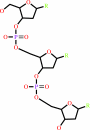 DNA(n)
|
+
|
2'-deoxyribonucleoside 5'-triphosphate
|
=
|
DNA(n+1)
|
+
|
 diphosphate
|
|
|
|
|
|
|
|
|
|
Enzyme class 3:
|
|
E.C.2.7.7.7
- DNA-directed Dna polymerase.
|
|
|
|
|
|
|
Reaction:
|
|
DNA(n) + a 2'-deoxyribonucleoside 5'-triphosphate = DNA(n+1) + diphosphate
|
|
|
|
|
|
DNA(n)
|
+
|
2'-deoxyribonucleoside 5'-triphosphate
|
=
|
DNA(n+1)
|
+
|
diphosphate
|
|
|
|
|
|
|
|
|
|
Enzyme class 4:
|
|
E.C.3.1.-.-
|
|
|
|
|
|
|
Enzyme class 5:
|
|
E.C.3.1.13.2
- exoribonuclease H.
|
|
|
|
|
|
|
Reaction:
|
|
Exonucleolytic cleavage to 5'-phosphomonoester oligonucleotides in both 5'- to 3'- and 3'- to 5'-directions.
|
|
|
|
|
|
Enzyme class 6:
|
|
E.C.3.1.26.13
- retroviral ribonuclease H.
|
|
|
|
|
|
|
Enzyme class 7:
|
|
E.C.3.4.23.16
- HIV-1 retropepsin.
|
|
|
|
|
|
|
Reaction:
|
|
Specific for a P1 residue that is hydrophobic, and P1' variable, but often Pro.
|
|
|
|
|
|
|
|
|
Note, where more than one E.C. class is given (as above), each may
correspond to a different protein domain or, in the case of polyprotein
precursors, to a different mature protein.
|
|
|
|
Molecule diagrams generated from .mol files obtained from the
KEGG ftp site
|
|
|
|
|
|
|
|
|
|
|
|
|
|
 |
|
|
|
|
|
|
| |
|
|
| |
|
DOI no:
|
Biochemistry
31:6646-6659
(1992)
|
|
PubMed id:
|
|
|
|
|
|
| |
|
Hydroxyethylene isostere inhibitors of human immunodeficiency virus-1 protease: structure-activity analysis using enzyme kinetics, X-ray crystallography, and infected T-cell assays.
|
|
G.B.Dreyer,
D.M.Lambert,
T.D.Meek,
T.J.Carr,
T.A.Tomaszek,
A.V.Fernandez,
H.Bartus,
E.Cacciavillani,
A.M.Hassell,
M.Minnich.
|
|
|
|
|
| |
ABSTRACT
|
|
|
|
| |
|
|
Analogues of peptides ranging in size from three to six amino acids and
containing the hydroxyethylene dipeptide isosteres Phe psi Gly, Phe psi Ala, Phe
psi NorVal, Phe psi Leu, and Phe psi Phe, where psi denotes replacement of CONH
by (S)-CH(OH)CH2, were synthesized and studied as HIV-1 protease inhibitors.
Inhibition constants (Ki) with purified HIV-1 protease depend strongly on the
isostere in the order Phe psi Gly greater than Phe psi Ala greater than Phe psi
NorVal greater than Phe psi Leu greater than Phe psi Phe and decrease with
increasing length of the peptide analogue, converging to a value of 0.4 nM. Ki
values are progressively less dependent on inhibitor length as the size of the
P1' side chain within the isostere increases. The structures of HIV-1 protease
complexed with the inhibitors Ala-Ala-X-Val-Val-OMe, where X is Phe psi Gly, Phe
psi Ala, Phe psi NorVal, and Phe psi Phe, have been determined by X-ray
crystallography (resolution 2.3-3.2 A). The crystals exhibit symmetry consistent
with space group P6(1) with strong noncrystallographic 2-fold symmetry, and the
inhibitors all exhibit 2-fold disorder. The inhibitors bind in similar
conformations, forming conserved hydrogen bonds with the enzyme. The Phe psi Gly
inhibitor adopts an altered conformation that places its P3' valine side chain
partially in the hydrophobic S1' pocket, thus suggesting an explanation for the
greater dependence of the Ki value on inhibitor length in the Phe psi Gly
series. From the kinetic and crystallographic data, a minimal inhibitor model
for tight-binding inhibition is derived in which the enzyme subsites S2-S2' are
optimally occupied. The Ki values for several compounds are compared with their
potencies as inhibitors of proteolytic processing in T-cell cultures chronically
infected with HIV-1 (MIC values) and as inhibitors of acute infectivity (IC50
values). There is a rank-order correspondence, but a 20-1000-fold difference,
between the values of Ki and those of MIC or IC50. IC50 values can approach
those of Ki but are highly dependent on the conditions of the acute infectivity
assay and are influenced by physiochemical properties of the inhibitors such as
solubility.
|
|
|
|
|
|
|
|
|
|
|
|
|
|
|
|
|
|
 |
 |
 |
|
Literature references that cite this PDB file's key reference
|
|
|
| |
PubMed id
|
|
Reference
|
|
|
|
|
|
J.P.Yesudas,
F.B.Sayyed,
and
C.H.Suresh
(2011).
Analysis of structural water and CH···π interactions in HIV-1 protease and PTP1B complexes using a hydrogen bond prediction tool, HBPredicT.
|
| |
J Mol Model,
17,
401-413.
|
|
|
|
|
|
|
S.L.Chen,
D.X.Zhao,
and
Z.Z.Yang
(2011).
An estimation method of binding free energy in terms of ABEEMσπ/MM and continuum electrostatics fused into LIE method.
|
| |
J Comput Chem,
32,
338-348.
|
|
|
|
|
|
|
E.C.Johnson,
E.Malito,
Y.Shen,
B.Pentelute,
D.Rich,
J.Florián,
W.J.Tang,
and
S.B.Kent
(2007).
Insights from atomic-resolution X-ray structures of chemically synthesized HIV-1 protease in complex with inhibitors.
|
| |
J Mol Biol,
373,
573-586.
|
|
|
PDB codes:
|
|
|
|
|
|
|
|
J.Dusková,
J.Dohnálek,
T.Skálová,
H.Petroková,
E.Vondrácková,
M.Hradílek,
J.Konvalinka,
M.Soucek,
J.Brynda,
M.Fábry,
J.Sedlácek,
and
J.Hasek
(2006).
On the role of the R configuration of the reaction-intermediate isostere in HIV-1 protease-inhibitor binding: X-ray structure at 2.0 A resolution.
|
| |
Acta Crystallogr D Biol Crystallogr,
62,
489-497.
|
|
|
PDB codes:
|
|
|
|
|
|
|
|
C.Bartels,
A.Widmer,
and
C.Ehrhardt
(2005).
Absolute free energies of binding of peptide analogs to the HIV-1 protease from molecular dynamics simulations.
|
| |
J Comput Chem,
26,
1294-1305.
|
|
|
|
|
|
|
J.Wang
(2005).
DNA polymerases: Hoogsteen base-pairing in DNA replication?
|
| |
Nature,
437,
E6.
|
|
|
PDB code:
|
|
|
|
|
|
|
|
B.Pillai,
K.K.Kannan,
S.V.Bhat,
and
M.V.Hosur
(2004).
Rapid screening for HIV-1 protease inhibitor leads through X-ray diffraction.
|
| |
Acta Crystallogr D Biol Crystallogr,
60,
594-596.
|
|
|
|
|
|
|
T.Goto,
T.Nakano,
T.Kohno,
S.Morimatsu,
C.Morita,
W.Hong,
Y.Kiso,
M.Nakai,
and
K.Sano
(2001).
Targets of a protease inhibitor, KNI-272, in HIV-1-infected cells.
|
| |
J Med Virol,
63,
203-209.
|
|
|
|
|
|
|
A.Wlodawer,
and
J.Vondrasek
(1998).
Inhibitors of HIV-1 protease: a major success of structure-assisted drug design.
|
| |
Annu Rev Biophys Biomol Struct,
27,
249-284.
|
|
|
|
|
|
|
D.Boden,
and
M.Markowitz
(1998).
Resistance to human immunodeficiency virus type 1 protease inhibitors.
|
| |
Antimicrob Agents Chemother,
42,
2775-2783.
|
|
|
|
|
|
|
R.B.Rose,
C.S.Craik,
and
R.M.Stroud
(1998).
Domain flexibility in retroviral proteases: structural implications for drug resistant mutations.
|
| |
Biochemistry,
37,
2607-2621.
|
|
|
PDB code:
|
|
|
|
|
|
|
|
J.Konvalinka,
J.Litera,
J.Weber,
J.Vondrásek,
M.Hradílek,
M.Soucek,
I.Pichová,
P.Majer,
P.Strop,
J.Sedlácek,
A.M.Heuser,
H.Kottler,
and
H.G.Kräusslich
(1997).
Configurations of diastereomeric hydroxyethylene isosteres strongly affect biological activities of a series of specific inhibitors of human-immunodeficiency-virus proteinase.
|
| |
Eur J Biochem,
250,
559-566.
|
|
|
|
|
|
|
M.Miller,
M.Geller,
M.Gribskov,
and
S.B.Kent
(1997).
Analysis of the structure of chemically synthesized HIV-1 protease complexed with a hexapeptide inhibitor. Part I: Crystallographic refinement of 2 A data.
|
| |
Proteins,
27,
184-194.
|
|
|
|
|
|
|
A.H.Kaplan
(1996).
Constraints on the sequence diversity of the protease of human immunodeficiency virus type 1: a guide for drug design.
|
| |
AIDS Res Hum Retroviruses,
12,
849-853.
|
|
|
|
|
|
|
C.S.Dukes,
T.J.Matthews,
D.M.Lambert,
G.B.Dreyer,
S.R.Petteway,
and
J.B.Weinberg
(1996).
Potent inhibition of HIV type 1 infection of mononuclear phagocytes by synthetic peptide analogs of HIV type 1 protease substrates.
|
| |
AIDS Res Hum Retroviruses,
12,
777-782.
|
|
|
|
|
|
|
E.E.Rutenber,
F.McPhee,
A.P.Kaplan,
S.L.Gallion,
J.C.Hogan,
C.S.Craik,
and
R.M.Stroud
(1996).
A new class of HIV-1 protease inhibitor: the crystallographic structure, inhibition and chemical synthesis of an aminimide peptide isostere.
|
| |
Bioorg Med Chem,
4,
1545-1558.
|
|
|
PDB code:
|
|
|
|
|
|
|
|
A.Wallqvist,
R.L.Jernigan,
and
D.G.Covell
(1995).
A preference-based free-energy parameterization of enzyme-inhibitor binding. Applications to HIV-1-protease inhibitor design.
|
| |
Protein Sci,
4,
1881-1903.
|
|
|
|
|
|
|
M.Vaillancourt,
G.Sauvé,
and
E.Cohen
(1995).
Antiviral properties of simple difunctionalized enols targeted to the HIV-1 protease.
|
| |
Antiviral Res,
27,
205-218.
|
|
|
|
|
|
|
V.Nauchitel,
M.C.Villaverde,
and
F.Sussman
(1995).
Solvent accessibility as a predictive tool for the free energy of inhibitor binding to the HIV-1 protease.
|
| |
Protein Sci,
4,
1356-1364.
|
|
|
|
|
|
|
P.L.Chau,
and
P.M.Dean
(1994).
Electrostatic complementarity between proteins and ligands. 1. Charge disposition, dielectric and interface effects.
|
| |
J Comput Aided Mol Des,
8,
513-525.
|
|
|
|
|
|
|
P.L.Chau,
and
P.M.Dean
(1994).
Electrostatic complementarity between proteins and ligands. 2. Ligand moieties.
|
| |
J Comput Aided Mol Des,
8,
527-544.
|
|
|
|
|
|
|
R.L.DesJarlais,
and
J.S.Dixon
(1994).
A shape- and chemistry-based docking method and its use in the design of HIV-1 protease inhibitors.
|
| |
J Comput Aided Mol Des,
8,
231-242.
|
|
|
|
|
|
|
P.L.Black,
M.B.Downs,
M.G.Lewis,
M.A.Ussery,
G.B.Dreyer,
S.R.Petteway,
and
D.M.Lambert
(1993).
Antiretroviral activities of protease inhibitors against murine leukemia virus and simian immunodeficiency virus in tissue culture.
|
| |
Antimicrob Agents Chemother,
37,
71-77.
|
|
|
|
|
|
|
S.S.Abdel-Meguid
(1993).
Inhibitors of aspartyl proteinases.
|
| |
Med Res Rev,
13,
731-778.
|
|
|
|
|
|
|
W.Prusoff,
T.S.Lin,
A.Pivazyan,
A.S.Sun,
and
E.Birks
(1993).
Empirical and rational approaches for development of inhibitors of the human immunodeficiency virus--HIV-1.
|
| |
Pharmacol Ther,
60,
315-329.
|
|
|
|
|
|
The most recent references are shown first.
Citation data come partly from CiteXplore and partly
from an automated harvesting procedure. Note that this is likely to be
only a partial list as not all journals are covered by
either method. However, we are continually building up the citation data
so more and more references will be included with time.
Where a reference describes a PDB structure, the PDB
codes are
shown on the right.
|
|


 Links
Links





