 |
PDBsum entry 1a9u

|
|
|
|
|
 |
Contents |
 |
|
|
|
|
|
|
|
|
|
|
|
|
* Residue conservation analysis
|
|
|
|
|
|
PDB id:
|
|
|
|
| Name: |
|
Transferase
|
|
|
Title:
|
|
The complex structure of the map kinase p38/sb203580
|
|
Structure:
|
|
Map kinase p38. Chain: a. Synonym: mitogen activated protein kinase. Engineered: yes. Mutation: yes. Other_details: sb203580 pyridinylimidazole
|
|
Source:
|
|
Homo sapiens. Human. Organism_taxid: 9606. Cell_line: bl21 (de3). Expressed in: escherichia coli bl21(de3). Expression_system_taxid: 469008. Expression_system_cell_line: bl21 (de3).
|
|
Resolution:
|
|
|
2.50Å
|
R-factor:
|
0.182
|
R-free:
|
0.240
|
|
|
Authors:
|
|
Z.Wang,B.Canagarajah,J.C.Boehm,S.Kassis,M.H.Cobb,P.R.Young,S.Abdel- Meguid,J.L.Adams,E.J.Goldsmith
|
Key ref:

|
|
Z.Wang
et al.
(1998).
Structural basis of inhibitor selectivity in MAP kinases.
Structure,
6,
1117-1128.
PubMed id:
DOI:

|
|
|
Date:
|
|
|
10-Apr-98
|
Release date:
|
20-Apr-99
|
|
|
|
|
|
|
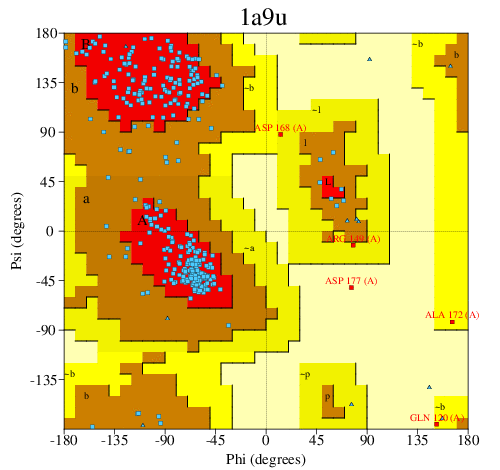
PROCHECK
|
|
|
|
|
|
Headers
|
|
|
|
References
|
|
|
|
|
|

|
|
Q16539
(MK14_HUMAN) -
Mitogen-activated protein kinase 14 from Homo sapiens
|
|
|
|
Seq:
Struc:
|
|
|
|
360 a.a.
351 a.a.
|
|

|

|

|
|
|
|
|
|
|
|
|
|
|
Key: |
 |
PfamA domain |
|
|
 |
Secondary structure |
|
 |
CATH domain |
|
|
|
|
|
|
|
|
|
|
|
|
|
Enzyme class:
|
|
E.C.2.7.11.24
- mitogen-activated protein kinase.
|
|
|
|
|
|
|
Reaction:
|
|
|
1.
|
L-seryl-[protein] + ATP = O-phospho-L-seryl-[protein] + ADP + H+
|
|
2.
|
L-threonyl-[protein] + ATP = O-phospho-L-threonyl-[protein] + ADP + H+
|
|
|
|
|
|
|
L-seryl-[protein]
|
+
|
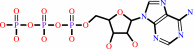 ATP
ATP
|
=
|
O-phospho-L-seryl-[protein]
|
+
|
 ADP
ADP
|
+
|
H(+)
|
|
|
|
|
|
|
L-threonyl-[protein]
|
+
|
ATP
|
=
|
O-phospho-L-threonyl-[protein]
|
+
|
ADP
|
+
|
H(+)
|
|
|
|
|
|
|
|
|
|
|
|
|
Molecule diagrams generated from .mol files obtained from the
KEGG ftp site
|
|
|
|
|
|
|
|
|
|
|
|
|
|
 |
|
|
|
|
|
|
| |
|
|
| |
|
DOI no:
|
Structure
6:1117-1128
(1998)
|
|
PubMed id:
|
|
|
|
|
|
| |
|
Structural basis of inhibitor selectivity in MAP kinases.
|
|
Z.Wang,
B.J.Canagarajah,
J.C.Boehm,
S.Kassisà,
M.H.Cobb,
P.R.Young,
S.Abdel-Meguid,
J.L.Adams,
E.J.Goldsmith.
|
|
|
|
|
| |
ABSTRACT
|
|
|
|
| |
|
|
BACKGROUND: The mitogen-activated protein (MAP) kinases are important signaling
molecules that participate in diverse cellular events and are potential targets
for intervention in inflammation, cancer, and other diseases. The MAP kinase p38
is responsive to environmental stresses and is involved in the production of
cytokines during inflammation. In contrast, the activation of the MAP kinase
ERK2 (extracellular-signal-regulated kinase 2) leads to cellular differentiation
or proliferation. The anti-inflammatory agent pyridinylimidazole and its analogs
compounds) are highly potent and selective inhibitors
of p38, but not of the closely-related ERK2, or other serine/threonine kinases.
Although these compounds are known to bind to the ATP-binding site, the origin
of the inhibitory specificity toward p38 is not clear. RESULTS: We report the
structural basis for the exceptional selectivity of these SB compounds for p38
over ERK2, as determined by comparative crystallography. In addition, structural
data on the origin of olomoucine (a better inhibitor of ERK2) selectivity are
presented. The crystal structures of four SB compounds in complex with p38 and
of one SB compound and olomoucine in complex with ERK2 are presented here. The
SB inhibitors bind in an extended pocket in the active site and are
complementary to the open domain structure of the low-activity form of p38. The
relatively closed domain structure of ERK2 is able to accommodate the smaller
olomoucine. CONCLUSIONS: The unique kinase-inhibitor interactions observed in
these complexes originate from amino-acid replacements in the active site and
replacements distant from the active site that affect the size of the domain
interface. This structural information should facilitate the design of better
MAP-kinase inhibitors for the treatment of inflammation and other diseases.
|
|
|
|
|
|
| |
Selected figure(s)
|
|
|
|
| |
|
|

|
|
Figure 6.
Figure 6. Thr106 of p38 plays a crucial role in the p38-SB
inhibitor interactions. (a) In the native p38 structure, Thr106
forms an interaction with a water molecule. (b) In the
p38-inhibitor complex, Thr106 rotates around x1 for about 120°
and participates in the nearby hydrogen-bonding network that
also involves His107. b strands in the N-terminal domain are
colored green.
|
|
|
|
|
|
| |
The above figure is
reprinted
by permission from Cell Press:
Structure
(1998,
6,
1117-1128)
copyright 1998.
|
|
| |
Figure was
selected
by an automated process.
|
|
|
|
|
|
|
|
|
|
|
|
|
|
|
|
 |
 |
 |
|
Literature references that cite this PDB file's key reference
|
|
|
| |
PubMed id
|
|
Reference
|
|
|
|
|
|
M.Ressurreição,
D.Rollinson,
A.M.Emery,
and
A.J.Walker
(2011).
A role for p38 MAPK in the regulation of ciliary motion in a eukaryote.
|
| |
BMC Cell Biol,
12,
6.
|
|
|
|
|
|
|
N.Jura,
X.Zhang,
N.F.Endres,
M.A.Seeliger,
T.Schindler,
and
J.Kuriyan
(2011).
Catalytic control in the EGF receptor and its connection to general kinase regulatory mechanisms.
|
| |
Mol Cell,
42,
9.
|
|
|
|
|
|
|
J.K.Son,
S.Varadarajan,
and
S.B.Bratton
(2010).
TRAIL-activated stress kinases suppress apoptosis through transcriptional upregulation of MCL-1.
|
| |
Cell Death Differ,
17,
1288-1301.
|
|
|
|
|
|
|
J.Su,
X.Cui,
Y.Li,
H.Mani,
G.A.Ferreyra,
R.L.Danner,
L.L.Hsu,
Y.Fitz,
and
P.Q.Eichacker
(2010).
SB203580, a p38 inhibitor, improved cardiac function but worsened lung injury and survival during Escherichia coli pneumonia in mice.
|
| |
J Trauma,
68,
1317-1327.
|
|
|
|
|
|
|
K.P.Ravindranathan,
V.Mandiyan,
A.R.Ekkati,
J.H.Bae,
J.Schlessinger,
and
W.L.Jorgensen
(2010).
Discovery of novel fibroblast growth factor receptor 1 kinase inhibitors by structure-based virtual screening.
|
| |
J Med Chem,
53,
1662-1672.
|
|
|
PDB code:
|
|
|
|
|
|
|
|
R.Akella,
X.Min,
Q.Wu,
K.H.Gardner,
and
E.J.Goldsmith
(2010).
The third conformation of p38α MAP kinase observed in phosphorylated p38α and in solution.
|
| |
Structure,
18,
1571-1578.
|
|
|
PDB code:
|
|
|
|
|
|
|
|
S.Ciavarella,
A.Milano,
F.Dammacco,
and
F.Silvestris
(2010).
Targeted therapies in cancer.
|
| |
BioDrugs,
24,
77-88.
|
|
|
|
|
|
|
T.K.Hyun,
L.Havlicek,
M.Strnad,
and
T.Roitsch
(2010).
Trisubstituted purines are useful tools for developing potent plant mitogen-activated protein kinase inhibitors.
|
| |
Biosci Biotechnol Biochem,
74,
553-557.
|
|
|
|
|
|
|
A.Schiefner,
M.Fujio,
D.Wu,
C.H.Wong,
and
I.A.Wilson
(2009).
Structural evaluation of potent NKT cell agonists: implications for design of novel stimulatory ligands.
|
| |
J Mol Biol,
394,
71-82.
|
|
|
PDB codes:
|
|
|
|
|
|
|
|
D.Rios-Barrera,
A.Vega-Segura,
V.Thibert,
J.S.Rodríguez-Zavala,
and
M.E.Torres-Marquez
(2009).
p38 MAPK as a signal transduction component of heavy metals stress in Euglena gracilis.
|
| |
Arch Microbiol,
191,
47-54.
|
|
|
|
|
|
|
J.J.Perry,
R.M.Harris,
D.Moiani,
A.J.Olson,
and
J.A.Tainer
(2009).
p38alpha MAP kinase C-terminal domain binding pocket characterized by crystallographic and computational analyses.
|
| |
J Mol Biol,
391,
1.
|
|
|
PDB code:
|
|
|
|
|
|
|
|
K.Burkhard,
S.Smith,
R.Deshmukh,
A.D.MacKerell,
and
P.Shapiro
(2009).
Development of extracellular signal-regulated kinase inhibitors.
|
| |
Curr Top Med Chem,
9,
678-689.
|
|
|
|
|
|
|
K.Ziegler,
D.R.Hauser,
A.Unger,
W.Albrecht,
and
S.A.Laufer
(2009).
2-Acylaminopyridin-4-ylimidazoles as p38 MAP kinase inhibitors: Design, synthesis, and biological and metabolic evaluations.
|
| |
ChemMedChem,
4,
1939-1948.
|
|
|
|
|
|
|
M.H.Seifert
(2009).
Robust optimization of scoring functions for a target class.
|
| |
J Comput Aided Mol Des,
23,
633-644.
|
|
|
|
|
|
|
R.S.Armen,
J.Chen,
and
C.L.Brooks
(2009).
An Evaluation of Explicit Receptor Flexibility in Molecular Docking Using Molecular Dynamics and Torsion Angle Molecular Dynamics.
|
| |
J Chem Theory Comput,
5,
2909-2923.
|
|
|
|
|
|
|
S.Han,
A.Mistry,
J.S.Chang,
D.Cunningham,
M.Griffor,
P.C.Bonnette,
H.Wang,
B.A.Chrunyk,
G.E.Aspnes,
D.P.Walker,
A.D.Brosius,
and
L.Buckbinder
(2009).
Structural Characterization of Proline-rich Tyrosine Kinase 2 (PYK2) Reveals a Unique (DFG-out) Conformation and Enables Inhibitor Design.
|
| |
J Biol Chem,
284,
13193-13201.
|
|
|
PDB codes:
|
|
|
|
|
|
|
|
D.R.Caffrey,
E.A.Lunney,
and
D.J.Moshinsky
(2008).
Prediction of specificity-determining residues for small-molecule kinase inhibitors.
|
| |
BMC Bioinformatics,
9,
491.
|
|
|
|
|
|
|
I.Reulecke,
G.Lange,
J.Albrecht,
R.Klein,
and
M.Rarey
(2008).
Towards an integrated description of hydrogen bonding and dehydration: decreasing false positives in virtual screening with the HYDE scoring function.
|
| |
ChemMedChem,
3,
885-897.
|
|
|
|
|
|
|
J.Subramanian,
S.Sharma,
and
C.B-Rao
(2008).
Modeling and selection of flexible proteins for structure-based drug design: backbone and side chain movements in p38 MAPK.
|
| |
ChemMedChem,
3,
336-344.
|
|
|
|
|
|
|
K.M.Sours,
S.C.Kwok,
T.Rachidi,
T.Lee,
A.Ring,
A.N.Hoofnagle,
K.A.Resing,
and
N.G.Ahn
(2008).
Hydrogen-exchange mass spectrometry reveals activation-induced changes in the conformational mobility of p38alpha MAP kinase.
|
| |
J Mol Biol,
379,
1075-1093.
|
|
|
|
|
|
|
P.Koch,
C.Bäuerlein,
D.Schollmeyer,
and
S.Laufer
(2008).
Methyl 4-[5-(4-fluoro-phen-yl)-4-(pyridin-4-yl)-1H-imidazol-2-ylsulfan-yl]butanoate.
|
| |
Acta Crystallogr Sect E Struct Rep Online,
64,
o1183-o1184.
|
|
|
|
|
|
|
R.Akella,
T.M.Moon,
and
E.J.Goldsmith
(2008).
Unique MAP Kinase binding sites.
|
| |
Biochim Biophys Acta,
1784,
48-55.
|
|
|
|
|
|
|
S.Laufer,
and
P.Koch
(2008).
Towards the improvement of the synthesis of novel 4(5)-aryl-5(4)-heteroaryl-2-thio-substituted imidazoles and their p38 MAP kinase inhibitory activity.
|
| |
Org Biomol Chem,
6,
437-439.
|
|
|
|
|
|
|
S.Margutti,
D.Schollmeyer,
and
S.Laufer
(2008).
4-(4-Fluoro-phen-yl)-2-methyl-3-(1-oxy-4-pyridyl)isoxazol-5(2H)-one.
|
| |
Acta Crystallogr Sect E Struct Rep Online,
64,
o504.
|
|
|
|
|
|
|
V.A.Potemkin,
and
M.A.Grishina
(2008).
A new paradigm for pattern recognition of drugs.
|
| |
J Comput Aided Mol Des,
22,
489-505.
|
|
|
|
|
|
|
D.Kuhn,
N.Weskamp,
E.Hüllermeier,
and
G.Klebe
(2007).
Functional Classification of Protein Kinase Binding Sites Using Cavbase.
|
| |
ChemMedChem,
2,
1432-1447.
|
|
|
|
|
|
|
J.E.Clark,
N.Sarafraz,
and
M.S.Marber
(2007).
Potential of p38-MAPK inhibitors in the treatment of ischaemic heart disease.
|
| |
Pharmacol Ther,
116,
192-206.
|
|
|
|
|
|
|
J.J.Gills,
S.S.Castillo,
C.Zhang,
P.A.Petukhov,
R.M.Memmott,
M.Hollingshead,
N.Warfel,
J.Han,
A.P.Kozikowski,
and
P.A.Dennis
(2007).
Phosphatidylinositol ether lipid analogues that inhibit AKT also independently activate the stress kinase, p38alpha, through MKK3/6-independent and -dependent mechanisms.
|
| |
J Biol Chem,
282,
27020-27029.
|
|
|
|
|
|
|
K.Müller,
C.Faeh,
and
F.Diederich
(2007).
Fluorine in pharmaceuticals: looking beyond intuition.
|
| |
Science,
317,
1881-1886.
|
|
|
PDB codes:
|
|
|
|
|
|
|
|
M.P.Mazanetz,
and
P.M.Fischer
(2007).
Untangling tau hyperphosphorylation in drug design for neurodegenerative diseases.
|
| |
Nat Rev Drug Discov,
6,
464-479.
|
|
|
|
|
|
|
O.Inatomi,
A.Andoh,
Y.Yagi,
A.Ogawa,
K.Hata,
H.Shiomi,
T.Tani,
A.Takayanagi,
N.Shimizu,
and
Y.Fujiyama
(2007).
Matrix metalloproteinase-3 secretion from human pancreatic periacinar myofibroblasts in response to inflammatory mediators.
|
| |
Pancreas,
34,
126-132.
|
|
|
|
|
|
|
R.G.Kulkarni,
P.Srivani,
G.Achaiah,
and
G.N.Sastry
(2007).
Strategies to design pyrazolyl urea derivatives for p38 kinase inhibition: a molecular modeling study.
|
| |
J Comput Aided Mol Des,
21,
155-166.
|
|
|
|
|
|
|
S.Han,
P.Loulakis,
M.Griffor,
and
Z.Xie
(2007).
Crystal structure of activin receptor type IIB kinase domain from human at 2.0 Angstrom resolution.
|
| |
Protein Sci,
16,
2272-2277.
|
|
|
PDB code:
|
|
|
|
|
|
|
|
S.Margutti,
D.Schollmeyer,
and
S.Laufer
(2007).
4-[4-(4-Fluoro-phen-yl)-2-methyl-5-oxo-2,5-dihydro-isoxazol-3-yl]-1-methyl-pyridinium iodide-4-[3-(4-fluoro-phen-yl)-2-methyl-5-oxo-2,5-dihydro-isoxazol-4-yl]-1-methyl-pyridinium iodide (0.6/0.4).
|
| |
Acta Crystallogr Sect E Struct Rep Online,
64,
o298-o299.
|
|
|
|
|
|
|
S.Margutti,
and
S.A.Laufer
(2007).
Are MAP Kinases Drug Targets? Yes, but Difficult Ones.
|
| |
ChemMedChem,
2,
1116-1140.
|
|
|
|
|
|
|
T.Ishii,
H.Sootome,
H.Toyoda,
M.Suda,
T.Noumi,
and
K.Yamashita
(2007).
Dual enzyme-linked immunosorbent assay system for detection of endogenous kinase activities of mitogen- and stress-activated protein kinase-1/2.
|
| |
Assay Drug Dev Technol,
5,
523-533.
|
|
|
|
|
|
|
C.S.Page,
and
P.A.Bates
(2006).
Can MM-PBSA calculations predict the specificities of protein kinase inhibitors?
|
| |
J Comput Chem,
27,
1990-2007.
|
|
|
|
|
|
|
G.Pelaia,
A.Vatrella,
L.Gallelli,
T.Renda,
M.Caputi,
R.Maselli,
and
S.A.Marsico
(2006).
Biological targets for therapeutic interventions in COPD: clinical potential.
|
| |
Int J Chron Obstruct Pulmon Dis,
1,
321-334.
|
|
|
|
|
|
|
G.Wagner,
and
S.Laufer
(2006).
Small molecular anti-cytokine agents.
|
| |
Med Res Rev,
26,
1.
|
|
|
|
|
|
|
J.S.Sebolt-Leopold,
and
J.M.English
(2006).
Mechanisms of drug inhibition of signalling molecules.
|
| |
Nature,
441,
457-462.
|
|
|
|
|
|
|
M.D.Kelly,
and
R.L.Mancera
(2006).
Comparative analysis of the surface interaction properties of the binding sites of CDK2, CDK4, and ERK2.
|
| |
ChemMedChem,
1,
366-375.
|
|
|
|
|
|
|
M.Vogtherr,
K.Saxena,
S.Hoelder,
S.Grimme,
M.Betz,
U.Schieborr,
B.Pescatore,
M.Robin,
L.Delarbre,
T.Langer,
K.U.Wendt,
and
H.Schwalbe
(2006).
NMR characterization of kinase p38 dynamics in free and ligand-bound forms.
|
| |
Angew Chem Int Ed Engl,
45,
993-997.
|
|
|
PDB code:
|
|
|
|
|
|
|
|
N.C.Romeiro,
M.G.Albuquerque,
R.B.de Alencastro,
M.Ravi,
and
A.J.Hopfinger
(2006).
Free-energy force-field three-dimensional quantitative structure-activity relationship analysis of a set of p38-mitogen activated protein kinase inhibitors.
|
| |
J Mol Model,
12,
855-868.
|
|
|
|
|
|
|
N.M.Levinson,
O.Kuchment,
K.Shen,
M.A.Young,
M.Koldobskiy,
M.Karplus,
P.A.Cole,
and
J.Kuriyan
(2006).
A Src-like inactive conformation in the abl tyrosine kinase domain.
|
| |
PLoS Biol,
4,
e144.
|
|
|
PDB codes:
|
|
|
|
|
|
|
|
N.Matthews,
C.Visintin,
B.Hartzoulakis,
A.Jarvis,
and
D.L.Selwood
(2006).
Aurora A and B kinases as targets for cancer: will they be selective for tumors?
|
| |
Expert Rev Anticancer Ther,
6,
109-120.
|
|
|
|
|
|
|
O.Levy,
and
Y.Granot
(2006).
Arginine-vasopressin activates the JAK-STAT pathway in vascular smooth muscle cells.
|
| |
J Biol Chem,
281,
15597-15604.
|
|
|
|
|
|
|
S.A.Laufer,
S.Margutti,
and
M.D.Fritz
(2006).
Substituted isoxazoles as potent inhibitors of p38 MAP kinase.
|
| |
ChemMedChem,
1,
197-207.
|
|
|
|
|
|
|
Y.Liu,
and
N.S.Gray
(2006).
Rational design of inhibitors that bind to inactive kinase conformations.
|
| |
Nat Chem Biol,
2,
358-364.
|
|
|
|
|
|
|
A.E.Szafranska,
and
K.N.Dalby
(2005).
Kinetic mechanism for p38 MAP kinase alpha. A partial rapid-equilibrium random-order ternary-complex mechanism for the phosphorylation of a protein substrate.
|
| |
FEBS J,
272,
4631-4645.
|
|
|
|
|
|
|
A.Gill,
A.Cleasby,
and
H.Jhoti
(2005).
The discovery of novel protein kinase inhibitors by using fragment-based high-throughput x-ray crystallography.
|
| |
Chembiochem,
6,
506-512.
|
|
|
|
|
|
|
A.Trifilieff,
T.H.Keller,
N.J.Press,
T.Howe,
P.Gedeck,
D.Beer,
and
C.Walker
(2005).
CGH2466, a combined adenosine receptor antagonist, p38 mitogen-activated protein kinase and phosphodiesterase type 4 inhibitor with potent in vitro and in vivo anti-inflammatory activities.
|
| |
Br J Pharmacol,
144,
1002-1010.
|
|
|
|
|
|
|
C.Morel,
G.Ibarz,
C.Oiry,
E.Carnazzi,
G.Bergé,
D.Gagne,
J.C.Galleyrand,
and
J.Martinez
(2005).
Cross-interactions of two p38 mitogen-activated protein (MAP) kinase inhibitors and two cholecystokinin (CCK) receptor antagonists with the CCK1 receptor and p38 MAP kinase.
|
| |
J Biol Chem,
280,
21384-21393.
|
|
|
|
|
|
|
G.M.Argast,
N.Fausto,
and
J.S.Campbell
(2005).
Inhibition of RIP2/RIck/CARDIAK activity by pyridinyl imidazole inhibitors of p38 MAPK.
|
| |
Mol Cell Biochem,
268,
129-140.
|
|
|
|
|
|
|
G.Pelaia,
G.Cuda,
A.Vatrella,
L.Gallelli,
M.Caraglia,
M.Marra,
A.Abbruzzese,
M.Caputi,
R.Maselli,
F.S.Costanzo,
and
S.A.Marsico
(2005).
Mitogen-activated protein kinases and asthma.
|
| |
J Cell Physiol,
202,
642-653.
|
|
|
|
|
|
|
L.Ylisastigui,
R.Kaur,
H.Johnson,
J.Volker,
G.He,
U.Hansen,
and
D.Margolis
(2005).
Mitogen-activated protein kinases regulate LSF occupancy at the human immunodeficiency virus type 1 promoter.
|
| |
J Virol,
79,
5952-5962.
|
|
|
|
|
|
|
N.C.Romeiro,
M.G.Albuquerque,
R.B.de Alencastro,
M.Ravi,
and
A.J.Hopfinger
(2005).
Construction of 4D-QSAR models for use in the design of novel p38-MAPK inhibitors.
|
| |
J Comput Aided Mol Des,
19,
385-400.
|
|
|
|
|
|
|
S.Miwatashi,
Y.Arikawa,
K.Naruo,
K.Igaki,
Y.Watanabe,
H.Kimura,
T.Kawamoto,
and
S.Ohkawa
(2005).
Synthesis and biological activities of 4-phenyl-5-pyridyl-1,3-thiazole derivatives as p38 MAP kinase inhibitors.
|
| |
Chem Pharm Bull (Tokyo),
53,
410-418.
|
|
|
|
|
|
|
U.Schieborr,
M.Vogtherr,
B.Elshorst,
M.Betz,
S.Grimme,
B.Pescatore,
T.Langer,
K.Saxena,
and
H.Schwalbe
(2005).
How much NMR data is required to determine a protein-ligand complex structure?
|
| |
Chembiochem,
6,
1891-1898.
|
|
|
|
|
|
|
A.M.Aronov,
and
G.W.Bemis
(2004).
A minimalist approach to fragment-based ligand design using common rings and linkers: application to kinase inhibitors.
|
| |
Proteins,
57,
36-50.
|
|
|
|
|
|
|
J.A.Olsen,
D.W.Banner,
P.Seiler,
B.Wagner,
T.Tschopp,
U.Obst-Sander,
M.Kansy,
K.Müller,
and
F.Diederich
(2004).
Fluorine interactions at the thrombin active site: protein backbone fragments H-C(alpha)-C=O comprise a favorable C-F environment and interactions of C-F with electrophiles.
|
| |
Chembiochem,
5,
666-675.
|
|
|
|
|
|
|
S.Parmar,
E.Katsoulidis,
A.Verma,
Y.Li,
A.Sassano,
L.Lal,
B.Majchrzak,
F.Ravandi,
M.S.Tallman,
E.N.Fish,
and
L.C.Platanias
(2004).
Role of the p38 mitogen-activated protein kinase pathway in the generation of the effects of imatinib mesylate (STI571) in BCR-ABL-expressing cells.
|
| |
J Biol Chem,
279,
25345-25352.
|
|
|
|
|
|
|
C.E.Fitzgerald,
S.B.Patel,
J.W.Becker,
P.M.Cameron,
D.Zaller,
V.B.Pikounis,
S.J.O'Keefe,
and
G.Scapin
(2003).
Structural basis for p38alpha MAP kinase quinazolinone and pyridol-pyrimidine inhibitor specificity.
|
| |
Nat Struct Biol,
10,
764-769.
|
|
|
PDB codes:
|
|
|
|
|
|
|
|
G.Scapin,
S.B.Patel,
J.Lisnock,
J.W.Becker,
and
P.V.LoGrasso
(2003).
The structure of JNK3 in complex with small molecule inhibitors: structural basis for potency and selectivity.
|
| |
Chem Biol,
10,
705-712.
|
|
|
PDB codes:
|
|
|
|
|
|
|
|
S.J.Teague
(2003).
Implications of protein flexibility for drug discovery.
|
| |
Nat Rev Drug Discov,
2,
527-541.
|
|
|
|
|
|
|
S.Kumar,
J.Boehm,
and
J.C.Lee
(2003).
p38 MAP kinases: key signalling molecules as therapeutic targets for inflammatory diseases.
|
| |
Nat Rev Drug Discov,
2,
717-726.
|
|
|
|
|
|
|
A.Verma,
D.K.Deb,
A.Sassano,
S.Uddin,
J.Varga,
A.Wickrema,
and
L.C.Platanias
(2002).
Activation of the p38 mitogen-activated protein kinase mediates the suppressive effects of type I interferons and transforming growth factor-beta on normal hematopoiesis.
|
| |
J Biol Chem,
277,
7726-7735.
|
|
|
|
|
|
|
A.Verma,
M.Mohindru,
D.K.Deb,
A.Sassano,
S.Kambhampati,
F.Ravandi,
S.Minucci,
D.V.Kalvakolanu,
and
L.C.Platanias
(2002).
Activation of Rac1 and the p38 mitogen-activated protein kinase pathway in response to arsenic trioxide.
|
| |
J Biol Chem,
277,
44988-44995.
|
|
|
|
|
|
|
B.Müller,
T.Patschinsky,
and
H.G.Kräusslich
(2002).
The late-domain-containing protein p6 is the predominant phosphoprotein of human immunodeficiency virus type 1 particles.
|
| |
J Virol,
76,
1015-1024.
|
|
|
|
|
|
|
G.Alton,
K.Schwamborn,
Y.Satoh,
and
J.K.Westwick
(2002).
Therapeutic modulation of inflammatory gene transcription by kinase inhibitors.
|
| |
Expert Opin Biol Ther,
2,
621-632.
|
|
|
|
|
|
|
G.M.Cheetham,
R.M.Knegtel,
J.T.Coll,
S.B.Renwick,
L.Swenson,
P.Weber,
J.A.Lippke,
and
D.A.Austen
(2002).
Crystal structure of aurora-2, an oncogenic serine/threonine kinase.
|
| |
J Biol Chem,
277,
42419-42422.
|
|
|
PDB code:
|
|
|
|
|
|
|
|
G.Scapin
(2002).
Structural biology in drug design: selective protein kinase inhibitors.
|
| |
Drug Discov Today,
7,
601-611.
|
|
|
|
|
|
|
J.M.English,
and
M.H.Cobb
(2002).
Pharmacological inhibitors of MAPK pathways.
|
| |
Trends Pharmacol Sci,
23,
40-45.
|
|
|
|
|
|
|
M.Huse,
and
J.Kuriyan
(2002).
The conformational plasticity of protein kinases.
|
| |
Cell,
109,
275-282.
|
|
|
|
|
|
|
M.J.Jang,
M.Jwa,
J.H.Kim,
and
K.Song
(2002).
Selective inhibition of MAPKK Wis1 in the stress-activated MAPK cascade of Schizosaccharomyces pombe by novel berberine derivatives.
|
| |
J Biol Chem,
277,
12388-12395.
|
|
|
|
|
|
|
R.A.Engh,
and
D.Bossemeyer
(2002).
Structural aspects of protein kinase control-role of conformational flexibility.
|
| |
Pharmacol Ther,
93,
99.
|
|
|
|
|
|
|
R.G.Donald,
J.Allocco,
S.B.Singh,
B.Nare,
S.P.Salowe,
J.Wiltsie,
and
P.A.Liberator
(2002).
Toxoplasma gondii cyclic GMP-dependent kinase: chemotherapeutic targeting of an essential parasite protein kinase.
|
| |
Eukaryot Cell,
1,
317-328.
|
|
|
|
|
|
|
A.P.Feranchak,
T.Berl,
J.Capasso,
P.A.Wojtaszek,
J.Han,
and
J.G.Fitz
(2001).
p38 MAP kinase modulates liver cell volume through inhibition of membrane Na+ permeability.
|
| |
J Clin Invest,
108,
1495-1504.
|
|
|
|
|
|
|
N.Majeux,
M.Scarsi,
and
A.Caflisch
(2001).
Efficient electrostatic solvation model for protein-fragment docking.
|
| |
Proteins,
42,
256-268.
|
|
|
|
|
|
|
A.M.Badger,
D.E.Griswold,
R.Kapadia,
S.Blake,
B.A.Swift,
S.J.Hoffman,
G.B.Stroup,
E.Webb,
D.J.Rieman,
M.Gowen,
J.C.Boehm,
J.L.Adams,
and
J.C.Lee
(2000).
Disease-modifying activity of SB 242235, a selective inhibitor of p38 mitogen-activated protein kinase, in rat adjuvant-induced arthritis.
|
| |
Arthritis Rheum,
43,
175-183.
|
|
|
|
|
|
|
C.García-Echeverría,
P.Traxler,
and
D.B.Evans
(2000).
ATP site-directed competitive and irreversible inhibitors of protein kinases.
|
| |
Med Res Rev,
20,
28-57.
|
|
|
|
|
|
|
J.C.Lee,
S.Kumar,
D.E.Griswold,
D.C.Underwood,
B.J.Votta,
and
J.L.Adams
(2000).
Inhibition of p38 MAP kinase as a therapeutic strategy.
|
| |
Immunopharmacology,
47,
185-201.
|
|
|
|
|
|
|
M.Allen,
L.Svensson,
M.Roach,
J.Hambor,
J.McNeish,
and
C.A.Gabel
(2000).
Deficiency of the stress kinase p38alpha results in embryonic lethality: characterization of the kinase dependence of stress responses of enzyme-deficient embryonic stem cells.
|
| |
J Exp Med,
191,
859-870.
|
|
|
|
|
|
|
T.Obata,
G.E.Brown,
and
M.B.Yaffe
(2000).
MAP kinase pathways activated by stress: the p38 MAPK pathway.
|
| |
Crit Care Med,
28,
N67-N77.
|
|
|
|
|
|
|
T.Schindler,
W.Bornmann,
P.Pellicena,
W.T.Miller,
B.Clarkson,
and
J.Kuriyan
(2000).
Structural mechanism for STI-571 inhibition of abelson tyrosine kinase.
|
| |
Science,
289,
1938-1942.
|
|
|
PDB code:
|
|
|
|
|
|
|
|
E.Herlaar,
and
Z.Brown
(1999).
p38 MAPK signalling cascades in inflammatory disease.
|
| |
Mol Med Today,
5,
439-447.
|
|
|
|
|
|
|
J.C.Lee,
S.Kassis,
S.Kumar,
A.Badger,
and
J.L.Adams
(1999).
p38 mitogen-activated protein kinase inhibitors--mechanisms and therapeutic potentials.
|
| |
Pharmacol Ther,
82,
389-397.
|
|
|
|
|
|
|
J.Turkson,
T.Bowman,
J.Adnane,
Y.Zhang,
J.Y.Djeu,
M.Sekharam,
D.A.Frank,
L.B.Holzman,
J.Wu,
S.Sebti,
and
R.Jove
(1999).
Requirement for Ras/Rac1-mediated p38 and c-Jun N-terminal kinase signaling in Stat3 transcriptional activity induced by the Src oncoprotein.
|
| |
Mol Cell Biol,
19,
7519-7528.
|
|
|
|
|
|
|
T.Schindler,
F.Sicheri,
A.Pico,
A.Gazit,
A.Levitzki,
and
J.Kuriyan
(1999).
Crystal structure of Hck in complex with a Src family-selective tyrosine kinase inhibitor.
|
| |
Mol Cell,
3,
639-648.
|
|
|
PDB code:
|
|
|
|
|
|
|
|
X.Zhu,
J.L.Kim,
J.R.Newcomb,
P.E.Rose,
D.R.Stover,
L.M.Toledo,
H.Zhao,
and
K.A.Morgenstern
(1999).
Structural analysis of the lymphocyte-specific kinase Lck in complex with non-selective and Src family selective kinase inhibitors.
|
| |
Structure,
7,
651-661.
|
|
|
PDB codes:
|
|
|
|
|
|
|
The most recent references are shown first.
Citation data come partly from CiteXplore and partly
from an automated harvesting procedure. Note that this is likely to be
only a partial list as not all journals are covered by
either method. However, we are continually building up the citation data
so more and more references will be included with time.
Where a reference describes a PDB structure, the PDB
code is
shown on the right.
|
|


 Links
Links


