 |
PDBsum entry 4z9l

|
|
|
|
|
|

|

|

|

|
|

|
|

|
|

|
|

|
|
|
 |

|

|
|
|
|
|
|
|
|
|
|
|
|
|
|
|
|
|
|
|
|
|
|
|
|
|
|
|
|
|
|
|
|
|
Transferase/inhibitor
|
PDB id
|
|
|
|
4z9l
|
|
|
|
|
|
|
|
|
|
|
|
|
|
|

|

|

|
|
|
|
|
|
|
PDB id:
|
|
|
|
| Name: |
|
Transferase/inhibitor
|
|
|
Title:
|
|
The structure of jnk3 in complex with an imidazole-pyrimidine inhibitor
|
|
Structure:
|
|
Mitogen-activated protein kinase 10. Chain: a. Fragment: unp residues 40-401. Synonym: mapk 10,map kinase p49 3f12,stress-activated protein kinase 1b,sapk1b,stress-activated protein kinase jnk3,c-jun n-terminal kinase 3. Engineered: yes
|
|
Source:
|
|
Homo sapiens. Human. Organism_taxid: 9606. Gene: mapk10, jnk3, jnk3a, prkm10, sapk1b. Expressed in: escherichia coli bl21(de3). Expression_system_taxid: 469008.
|
|
Resolution:
|
|
|
2.10Å
|
R-factor:
|
0.201
|
R-free:
|
0.226
|
|
|
Authors:
|
|
G.Scapin,S.B.Patel,J.Lisnock,J.W.Becker,P.V.Lograsso,O.S.Smart, G.Bricogne
|
Key ref:

|
|
G.Scapin
et al.
(2003).
The structure of JNK3 in complex with small molecule inhibitors: structural basis for potency and selectivity.
Chem Biol,
10,
705-712.
PubMed id:
DOI:

|
|
|
Date:
|
|
|
10-Apr-15
|
Release date:
|
06-May-15
|
|
|
Supersedes:
|
|
|
|
|
|
|
|
PROCHECK
|

|
|
|
|
|
Headers
|
|
|
|
References
|
|
|
|
|
|

|
|
P53779
(MK10_HUMAN) -
Mitogen-activated protein kinase 10 from Homo sapiens
|
|
|
|
Seq:
Struc:
|
|
|
|
464 a.a.
333 a.a.
|
|

|

|

|
|
|
|
|
|
|
|
|
|
|
Key: |
 |
PfamA domain |
|
|
 |
Secondary structure |
|
 |
CATH domain |
|
|
|
|
|
|
|
|
|
|
|
|
|
Enzyme class:
|
|
E.C.2.7.11.24
- mitogen-activated protein kinase.
|
|
|
|
|
|
|
Reaction:
|
|
|
1.
|
L-seryl-[protein] + ATP = O-phospho-L-seryl-[protein] + ADP + H+
|
|
2.
|
L-threonyl-[protein] + ATP = O-phospho-L-threonyl-[protein] + ADP + H+
|
|
|
|
|
|
|
L-seryl-[protein]
|
+
|
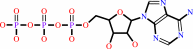 ATP
ATP
|
=
|
O-phospho-L-seryl-[protein]
Bound ligand (Het Group name = )
matches with 81.25% similarity
|
+
|
 ADP
ADP
|
+
|
H(+)
|
|
|
|
|
|
|
L-threonyl-[protein]
|
+
|
ATP
|
=
|
O-phospho-L-threonyl-[protein]
Bound ligand (Het Group name = )
matches with 81.25% similarity
|
+
|
ADP
|
+
|
H(+)
|
|
|
|
|
|
|
|
|
|
|
|
|
Molecule diagrams generated from .mol files obtained from the
KEGG ftp site
|
|
|
|
|
|
|
|
|
|
|
|
|
|
 |
|
|
|
|
|
|
| |
|
|
| |
|
DOI no:
|
Chem Biol
10:705-712
(2003)
|
|
PubMed id:
|
|
|
|
|
|
| |
|
The structure of JNK3 in complex with small molecule inhibitors: structural basis for potency and selectivity.
|
|
G.Scapin,
S.B.Patel,
J.Lisnock,
J.W.Becker,
P.V.LoGrasso.
|
|
|
|
|
| |
ABSTRACT
|
|
|
|
| |
|
|
The c-Jun terminal kinases (JNKs) are members of the mitogen-activated protein
(MAP) kinase family and regulate signal transduction in response to
environmental stress. Activation of JNK3, a neuronal-specific isoform, has been
associated with neurological damage, and as such, JNK3 may represent an
attractive target for the treatment of neurological disorders. The MAP kinases
share between 50% and 80% sequence identity. In order to obtain efficacious and
safe compounds, it is necessary to address the issues of potency and
selectivity. We report here four crystal structures of JNK3 in complex with
three different classes of inhibitors. These structures provide a clear picture
of the interactions that each class of compound made with the kinase. Knowledge
of the atomic interactions involved in these diverse binding modes provides a
platform for structure-guided modification of these compounds, or the de novo
design of novel inhibitors that could satisfy the need for potency and
selectivity.
|
|
|
|
|
|
| |
Selected figure(s)
|
|
|
|
| |
|
|

|
|

|
|
Figure 1.
Figure 1. Schematic Representation of the ATP Binding Site
in KinasesATP (in ball-and-sticks) interacts mainly with the
linker/adenine binding region (1), the ribose binding region
(2), and the phosphate binding region (3). The two hydrophobic
regions I (4) and II (5) do not directly interact with ATP and
contain residues that vary among kinases, thus providing
possibilities for the development of selective inhibitors [17].
Figures 1, 2B, and 3–6 were made with RIBBONS [42].
|
|
Figure 5.
Figure 5. Binding of Compound 3 to JNK3(A) Overlay of the
Cα traces of JNK3:compound 1 (magenta) and JNK3:compound 3
complexes (yellow) in the region of the glycine-rich loop
(G71-V78). The conformational change observed for residues
Ile70–Ile77 was ligand induced.(B) Close-up of the compound 3
binding site; hydrogen bond interactions with protein atoms are
shown as blue dotted lines.
|
|
|
|
|
|
| |
The above figures are
reprinted
by permission from Cell Press:
Chem Biol
(2003,
10,
705-712)
copyright 2003.
|
|
| |
Figures were
selected
by the author.
|
|
|
|
|
|
|
|
|
|
|
|
|
|
|
|
 |
 |
 |
|
Literature references that cite this PDB file's key reference
|
|
|
| |
PubMed id
|
|
Reference
|
|
|
|
|
|
B.V.Kumar,
R.Kotla,
R.Buddiga,
J.Roy,
S.S.Singh,
R.Gundla,
M.Ravikumar,
and
J.A.Sarma
(2011).
Ligand-based and structure-based approaches in identifying ideal pharmacophore against c-Jun N-terminal kinase-3.
|
| |
J Mol Model,
17,
151-163.
|
|
|
|
|
|
|
D.Huang,
T.Zhou,
K.Lafleur,
C.Nevado,
and
A.Caflisch
(2010).
Kinase selectivity potential for inhibitors targeting the ATP binding site: a network analysis.
|
| |
Bioinformatics,
26,
198-204.
|
|
|
|
|
|
|
M.Goettert,
V.Schattel,
P.Koch,
I.Merfort,
and
S.Laufer
(2010).
Biological evaluation and structural determinants of p38α mitogen-activated-protein kinase and c-Jun-N-terminal kinase 3 inhibition by flavonoids.
|
| |
Chembiochem,
11,
2579-2588.
|
|
|
|
|
|
|
T.Kamenecka,
R.Jiang,
X.Song,
D.Duckett,
W.Chen,
Y.Y.Ling,
J.Habel,
J.D.Laughlin,
J.Chambers,
M.Figuera-Losada,
M.D.Cameron,
L.Lin,
C.H.Ruiz,
and
P.V.LoGrasso
(2010).
Synthesis, biological evaluation, X-ray structure, and pharmacokinetics of aminopyrimidine c-jun-N-terminal kinase (JNK) inhibitors.
|
| |
J Med Chem,
53,
419-431.
|
|
|
PDB code:
|
|
|
|
|
|
|
|
F.Robert,
C.Williams,
Y.Yan,
E.Donohue,
R.Cencic,
S.K.Burley,
and
J.Pelletier
(2009).
Blocking UV-induced eIF2alpha phosphorylation with small molecule inhibitors of GCN2.
|
| |
Chem Biol Drug Des,
74,
57-67.
|
|
|
|
|
|
|
T.Kamenecka,
J.Habel,
D.Duckett,
W.Chen,
Y.Y.Ling,
B.Frackowiak,
R.Jiang,
Y.Shin,
X.Song,
and
P.Lograsso
(2009).
Structure-Activity Relationships and X-ray Structures Describing the Selectivity of Aminopyrazole Inhibitors for c-Jun N-terminal Kinase 3 (JNK3) over p38.
|
| |
J Biol Chem,
284,
12853-12861.
|
|
|
PDB codes:
|
|
|
|
|
|
|
|
Z.Tang,
S.Jiang,
R.Du,
E.T.Petri,
A.El-Telbany,
P.S.Chan,
T.Kijima,
S.Dietrich,
K.Matsui,
M.Kobayashi,
S.Sasada,
N.Okamoto,
H.Suzuki,
K.Kawahara,
T.Iwasaki,
K.Nakagawa,
I.Kawase,
J.G.Christensen,
T.Hirashima,
B.Halmos,
R.Salgia,
T.J.Boggon,
J.A.Kern,
and
P.C.Ma
(2009).
Disruption of the EGFR E884-R958 ion pair conserved in the human kinome differentially alters signaling and inhibitor sensitivity.
|
| |
Oncogene,
28,
518-533.
|
|
|
|
|
|
|
M.L.Chu,
L.M.Chavas,
K.T.Douglas,
P.A.Eyers,
and
L.Tabernero
(2008).
Crystal structure of the catalytic domain of the mitotic checkpoint kinase Mps1 in complex with SP600125.
|
| |
J Biol Chem,
283,
21495-21500.
|
|
|
PDB codes:
|
|
|
|
|
|
|
|
C.W.Chung
(2007).
The use of biophysical methods increases success in obtaining liganded crystal structures.
|
| |
Acta Crystallogr D Biol Crystallogr,
63,
62-71.
|
|
|
|
|
|
|
D.Kuhn,
N.Weskamp,
E.Hüllermeier,
and
G.Klebe
(2007).
Functional Classification of Protein Kinase Binding Sites Using Cavbase.
|
| |
ChemMedChem,
2,
1432-1447.
|
|
|
|
|
|
|
E.Perola
(2006).
Minimizing false positives in kinase virtual screens.
|
| |
Proteins,
64,
422-435.
|
|
|
|
|
|
|
M.A.Bogoyevitch,
and
B.Kobe
(2006).
Uses for JNK: the many and varied substrates of the c-Jun N-terminal kinases.
|
| |
Microbiol Mol Biol Rev,
70,
1061-1095.
|
|
|
|
|
|
|
S.E.Sweeney,
and
G.S.Firestein
(2006).
Mitogen activated protein kinase inhibitors: where are we now and where are we going?
|
| |
Ann Rheum Dis,
65,
iii83-iii88.
|
|
|
|
|
|
|
M.A.Bogoyevitch
(2005).
Therapeutic promise of JNK ATP-noncompetitive inhibitors.
|
| |
Trends Mol Med,
11,
232-239.
|
|
|
|
|
|
|
S.Brecht,
R.Kirchhof,
A.Chromik,
M.Willesen,
T.Nicolaus,
G.Raivich,
J.Wessig,
V.Waetzig,
M.Goetz,
M.Claussen,
D.Pearse,
C.Y.Kuan,
E.Vaudano,
A.Behrens,
E.Wagner,
R.A.Flavell,
R.J.Davis,
and
T.Herdegen
(2005).
Specific pathophysiological functions of JNK isoforms in the brain.
|
| |
Eur J Neurosci,
21,
363-377.
|
|
|
|
|
|
|
L.Resnick,
and
M.Fennell
(2004).
Targeting JNK3 for the treatment of neurodegenerative disorders.
|
| |
Drug Discov Today,
9,
932-939.
|
|
|
|
|
|
|
Y.S.Heo,
S.K.Kim,
C.I.Seo,
Y.K.Kim,
B.J.Sung,
H.S.Lee,
J.I.Lee,
S.Y.Park,
J.H.Kim,
K.Y.Hwang,
Y.L.Hyun,
Y.H.Jeon,
S.Ro,
J.M.Cho,
T.G.Lee,
and
C.H.Yang
(2004).
Structural basis for the selective inhibition of JNK1 by the scaffolding protein JIP1 and SP600125.
|
| |
EMBO J,
23,
2185-2195.
|
|
|
PDB codes:
|
|
|
|
|
|
|
The most recent references are shown first.
Citation data come partly from CiteXplore and partly
from an automated harvesting procedure. Note that this is likely to be
only a partial list as not all journals are covered by
either method. However, we are continually building up the citation data
so more and more references will be included with time.
Where a reference describes a PDB structure, the PDB
code is
shown on the right.
|
|


 Links
Links


