|
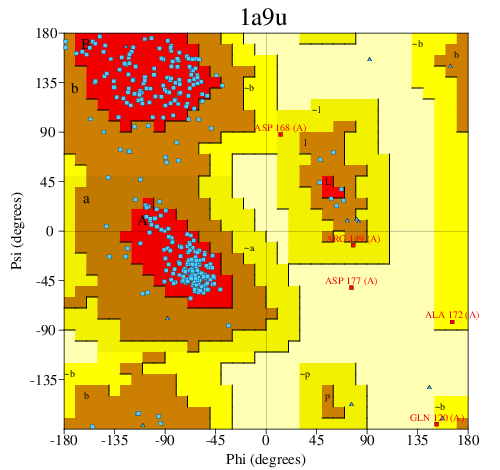
PDBsum entry 1a9u
|
|
|
|
References listed in PDB file
|
 |
|
Key reference
|
|
|
Title
|
|
Structural basis of inhibitor selectivity in map kinases.
|
|
|
Authors
|
|
Z.Wang,
B.J.Canagarajah,
J.C.Boehm,
S.Kassisà,
M.H.Cobb,
P.R.Young,
S.Abdel-Meguid,
J.L.Adams,
E.J.Goldsmith.
|
|
|
Ref.
|
|
Structure, 1998,
6,
1117-1128.
[DOI no: ]
|
|
|
PubMed id
|
|
|
|
|
|
Abstract
|
|
|
BACKGROUND: The mitogen-activated protein (MAP) kinases are important signaling
molecules that participate in diverse cellular events and are potential targets
for intervention in inflammation, cancer, and other diseases. The MAP kinase p38
is responsive to environmental stresses and is involved in the production of
cytokines during inflammation. In contrast, the activation of the MAP kinase
ERK2 (extracellular-signal-regulated kinase 2) leads to cellular differentiation
or proliferation. The anti-inflammatory agent pyridinylimidazole and its analogs
compounds) are highly potent and selective inhibitors
of p38, but not of the closely-related ERK2, or other serine/threonine kinases.
Although these compounds are known to bind to the ATP-binding site, the origin
of the inhibitory specificity toward p38 is not clear. RESULTS: We report the
structural basis for the exceptional selectivity of these SB compounds for p38
over ERK2, as determined by comparative crystallography. In addition, structural
data on the origin of olomoucine (a better inhibitor of ERK2) selectivity are
presented. The crystal structures of four SB compounds in complex with p38 and
of one SB compound and olomoucine in complex with ERK2 are presented here. The
SB inhibitors bind in an extended pocket in the active site and are
complementary to the open domain structure of the low-activity form of p38. The
relatively closed domain structure of ERK2 is able to accommodate the smaller
olomoucine. CONCLUSIONS: The unique kinase-inhibitor interactions observed in
these complexes originate from amino-acid replacements in the active site and
replacements distant from the active site that affect the size of the domain
interface. This structural information should facilitate the design of better
MAP-kinase inhibitors for the treatment of inflammation and other diseases.
|
|
|
|

|
|
Figure 6.
Figure 6. Thr106 of p38 plays a crucial role in the p38-SB
inhibitor interactions. (a) In the native p38 structure, Thr106
forms an interaction with a water molecule. (b) In the
p38-inhibitor complex, Thr106 rotates around x1 for about 120°
and participates in the nearby hydrogen-bonding network that
also involves His107. b strands in the N-terminal domain are
colored green.
|
|
|
|
|
|
The above figure is
reprinted
by permission from Cell Press:
Structure
(1998,
6,
1117-1128)
copyright 1998.
|
|
|
Secondary reference #1
|
|
|
Title
|
|
Pro-Inflammatory cytokines and environmental stress cause p38 mitogen-Activated protein kinase activation by dual phosphorylation on tyrosine and threonine.
|
|
|
Authors
|
|
J.Raingeaud,
S.Gupta,
J.S.Rogers,
M.Dickens,
J.Han,
R.J.Ulevitch,
R.J.Davis.
|
|
|
Ref.
|
|
J Biol Chem, 1995,
270,
7420-7426.
|
|
|
PubMed id
|
|
|
|
|
|
|
|
|
Secondary reference #2
|
|
|
Title
|
|
A map kinase targeted by endotoxin and hyperosmolarity in mammalian cells.
|
|
|
Authors
|
|
J.Han,
J.D.Lee,
L.Bibbs,
R.J.Ulevitch.
|
|
|
Ref.
|
|
Science, 1994,
265,
808-811.
[DOI no: ]
|
|
|
PubMed id
|
|
|
|
|
|
|
|
|
Secondary reference #3
|
|
|
Title
|
|
A protein kinase involved in the regulation of inflammatory cytokine biosynthesis.
|
|
|
Authors
|
|
J.C.Lee,
J.T.Laydon,
P.C.Mcdonnell,
T.F.Gallagher,
S.Kumar,
D.Green,
D.Mcnulty,
M.J.Blumenthal,
J.R.Heys,
S.W.Landvatter.
|
|
|
Ref.
|
|
Nature, 1994,
372,
739-746.
|
|
|
PubMed id
|
|
|
|
|
|
|
|
|
|
|
|
|