|
PDBsum entry 1a4z

|
|
|
|
|
|

|

|

|

|
|

|
|

|
|

|
|

|
|

|
|

|
|

|
|
|
 |

|

|
|
|
|
|
|
|
|
|
|
|
|
|
|
|
|
|
|
|
|
|
|
|
|
|
|
|
|
|
|
|
|
|
|
|
|
Oxidoreductase
|
PDB id
|
|
|
|
1a4z
|
|
|
|
|
|
|
|
|
|
|
|
|
|
|

|

|

|
|
|
|
|
|
|
|
 |
Contents |
 |
|
|
|
|
|
|
|
|
|
|
|
|
|
|
* Residue conservation analysis
|
|
|
|
|
|
|
|
|
|
|
Enzyme class:
|
|
E.C.1.2.1.3
- aldehyde dehydrogenase (NAD(+)).
|
|
|
|
|
|
|
Reaction:
|
|
an aldehyde + NAD+ + H2O = a carboxylate + NADH + 2 H+
|
|
|
|
|
|
 aldehyde
|
+
|
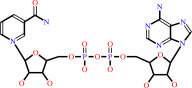 NAD(+)
|
+
|
H2O
Bound ligand (Het Group name = )
corresponds exactly
|
=
|
 carboxylate
|
+
|
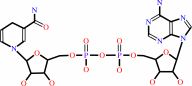 NADH
NADH
|
+
|
2
×
H(+)
|
|
|
|
|
|
|
|
|
|
|
|
|
Molecule diagrams generated from .mol files obtained from the
KEGG ftp site
|
|
|
|
|
|
|
|
|
|
|
|
|
|
 |
|
|
|
|
|
|
| |
|
|
| |
|
DOI no:
|
Structure
5:701-711
(1997)
|
|
PubMed id:
|
|
|
|
|
|
| |
|
Structure of mitochondrial aldehyde dehydrogenase: the genetic component of ethanol aversion.
|
|
C.G.Steinmetz,
P.Xie,
H.Weiner,
T.D.Hurley.
|
|
|
|
|
| |
ABSTRACT
|
|
|
|
| |
|
|
BACKGROUND: The single genetic factor most strongly correlated with reduced
alcohol consumption and incidence of alcoholism is a naturally occurring variant
of mitochondrial aldehyde dehydrogenase (ALDH2). This variant contains a
glutamate to lysine substitution at position 487 (E487K). The E487K variant of
ALDH2 is found in approximately 50% of the Asian population, and is associated
with a phenotypic loss of ALDH2 activity in both heterozygotes and homozygotes.
ALDH2-deficient individuals exhibit an averse response to ethanol consumption,
which is probably caused by elevated levels of blood acetaldehyde. The structure
of ALDH2 is important for the elucidation of its catalytic mechanism, to gain a
clear understanding of the contribution of ALDH2 to the genetic component of
alcoholism and for the development of specific ALDH2 inhibitors as potential
drugs for use in the treatment of alcoholism. RESULTS: The X-ray structure of
bovine ALDH2 has been solved to 2.65 A in its free form and to 2.75 A in a
complex with NAD+. The enzyme structure contains three domains; two
dinucleotide-binding domains and a small three-stranded beta-sheet domain, which
is involved in subunit interactions in this tetrameric enzyme. The E487K
mutation occurs in this small oligomerization domain and is located at a key
interface between subunits immediately below the active site of another monomer.
The active site of ALDH2 is divided into two halves by the nicotinamide ring of
NAD+. Adjacent to the A-side (Pro-R) of the nicotinamide ring is a cluster of
three cysteines (Cys301, Cys302 and Cys303) and adjacent to the B-side (Pro-S)
are Thr244, Glu268, Glu476 and an ordered water molecule bound to Thr244 and
Glu476. CONCLUSIONS: Although there is a recognizable Rossmann-type fold, the
coenzyme-binding region of ALDH2 binds NAD+ in a manner not seen in other
NAD+-binding enzymes. The positions of the residues near the nicotinamide ring
of NAD+ suggest a chemical mechanism whereby Glu268 functions as a general base
through a bound water molecule. The sidechain amide nitrogen of Asn169 and the
peptide nitrogen of Cys302 are in position to stabilize the oxyanion present in
the tetrahedral transition state prior to hydride transfer. The functional
importance of residue Glu487 now appears to be due to indirect interactions of
this residue with the substrate-binding site via Arg264 and Arg475.
|
|
|
|
|
|
| |
Selected figure(s)
|
|
|
|
| |
|
|

|
|
Figure 5.
Figure 5. Interactions between the enzyme and the bound
cofactor from a single subunit in ALDH2. The bound NAD^+
molecule is shown using a ball-and-stick representation and
colored according to atom type. Dashed lines indicate potential
hydrogen-bonding interactions <3.3 Å, except for the interaction
between the peptide nitrogen of Trp168 and the nicotinamide
phosphate which is 3.6 Å (see text). (Figure was produced using
the program MOLSCRIPT [52].)
|
|
|
|
|
|
| |
The above figure is
reprinted
by permission from Cell Press:
Structure
(1997,
5,
701-711)
copyright 1997.
|
|
| |
Figure was
selected
by an automated process.
|
|
|
|
|
|
|
|
|
|
|
|
|
|
|
|
 |
 |
 |
|
Literature references that cite this PDB file's key reference
|
|
|
| |
PubMed id
|
|
Reference
|
|
|
|
|
|
N.Stiti,
I.O.Adewale,
J.Petersen,
D.Bartels,
and
H.H.Kirch
(2011).
Engineering the nucleotide coenzyme specificity and sulfhydryl redox sensitivity of two stress-responsive aldehyde dehydrogenase isoenzymes of Arabidopsis thaliana.
|
| |
Biochem J,
434,
459-471.
|
|
|
|
|
|
|
C.G.Langendorf,
T.L.Key,
G.Fenalti,
W.T.Kan,
A.M.Buckle,
T.Caradoc-Davies,
K.L.Tuck,
R.H.Law,
and
J.C.Whisstock
(2010).
The X-ray crystal structure of Escherichia coli succinic semialdehyde dehydrogenase; structural insights into NADP+/enzyme interactions.
|
| |
PLoS One,
5,
e9280.
|
|
|
PDB code:
|
|
|
|
|
|
|
|
C.H.Chen,
L.Sun,
and
D.Mochly-Rosen
(2010).
Mitochondrial aldehyde dehydrogenase and cardiac diseases.
|
| |
Cardiovasc Res,
88,
51-57.
|
|
|
|
|
|
|
C.L.Huang
(2010).
The role of serotonin and possible interaction of serotonin-related genes with alcohol dehydrogenase and aldehyde dehydrogenase genes in alcohol dependence-a review.
|
| |
Am J Transl Res,
2,
190-199.
|
|
|
|
|
|
|
S.O.Kotchoni,
J.C.Jimenez-Lopez,
D.Gao,
V.Edwards,
E.W.Gachomo,
V.M.Margam,
and
M.J.Seufferheld
(2010).
Modeling-Dependent Protein Characterization of the Rice Aldehyde Dehydrogenase (ALDH) Superfamily Reveals Distinct Functional and Structural Features.
|
| |
PLoS One,
5,
e11516.
|
|
|
|
|
|
|
A.G.Solov'eva,
Y.V.Zimin,
and
A.M.Razmakhov
(2009).
Kinetic parameters of liver aldehyde dehydrogenase in rats with cold injury.
|
| |
Bull Exp Biol Med,
148,
191-192.
|
|
|
|
|
|
|
M.Pavan,
V.F.Ruiz,
F.A.Silva,
T.J.Sobreira,
R.M.Cravo,
M.Vasconcelos,
L.P.Marques,
S.M.Mesquita,
J.E.Krieger,
A.A.Lopes,
P.S.Oliveira,
A.C.Pereira,
and
J.Xavier-Neto
(2009).
ALDH1A2 (RALDH2) genetic variation in human congenital heart disease.
|
| |
BMC Med Genet,
10,
113.
|
|
|
|
|
|
|
R.S.Holmes
(2009).
Opossum aldehyde dehydrogenases: evidence for four ALDH1A1-like genes on chromosome 6 and ALDH1A2 and ALDH1A3 genes on chromosome 1.
|
| |
Biochem Genet,
47,
609-624.
|
|
|
|
|
|
|
S.A.Krupenko
(2009).
FDH: an aldehyde dehydrogenase fusion enzyme in folate metabolism.
|
| |
Chem Biol Interact,
178,
84-93.
|
|
|
|
|
|
|
S.Y.Lee,
C.Y.Hahn,
J.F.Lee,
S.L.Chen,
S.H.Chen,
T.L.Yeh,
P.H.Kuo,
I.H.Lee,
Y.K.Yang,
S.Y.Huang,
H.C.Ko,
and
R.B.Lu
(2009).
MAOA-uVNTR polymorphism may modify the protective effect of ALDH2 gene against alcohol dependence in antisocial personality disorder.
|
| |
Alcohol Clin Exp Res,
33,
985-990.
|
|
|
|
|
|
|
Y.G.Kim,
S.Lee,
O.S.Kwon,
S.Y.Park,
S.J.Lee,
B.J.Park,
and
K.J.Kim
(2009).
Redox-switch modulation of human SSADH by dynamic catalytic loop.
|
| |
EMBO J,
28,
959-968.
|
|
|
PDB codes:
|
|
|
|
|
|
|
|
S.A.Marchitti,
C.Brocker,
D.Stagos,
and
V.Vasiliou
(2008).
Non-P450 aldehyde oxidizing enzymes: the aldehyde dehydrogenase superfamily.
|
| |
Expert Opin Drug Metab Toxicol,
4,
697-720.
|
|
|
|
|
|
|
S.Arias,
E.R.Olivera,
M.Arcos,
G.Naharro,
and
J.M.Luengo
(2008).
Genetic analyses and molecular characterization of the pathways involved in the conversion of 2-phenylethylamine and 2-phenylethanol into phenylacetic acid in Pseudomonas putida U.
|
| |
Environ Microbiol,
10,
413-432.
|
|
|
|
|
|
|
A.Mukhopadhyay,
C.S.Yang,
B.Wei,
and
H.Weiner
(2007).
Precursor Protein Is Readily Degraded in Mitochondrial Matrix Space if the Leader Is Not Processed by Mitochondrial Processing Peptidase.
|
| |
J Biol Chem,
282,
37266-37275.
|
|
|
|
|
|
|
H.N.Larson,
J.Zhou,
Z.Chen,
J.S.Stamler,
H.Weiner,
and
T.D.Hurley
(2007).
Structural and functional consequences of coenzyme binding to the inactive asian variant of mitochondrial aldehyde dehydrogenase: roles of residues 475 and 487.
|
| |
J Biol Chem,
282,
12940-12950.
|
|
|
PDB codes:
|
|
|
|
|
|
|
|
L.Di Costanzo,
G.A.Gomez,
and
D.W.Christianson
(2007).
Crystal structure of lactaldehyde dehydrogenase from Escherichia coli and inferences regarding substrate and cofactor specificity.
|
| |
J Mol Biol,
366,
481-493.
|
|
|
PDB codes:
|
|
|
|
|
|
|
|
S.A.Marchitti,
D.J.Orlicky,
and
V.Vasiliou
(2007).
Expression and initial characterization of human ALDH3B1.
|
| |
Biochem Biophys Res Commun,
356,
792-798.
|
|
|
|
|
|
|
T.Wymore,
D.W.Deerfield,
and
J.Hempel
(2007).
Mechanistic implications of the cysteine-nicotinamide adduct in aldehyde dehydrogenase based on quantum mechanical/molecular mechanical simulations.
|
| |
Biochemistry,
46,
9495-9506.
|
|
|
|
|
|
|
Y.Rinkevich,
G.Paz,
B.Rinkevich,
and
R.Reshef
(2007).
Systemic bud induction and retinoic acid signaling underlie whole body regeneration in the urochordate Botrylloides leachi.
|
| |
PLoS Biol,
5,
e71.
|
|
|
|
|
|
|
F.B.Rahman,
and
K.Yamauchi
(2006).
Uncompetitive inhibition of Xenopus laevis aldehyde dehydrogenase 1A1 by divalent cations.
|
| |
Zoolog Sci,
23,
239-244.
|
|
|
|
|
|
|
J.Gescher,
W.Ismail,
E.Olgeschläger,
W.Eisenreich,
J.Wörth,
and
G.Fuchs
(2006).
Aerobic benzoyl-coenzyme A (CoA) catabolic pathway in Azoarcus evansii: conversion of ring cleavage product by 3,4-dehydroadipyl-CoA semialdehyde dehydrogenase.
|
| |
J Bacteriol,
188,
2919-2927.
|
|
|
|
|
|
|
J.S.Rodríguez-Zavala,
A.Allali-Hassani,
and
H.Weiner
(2006).
Characterization of E. coli tetrameric aldehyde dehydrogenases with atypical properties compared to other aldehyde dehydrogenases.
|
| |
Protein Sci,
15,
1387-1396.
|
|
|
|
|
|
|
S.Watanabe,
T.Kodaki,
and
K.Makino
(2006).
A novel alpha-ketoglutaric semialdehyde dehydrogenase: evolutionary insight into an alternative pathway of bacterial L-arabinose metabolism.
|
| |
J Biol Chem,
281,
28876-28888.
|
|
|
|
|
|
|
E.Inagaki,
H.Takahashi,
C.Kuroishi,
and
T.H.Tahirov
(2005).
Crystallization and avoiding the problem of hemihedral twinning in crystals of Delta1-pyrroline-5-carboxylate dehydrogenase from Thermus thermophilus.
|
| |
Acta Crystallogr Sect F Struct Biol Cryst Commun,
61,
609-611.
|
|
|
|
|
|
|
H.N.Larson,
H.Weiner,
and
T.D.Hurley
(2005).
Disruption of the coenzyme binding site and dimer interface revealed in the crystal structure of mitochondrial aldehyde dehydrogenase "Asian" variant.
|
| |
J Biol Chem,
280,
30550-30556.
|
|
|
PDB code:
|
|
|
|
|
|
|
|
K.K.Ho,
and
H.Weiner
(2005).
Isolation and characterization of an aldehyde dehydrogenase encoded by the aldB gene of Escherichia coli.
|
| |
J Bacteriol,
187,
1067-1073.
|
|
|
|
|
|
|
T.Ohta,
A.Tani,
K.Kimbara,
and
F.Kawai
(2005).
A novel nicotinoprotein aldehyde dehydrogenase involved in polyethylene glycol degradation.
|
| |
Appl Microbiol Biotechnol,
68,
639-646.
|
|
|
|
|
|
|
A.A.Chumanevich,
S.A.Krupenko,
and
C.Davies
(2004).
The crystal structure of the hydrolase domain of 10-formyltetrahydrofolate dehydrogenase: mechanism of hydrolysis and its interplay with the dehydrogenase domain.
|
| |
J Biol Chem,
279,
14355-14364.
|
|
|
PDB code:
|
|
|
|
|
|
|
|
B.R.Lee,
D.W.Kim,
J.W.Hong,
W.S.Eum,
H.S.Choi,
S.H.Choi,
S.Y.Kim,
J.J.An,
J.Y.Ahn,
O.S.Kwon,
T.C.Kang,
M.H.Won,
S.W.Cho,
K.S.Lee,
J.Park,
and
S.Y.Choi
(2004).
Brain succinic semialdehyde dehydrogenase. Reactions of sulfhydryl residues connected with catalytic activity.
|
| |
Eur J Biochem,
271,
4903-4908.
|
|
|
|
|
|
|
H.Dubourg,
C.Stines-Chaumeil,
C.Didierjean,
F.Talfournier,
S.Rahuel-Clermont,
G.Branlant,
and
A.Aubry
(2004).
Expression, purification, crystallization and preliminary X-ray diffraction data of methylmalonate-semialdehyde dehydrogenase from Bacillus subtilis.
|
| |
Acta Crystallogr D Biol Crystallogr,
60,
1435-1437.
|
|
|
|
|
|
|
K.Sydow,
A.Daiber,
M.Oelze,
Z.Chen,
M.August,
M.Wendt,
V.Ullrich,
A.Mülsch,
E.Schulz,
J.F.Keaney,
J.S.Stamler,
and
T.Münzel
(2004).
Central role of mitochondrial aldehyde dehydrogenase and reactive oxygen species in nitroglycerin tolerance and cross-tolerance.
|
| |
J Clin Invest,
113,
482-489.
|
|
|
|
|
|
|
R.Page,
M.S.Nelson,
F.von Delft,
M.A.Elsliger,
J.M.Canaves,
L.S.Brinen,
X.Dai,
A.M.Deacon,
R.Floyd,
A.Godzik,
C.Grittini,
S.K.Grzechnik,
L.Jaroszewski,
H.E.Klock,
E.Koesema,
J.S.Kovarik,
A.Kreusch,
P.Kuhn,
S.A.Lesley,
D.McMullan,
T.M.McPhillips,
M.D.Miller,
A.Morse,
K.Moy,
J.Ouyang,
A.Robb,
K.Rodrigues,
R.Schwarzenbacher,
G.Spraggon,
R.C.Stevens,
H.van den Bedem,
J.Velasquez,
J.Vincent,
X.Wang,
B.West,
G.Wolf,
K.O.Hodgson,
J.Wooley,
and
I.A.Wilson
(2004).
Crystal structure of gamma-glutamyl phosphate reductase (TM0293) from Thermotoga maritima at 2.0 A resolution.
|
| |
Proteins,
54,
157-161.
|
|
|
PDB code:
|
|
|
|
|
|
|
|
S.Y.Huang,
W.W.Lin,
H.C.Ko,
J.F.Lee,
T.J.Wang,
Y.H.Chou,
S.J.Yin,
and
R.B.Lu
(2004).
Possible interaction of alcohol dehydrogenase and aldehyde dehydrogenase genes with the dopamine D2 receptor gene in anxiety-depressive alcohol dependence.
|
| |
Alcohol Clin Exp Res,
28,
374-384.
|
|
|
|
|
|
|
T.Bordelon,
S.K.Montegudo,
S.Pakhomova,
M.L.Oldham,
and
M.E.Newcomer
(2004).
A disorder to order transition accompanies catalysis in retinaldehyde dehydrogenase type II.
|
| |
J Biol Chem,
279,
43085-43091.
|
|
|
|
|
|
|
X.Fan,
A.Molotkov,
S.Manabe,
C.M.Donmoyer,
L.Deltour,
M.H.Foglio,
A.E.Cuenca,
W.S.Blaner,
S.A.Lipton,
and
G.Duester
(2003).
Targeted disruption of Aldh1a1 (Raldh1) provides evidence for a complex mechanism of retinoic acid synthesis in the developing retina.
|
| |
Mol Cell Biol,
23,
4637-4648.
|
|
|
|
|
|
|
A.Mukhopadhyay,
P.Hammen,
M.Waltner-Law,
and
H.Weiner
(2002).
Timing and structural consideration for the processing of mitochondrial matrix space proteins by the mitochondrial processing peptidase (MPP).
|
| |
Protein Sci,
11,
1026-1035.
|
|
|
|
|
|
|
E.Pohl,
N.Brunner,
M.Wilmanns,
and
R.Hensel
(2002).
The crystal structure of the allosteric non-phosphorylating glyceraldehyde-3-phosphate dehydrogenase from the hyperthermophilic archaeum Thermoproteus tenax.
|
| |
J Biol Chem,
277,
19938-19945.
|
|
|
PDB code:
|
|
|
|
|
|
|
|
J.S.Rodriguez-Zavala,
and
H.Weiner
(2002).
Structural aspects of aldehyde dehydrogenase that influence dimer-tetramer formation.
|
| |
Biochemistry,
41,
8229-8237.
|
|
|
|
|
|
|
S.Marchal,
and
G.Branlant
(2002).
Characterization of the amino acids involved in substrate specificity of nonphosphorylating glyceraldehyde-3-phosphate dehydrogenase from Streptococcus mutans.
|
| |
J Biol Chem,
277,
39235-39242.
|
|
|
|
|
|
|
V.Montplaisir,
N.C.Lan,
J.Guimond,
C.Savineau,
P.V.Bhat,
and
S.Mader
(2002).
Recombinant class I aldehyde dehydrogenases specific for all-trans- or 9-cis-retinal.
|
| |
J Biol Chem,
277,
17486-17492.
|
|
|
|
|
|
|
A.Allali-Hassani,
and
H.Weiner
(2001).
Interaction of human aldehyde dehydrogenase with aromatic substrates and ligands.
|
| |
Chem Biol Interact,
130,
125-133.
|
|
|
|
|
|
|
B.Wei,
and
H.Weiner
(2001).
Making an Oriental equivalent of the yeast cytosolic aldehyde dehydrogenase as well as making one with positive cooperativity in coenzyme binding by mutations of glutamate 492 and arginine 480.
|
| |
Chem Biol Interact,
130,
173-179.
|
|
|
|
|
|
|
H.Weiner,
B.Wei,
and
J.Zhou
(2001).
Subunit communication in tetrameric class 2 human liver aldehyde dehydrogenase as the basis for half-of-the-site reactivity and the dominance of the oriental subunit in a heterotetramer.
|
| |
Chem Biol Interact,
130,
47-56.
|
|
|
|
|
|
|
L.Zhang,
B.Ahvazi,
R.Szittner,
A.Vrielink,
and
E.Meighen
(2001).
Differences in nucleotide specificity and catalytic mechanism between Vibrio harveyi aldehyde dehydrogenase and other members of the aldehyde dehydrogenase superfamily.
|
| |
Chem Biol Interact,
130,
29-38.
|
|
|
|
|
|
|
T.D.Hurley,
S.Perez-Miller,
and
H.Breen
(2001).
Order and disorder in mitochondrial aldehyde dehydrogenase.
|
| |
Chem Biol Interact,
130,
3.
|
|
|
PDB code:
|
|
|
|
|
|
|
|
T.K.Li,
S.J.Yin,
D.W.Crabb,
S.O'Connor,
and
V.A.Ramchandani
(2001).
Genetic and environmental influences on alcohol metabolism in humans.
|
| |
Alcohol Clin Exp Res,
25,
136-144.
|
|
|
|
|
|
|
T.Wymore,
H.B.Nicholas,
and
J.Hempel
(2001).
Molecular dynamics simulation of class 3 aldehyde dehydrogenase.
|
| |
Chem Biol Interact,
130,
201-207.
|
|
|
|
|
|
|
A.Incharoensakdi,
N.Matsuda,
T.Hibino,
Y.L.Meng,
H.Ishikawa,
A.Hara,
T.Funaguma,
T.Takabe,
and
T.Takabe
(2000).
Overproduction of spinach betaine aldehyde dehydrogenase in Escherichia coli. Structural and functional properties of wild-type, mutants and E. coli enzymes.
|
| |
Eur J Biochem,
267,
7015-7023.
|
|
|
|
|
|
|
J.Perozich,
I.Kuo,
B.C.Wang,
J.S.Boesch,
R.Lindahl,
and
J.Hempel
(2000).
Shifting the NAD/NADP preference in class 3 aldehyde dehydrogenase.
|
| |
Eur J Biochem,
267,
6197-6203.
|
|
|
|
|
|
|
J.Zhou,
and
H.Weiner
(2000).
Basis for half-of-the-site reactivity and the dominance of the K487 oriental subunit over the E487 subunit in heterotetrameric human liver mitochondrial aldehyde dehydrogenase.
|
| |
Biochemistry,
39,
12019-12024.
|
|
|
|
|
|
|
L.Zhang,
B.Ahvazi,
R.Szittner,
A.Vrielink,
and
E.Meighen
(2000).
A histidine residue in the catalytic mechanism distinguishes Vibrio harveyi aldehyde dehydrogenase from other members of the aldehyde dehydrogenase superfamily.
|
| |
Biochemistry,
39,
14409-14418.
|
|
|
|
|
|
|
N.A.Brunner,
D.A.Lang,
M.Wilmanns,
and
R.Hensel
(2000).
Crystallization and preliminary X-ray diffraction analysis of the NAD-dependent non--phosphorylating GAPDH of the hyperthermophilic archaeon Thermoproteus tenax.
|
| |
Acta Crystallogr D Biol Crystallogr,
56,
89-91.
|
|
|
|
|
|
|
S.Marchal,
S.Rahuel-Clermont,
and
G.Branlant
(2000).
Role of glutamate-268 in the catalytic mechanism of nonphosphorylating glyceraldehyde-3-phosphate dehydrogenase from Streptococcus mutans.
|
| |
Biochemistry,
39,
3327-3335.
|
|
|
|
|
|
|
T.M.Kitson,
and
K.E.Kitson
(2000).
The effect of quercetin, a widely distributed flavonoid in food and drink, on cytosolic aldehyde dehydrogenase: a comparison with the effect of diethylstilboestrol.
|
| |
Biochim Biophys Acta,
1481,
247-254.
|
|
|
|
|
|
|
A.Kikonyogo,
D.P.Abriola,
M.Dryjanski,
and
R.Pietruszko
(1999).
Mechanism of inhibition of aldehyde dehydrogenase by citral, a retinoid antagonist.
|
| |
Eur J Biochem,
262,
704-712.
|
|
|
|
|
|
|
A.L.Lamb,
and
M.E.Newcomer
(1999).
The structure of retinal dehydrogenase type II at 2.7 A resolution: implications for retinal specificity.
|
| |
Biochemistry,
38,
6003-6011.
|
|
|
PDB code:
|
|
|
|
|
|
|
|
C.C.Chen,
R.B.Lu,
Y.C.Chen,
M.F.Wang,
Y.C.Chang,
T.K.Li,
and
S.J.Yin
(1999).
Interaction between the functional polymorphisms of the alcohol-metabolism genes in protection against alcoholism.
|
| |
Am J Hum Genet,
65,
795-807.
|
|
|
|
|
|
|
C.J.Mann,
and
H.Weiner
(1999).
Differences in the roles of conserved glutamic acid residues in the active site of human class 3 and class 2 aldehyde dehydrogenases.
|
| |
Protein Sci,
8,
1922-1929.
|
|
|
|
|
|
|
J.Perozich,
H.Nicholas,
B.C.Wang,
R.Lindahl,
and
J.Hempel
(1999).
Relationships within the aldehyde dehydrogenase extended family.
|
| |
Protein Sci,
8,
137-146.
|
|
|
|
|
|
|
J.Toth,
A.A.Ismaiel,
and
J.S.Chen
(1999).
The ald gene, encoding a coenzyme A-acylating aldehyde dehydrogenase, distinguishes Clostridium beijerinckii and two other solvent-producing clostridia from Clostridium acetobutylicum.
|
| |
Appl Environ Microbiol,
65,
4973-4980.
|
|
|
|
|
|
|
K.Yamauchi,
J.Nakajima,
H.Hayashi,
R.Horiuchi,
and
J.R.Tata
(1999).
Xenopus cytosolic thyroid hormone-binding protein (xCTBP) is aldehyde dehydrogenase catalyzing the formation of retinoic acid.
|
| |
J Biol Chem,
274,
8460-8469.
|
|
|
|
|
|
|
L.Ni,
J.Zhou,
T.D.Hurley,
and
H.Weiner
(1999).
Human liver mitochondrial aldehyde dehydrogenase: three-dimensional structure and the restoration of solubility and activity of chimeric forms.
|
| |
Protein Sci,
8,
2784-2790.
|
|
|
PDB code:
|
|
|
|
|
|
|
|
O.Sprusanský,
D.Homérová,
B.Sevcíková,
and
J.Kormanec
(1999).
Cloning of the putative aldehyde dehydrogenase, aldA, gene from Streptomyces aureofaciens.
|
| |
Folia Microbiol (Praha),
44,
491-502.
|
|
|
|
|
|
|
K.Johansson,
M.El-Ahmad,
S.Ramaswamy,
L.Hjelmqvist,
H.Jörnvall,
and
H.Eklund
(1998).
Structure of betaine aldehyde dehydrogenase at 2.1 A resolution.
|
| |
Protein Sci,
7,
2106-2117.
|
|
|
PDB codes:
|
|
|
|
|
|
|
|
M.Dryjanski,
L.L.Kosley,
and
R.Pietruszko
(1998).
N-tosyl-L-phenylalanine chloromethyl ketone, a serine protease inhibitor, identifies glutamate 398 at the coenzyme-binding site of human aldehyde dehydrogenase. Evidence for a second "naked anion" at the active site.
|
| |
Biochemistry,
37,
14151-14156.
|
|
|
|
|
|
|
N.A.Brunner,
H.Brinkmann,
B.Siebers,
and
R.Hensel
(1998).
NAD+-dependent glyceraldehyde-3-phosphate dehydrogenase from Thermoproteus tenax. The first identified archaeal member of the aldehyde dehydrogenase superfamily is a glycolytic enzyme with unusual regulatory properties.
|
| |
J Biol Chem,
273,
6149-6156.
|
|
|
|
|
|
|
S.A.Moore,
H.M.Baker,
T.J.Blythe,
K.E.Kitson,
T.M.Kitson,
and
E.N.Baker
(1998).
Sheep liver cytosolic aldehyde dehydrogenase: the structure reveals the basis for the retinal specificity of class 1 aldehyde dehydrogenases.
|
| |
Structure,
6,
1541-1551.
|
|
|
PDB code:
|
|
|
|
|
|
|
|
S.Achterholt,
H.Priefert,
and
A.Steinbüchel
(1998).
Purification and characterization of the coniferyl aldehyde dehydrogenase from Pseudomonas sp. Strain HR199 and molecular characterization of the gene.
|
| |
J Bacteriol,
180,
4387-4391.
|
|
|
|
|
|
|
W.E.Lands
(1998).
A review of alcohol clearance in humans.
|
| |
Alcohol,
15,
147-160.
|
|
|
|
|
|
|
L.Ni,
S.Sheikh,
and
H.Weiner
(1997).
Involvement of glutamate 399 and lysine 192 in the mechanism of human liver mitochondrial aldehyde dehydrogenase.
|
| |
J Biol Chem,
272,
18823-18826.
|
|
|
|
|
|
|
S.Sheikh,
L.Ni,
T.D.Hurley,
and
H.Weiner
(1997).
The potential roles of the conserved amino acids in human liver mitochondrial aldehyde dehydrogenase.
|
| |
J Biol Chem,
272,
18817-18822.
|
|
|
|
|
|
The most recent references are shown first.
Citation data come partly from CiteXplore and partly
from an automated harvesting procedure. Note that this is likely to be
only a partial list as not all journals are covered by
either method. However, we are continually building up the citation data
so more and more references will be included with time.
Where a reference describes a PDB structure, the PDB
code is
shown on the right.
|
|


 Links
Links