
ChEBI highlight: phorbol
Phorbol is at the core of many of the active compounds that make the manchineel tree the most dangerous in the world. It is also at the core of several new anti-cancer agents. ChEBI's entity of the month explains
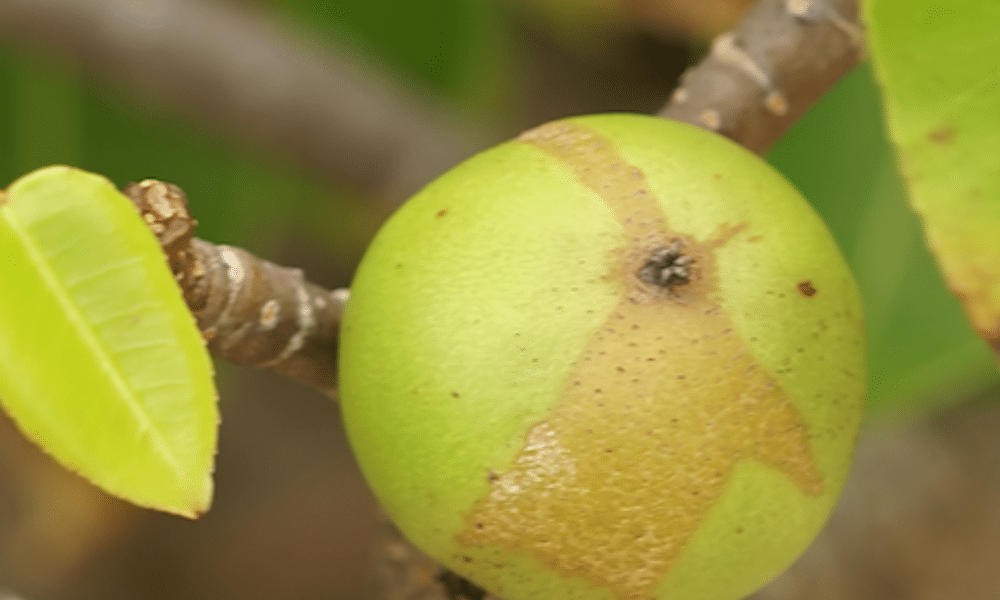
An evergreen member of the spurge (Euphorbiaceae) family, the manchineel tree (Hippomane mancinella) is found along beaches and in swamps in tropical southern North America, Central America, and the West Indies, where it is often cultivated to provide windbreaks. While it can survive in a stunted form, only a few inches high, on windward cliffs, in more favourable conditions it can grow to around 15 m (50 ft) tall. The yellow-green or yellowish fruits of the tree, which look and smell like small apples, give the tree its alternative name – the beach apple. Guinness World Records classes it as the most dangerous tree in the world [1].
When any part of the tree is cut or broken, a milky-white sap or latex is exuded that is intensely irritating. Contact of the sap with the skin causes blistering and allergic dermatitis. Simply standing under a manchineel during rain can result in skin blistering due the raindrops dissolving small amounts of exuded sap as they run off of the leaves [2]. Contact of the sap with the eyes is also extremely unpleasant and can cause acute keratoconjunctivitis [3]; even smoke from the burning wood of a manchineel can result in eye damage.
The apple-like fruits of the tree are also dangerous. A vivid description of a holiday misadventure in the BMJ describes how the apple tastes "pleasantly sweet" at first, but then there is an odd peppery feeling that slowly becomes a "burning, tearing sensation and tightness of the throat". After a couple of hours, the author could "barely swallow solid food because of the excruciating pain and the feeling of a huge obstructing pharyngeal lump." The symptoms gradually declined over the next eight hours; the pain was slightly diminished by drinking milk, while most alcoholic beverages made it worse [4].
The numerous compounds responsible for the irritant properties of manchineel sap include several ester and orthoester derivatives of phorbol (CHEBI:8116) [5]. Phorbol itself was first isolated in 1934 as a hydrolysis product of croton oil (obtained from the seeds of the purging croton plant, Croton tiglium and formerly used as a drastic cathartic and counterirritant) [6]. A tetracyclic diterpenoid with a skeleton based on tigliane, it took over 30 years before its structure was finally settled [7,8].
Interesting compounds, but how to make them?
The biological properties of various esters of phorbol, notably as tumour promoters and activators of protein kinase C, have attracted the attention of researchers for many years. Of particular interest has been phorbol 13-acetate 12-myristate, currently in phase II clinical trials for the treatment of acute myeloid leukaemia. The complex structure of phorbol, containing four fused rings and eight chiral centres, has meant that to date, the preparation of phorbol derivatives has depended on semisynthesis – the synthetic modification of naturally-sourced phorbol or phorbol-related compounds. A downside of this technique is that, with a restricted structure as the starting material, it can often be impossible to prepare certain desired analogues. In principle, this problem could be overcome by a total synthesis approach, but until recently only two total syntheses and two formal syntheses of phorbol had been reported, and they involved between 40 and 52 separate steps, making them impractical on a preparative-scale.
In a remarkable demonstration of the power of synthetic organic chemistry, a team led by Professor Phil Baran at the Scripps Research Institute in La Jolla, California, has recently reported a new synthesis of (+)-phorbol from the readily-available monoterpene (+)-car-3-ene using a route that was designed specifically to permit the preparation of phorbol analogues containing unique placements of oxygen atoms that were previously inaccessible [9]. The elegance of the team's strategy is highlighted not only by it being dramatically shorter than all previous syntheses – just 19 steps – but by the fact that no new chemistry was required to achieve it; all of the reactions employed have been in the synthetic chemist's arsenal for decades.
Pictured: A Creative Commons-licensed photograph showing the fruit of the manchineel tree, taken from Wikimedia Commons.
Reference(s)
- Guinness World Records. Most Dangerous Tree.
- Nellis, D.W. Poisonous plants and animals of Florida and the Caribbean. Pineapple Press, Inc., Sarasoto, Florida. (1997) p. 173
- Pitts JF, Barker NH, Gibbons DC, Jay JL (1993) Manchineel keratoconjunctivitis. Br. J. Ophthalmol. 77:284–288
- Strickland NH, Glennie A, Sanderson H (2000) Eating a manchineel "beach apple". BMJ 321:428
- Adolf W, Hecker E (1984) On the active principles of the spurge family, X. Skin irritants, cocarcinogens, and cryptic cocarcinogens from the latex of the manchineel tree. J. Nat. Prod.47:482–496
- Flaschenträger B, v. Wolffersdorff R (1934) Über den Giftstoff des Crotonöles. 1. Die Säuren des Crotonöles. Helv. Chim. Acta, 17:1444–1452
- Elix JA, Roffey P, Sargent MV (1967) The conversion of tri-O-methylsolorinic acid into tetra-O-methylaverythrin. Tetrahedron Lett. 8:3161–3163
- Pettersen RC, Ferguson G, Crombie L, Games ML, Pointer DJ (1967) The structure and stereochemistry of phorbol, diterpene parent of co-carcinogens of croton oil. Chem. Commun. (London) 14:716–717
- Kawamura S, Chu H, Felding J, Baran PS (2016) Nineteen-step total synthesis of (+)-phorbol. Nature 532:90–93