 |
PDBsum entry 4zuh

|
|
|
|
|
|

|

|

|

|
|

|
|

|
|

|
|

|
|

|
|

|
|
|
 |

|

|
|
|
|
|
|
|
|
|
|
|
|
|
|
|
|
|
|
|
|
|
|
|
|
|
|
|
|
|
|
|
|
|
|
|
Hydrolase/peptide
|
PDB id
|
|
|
|
4zuh
|
|
|
|
|
|
|
|
|
|
|
|
|
|
|

|

|

|
|
|
|
|
|
|
|
|
Enzyme class 1:
|
|
E.C.2.1.1.57
- methyltransferase cap1.
|
|
|
|
|
|
|
Reaction:
|
|
a 5'-end (N(7)-methyl 5'-triphosphoguanosine)-ribonucleoside in mRNA + S-adenosyl-L-methionine = a 5'-end (N(7)-methyl 5'-triphosphoguanosine)- (2'-O-methyl-ribonucleoside) in mRNA + S-adenosyl-L-homocysteine + H+
|
|
|
|
|
|
5'-end (N(7)-methyl 5'-triphosphoguanosine)-ribonucleoside in mRNA
|
+
|
 S-adenosyl-L-methionine
|
=
|
5'-end (N(7)-methyl 5'-triphosphoguanosine)- (2'-O-methyl-ribonucleoside) in mRNA
|
+
|
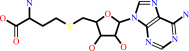 S-adenosyl-L-homocysteine
|
+
|
H(+)
|
|
|
|
|
|
|
|
|
|
Enzyme class 2:
|
|
E.C.3.4.19.12
- ubiquitinyl hydrolase 1.
|
|
|
|
|
|
|
Reaction:
|
|
Thiol-dependent hydrolysis of ester, thiolester, amide, peptide and isopeptide bonds formed by the C-terminal Gly of ubiquitin (a 76-residue protein attached to proteins as an intracellular targeting signal).
|
|
|
|
|
|
Enzyme class 3:
|
|
E.C.3.6.4.12
- Dna helicase.
|
|
|
|
|
|
|
Reaction:
|
|
ATP + H2O = ADP + phosphate + H+
|
|
|
|
|
|
 ATP
ATP
|
+
|
H2O
|
=
|
 ADP
ADP
|
+
|
 phosphate
|
+
|
H(+)
|
|
|
|
|
|
|
|
|
|
Enzyme class 4:
|
|
E.C.3.6.4.13
- Rna helicase.
|
|
|
|
|
|
|
Reaction:
|
|
ATP + H2O = ADP + phosphate + H+
|
|
|
|
|
|
ATP
|
+
|
H2O
|
=
|
ADP
|
+
|
phosphate
|
+
|
H(+)
|
|
|
|
|
|
|
|
|
|
|
|
|
Note, where more than one E.C. class is given (as above), each may
correspond to a different protein domain or, in the case of polyprotein
precursors, to a different mature protein.
|
|
|
|
Molecule diagrams generated from .mol files obtained from the
KEGG ftp site
|
|
|
|
|
|
|
|
|
|
|
|
|
|
 |
|
|
|
|
|
|
| |
|
|
| |
|
DOI no:
|
Virology
494:225-235
(2016)
|
|
PubMed id:
|
|
|
|
|
|
| |
|
Structural basis for the dimerization and substrate recognition specificity of porcine epidemic diarrhea virus 3C-like protease.
|
|
G.Ye,
F.Deng,
Z.Shen,
R.Luo,
L.Zhao,
S.Xiao,
Z.F.Fu,
G.Peng.
|
|
|
|
|
| |
ABSTRACT
|
|
|
|
| |
|
|
Porcine epidemic diarrhea virus (PEDV), a member of the genus Alphacoronavirus,
has caused significant damage to the Asian and American pork industries.
Coronavirus 3C-like protease (3CL(pro)), which is involved in the processing of
viral polyproteins for viral replication, is an appealing antiviral drug target.
Here, we present the crystal structures of PEDV 3CL(pro) and a molecular complex
between an inactive PEDV 3CL(pro) variant C144A bound to a peptide substrate.
Structural characterization, mutagenesis and biochemical analysis reveal the
substrate-binding pockets and the residues that comprise the active site of PEDV
3CL(pro). The dimerization of PEDV 3CL(pro) is similar to that of other
Alphacoronavirus 3CL(pro)s but has several differences from that of SARS-CoV
3CL(pro) from the genus Betacoronavirus. Furthermore, the non-conserved motifs
in the pockets cause different cleavage of substrate between PEDV and SARS-CoV
3CL(pro)s, which may provide new insights into the recognition of substrates by
3CL(pro)s in various coronavirus genera.
|
|
|
|
|
|
|
|
|
|
|
|
|
|
|
|
|
|
 |
 |
 |
|


 Links
Links





