 |
PDBsum entry 3c2m

|
|
|
|
|
|

|

|

|

|
|

|
|

|
|

|
|

|
|

|
|

|
|

|
|

|
|
|
 |

|

|
|
|
|
|
|
|
|
|
|
|
|
|
|
|
|
|
|
|
|
|
|
|
|
|
|
|
|
|
|
|
|
|
|
|
|
|
Transferase, lyase/DNA
|
PDB id
|
|
|
|
3c2m
|
|
|
|
|
|
|
|
|
|
|
|
|
|
|

|

|

|
|
|
|
|
|
|
|
 |
Contents |
 |
|
|
|
|
|
|
|
|
|
|
|
|
|
|
|
|
* Residue conservation analysis
|
|
|
|
|
|
|
|
|
|
|
Enzyme class 1:
|
|
E.C.2.7.7.7
- DNA-directed Dna polymerase.
|
|
|
|
|
|
|
Reaction:
|
|
DNA(n) + a 2'-deoxyribonucleoside 5'-triphosphate = DNA(n+1) + diphosphate
|
|
|
|
|
|
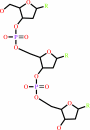 DNA(n)
|
+
|
2'-deoxyribonucleoside 5'-triphosphate
|
=
|
DNA(n+1)
|
+
|
 diphosphate
|
|
|
|
|
|
|
|
|
|
Enzyme class 2:
|
|
E.C.4.2.99.-
- ?????
|
|
|
|
|
|
|
Enzyme class 3:
|
|
E.C.4.2.99.18
- DNA-(apurinic or apyrimidinic site) lyase.
|
|
|
|
|
|
|
Reaction:
|
|
2'-deoxyribonucleotide-(2'-deoxyribose 5'-phosphate)- 2'-deoxyribonucleotide-DNA = a 3'-end 2'-deoxyribonucleotide-(2,3- dehydro-2,3-deoxyribose 5'-phosphate)-DNA + a 5'-end 5'-phospho- 2'-deoxyribonucleoside-DNA + H+
|
|
|
|
|
|
|
|
|
Note, where more than one E.C. class is given (as above), each may
correspond to a different protein domain or, in the case of polyprotein
precursors, to a different mature protein.
|
|
|
|
Molecule diagrams generated from .mol files obtained from the
KEGG ftp site
|
|
|
|
|
|
|
|
|
|
|
|
|
|
 |
|
|
|
|
|
|
| |
|
|
| |
|
DOI no:
|
Mol Cell
30:315-324
(2008)
|
|
PubMed id:
|
|
|
|
|
|
| |
|
Structures of DNA polymerase beta with active-site mismatches suggest a transient abasic site intermediate during misincorporation.
|
|
V.K.Batra,
W.A.Beard,
D.D.Shock,
L.C.Pedersen,
S.H.Wilson.
|
|
|
|
|
| |
ABSTRACT
|
|
|
|
| |
|
|
We report the crystallographic structures of DNA polymerase beta with dG-dAMPCPP
and dC-dAMPCPP mismatches in the active site. These premutagenic structures were
obtained with a nonhydrolyzable incoming nucleotide analog, dAMPCPP, and Mn(2+).
Substituting Mn(2+) for Mg(2+) significantly decreases the fidelity of DNA
synthesis. The structures reveal that the enzyme is in a closed conformation
like that observed with a matched Watson-Crick base pair. The incorrect dAMPCPP
binds in a conformation identical to that observed with the correct nucleotide.
To accommodate the incorrect nucleotide and closed protein conformation, the
template strand in the vicinity of the active site has shifted upstream over 3
A, removing the coding base from the active site and generating an abasic
templating pocket. The primer terminus rotates as its complementary template
base is repositioned. This rotation moves O3' of the primer terminus away from
the alpha-phosphate of the incoming nucleotide, thereby deterring
misincorporation.
|
|
|
|
|
|
| |
Selected figure(s)
|
|
|
|
| |
|
|

|
|

|
|
Figure 1.
Figure 1. Closed Conformation of the Ternary Substrate
Complex with an Active-Site Mismatched Nascent Base Pair
(A) Licorice representation of the Pol β backbone of the binary
DNA complex (PDB ID 1BPX; orange) and ternary substrate complex
(green) with an incorrect incoming nucleotide (dAMPCPP; yellow
carbons) with a templating guanine. The catalytic and
DNA-binding subdomains superimposed (gray backbone) with an rmsd
of 0.56 Å (177 Cα). The DNA is omitted for clarity, but
the 5′→3′ direction of the primer entry into the active
site is indicated with a solid arrow. The open and closed
positions of α helix N are shown. The amino-terminal lyase
domain and carboxyl-terminal N subdomain (colored) move in
response to binding an incorrect dNTP. The amino- (N) and
carboxyl-terminal (C) ends are labeled.
(B) Ribbon
representation of the Pol β backbone of the ternary substrate
complex with correct (gray) or incorrect (green) incoming
nucleotides. The polymerase domains with a correct (dA-dUMPNPP;
PDB ID 2FMS) and incorrect (dG-dAMPCPP) nascent base pair were
superimposed with an rmsd of 0.62 Å (314 Cα). The
superimposed structures indicate that α helix N is in a
“closed” position like that observed with a Watson-Crick
nascent base pair. The incoming dAMPCPP of the mismatch
structure is shown (yellow carbons), but the DNA is omitted for
clarity. The amino terminus (N) of the lyase domain is also
indicated.
|
|
Figure 4.
Figure 4. Position of Key Protein Residues in Closed
Polymerase Complexes with Correct or Incorrect Incoming
Nucleotides
(A) Two views (major groove view, top;
−90° rotation of the top view, bottom) of the nascent base
pair of the mismatch structure (dG-dAMPCPP; green carbons)
superimposed (see Figure 1) with that for a correctly matched
base pair (gray carbons). The templating base is omitted from
the correctly matched overlay for clarity. The structure
illustrates the position of key protein side chains that can
influence catalytic behavior. For catalytic activation with the
correct incoming nucleotide, N subdomain closing is associated
with the loss of a salt bridge between Arg258 (R258) and Asp192
(D192), which coordinate both active-site metals (M^2+), and the
formation of hydrogen bonds (black dashed lines) with Glu295
(E295) and Tyr296 (Y296). Phe272 (F272) is repositioned in the
closed complex to insulate Asp192 from Arg258. Arg283 (R283)
that is situated in the N subdomain interacts with the minor
groove edge of the templating strand (not shown). With an
incorrect incoming nucleotide, R258 and R283 are in
conformations that preclude catalytic activation. Arg283 is
observed to hydrogen bond with the minor groove edge and
phosphate backbone of the templating base. Other key residues
(Asp192, Asn279, and Phe272) are observed in similar positions
as that found with a correct incoming nucleotide.
(B) Major
groove view of the nascent base pair of the dG/dC-dAMPCPP
superimposed mismatch structures (dC template, light blue
carbons; dG template, green carbons).
|
|
|
|
|
|
| |
The above figures are
reprinted
from an Open Access publication published by Cell Press:
Mol Cell
(2008,
30,
315-324)
copyright 2008.
|
|
| |
Figures were
selected
by an automated process.
|
|
|
|
|
|
|
|
|
|
|
|
|
|
|
|
 |
 |
 |
|
Literature references that cite this PDB file's key reference
|
|
|
| |
PubMed id
|
|
Reference
|
|
|
|
|
|
K.Bebenek,
L.C.Pedersen,
and
T.A.Kunkel
(2011).
Replication infidelity via a mismatch with Watson-Crick geometry.
|
| |
Proc Natl Acad Sci U S A,
108,
1862-1867.
|
|
|
PDB codes:
|
|
|
|
|
|
|
|
P.Xie
(2011).
A model for the dynamics of mammalian family X DNA polymerases.
|
| |
J Theor Biol,
277,
111-122.
|
|
|
|
|
|
|
A.A.Kazakov,
E.E.Grishina,
V.Z.Tarantul,
and
L.V.Gening
(2010).
Effect of human cell malignancy on activity of DNA polymerase iota.
|
| |
Biochemistry (Mosc),
75,
905-911.
|
|
|
|
|
|
|
J.Yamtich,
and
J.B.Sweasy
(2010).
DNA polymerase family X: function, structure, and cellular roles.
|
| |
Biochim Biophys Acta,
1804,
1136-1150.
|
|
|
|
|
|
|
R.Rucker,
P.Oelschlaeger,
and
A.Warshel
(2010).
A binding free energy decomposition approach for accurate calculations of the fidelity of DNA polymerases.
|
| |
Proteins,
78,
671-680.
|
|
|
|
|
|
|
S.H.Wilson,
W.A.Beard,
D.D.Shock,
V.K.Batra,
N.A.Cavanaugh,
R.Prasad,
E.W.Hou,
Y.Liu,
K.Asagoshi,
J.K.Horton,
D.F.Stefanick,
P.S.Kedar,
M.J.Carrozza,
A.Masaoka,
and
M.L.Heacock
(2010).
Base excision repair and design of small molecule inhibitors of human DNA polymerase β.
|
| |
Cell Mol Life Sci,
67,
3633-3647.
|
|
|
|
|
|
|
V.K.Batra,
W.A.Beard,
E.W.Hou,
L.C.Pedersen,
R.Prasad,
and
S.H.Wilson
(2010).
Mutagenic conformation of 8-oxo-7,8-dihydro-2'-dGTP in the confines of a DNA polymerase active site.
|
| |
Nat Struct Mol Biol,
17,
889-890.
|
|
|
PDB code:
|
|
|
|
|
|
|
|
A.Y.Mulkidjanian,
and
M.Y.Galperin
(2009).
On the origin of life in the Zinc world. 2. Validation of the hypothesis on the photosynthesizing zinc sulfide edifices as cradles of life on Earth.
|
| |
Biol Direct,
4,
27.
|
|
|
|
|
|
|
G.C.Lin,
J.Jaeger,
K.A.Eckert,
and
J.B.Sweasy
(2009).
Loop II of DNA polymerase beta is important for discrimination during substrate binding.
|
| |
DNA Repair (Amst),
8,
182-189.
|
|
|
|
|
|
|
H.Li,
R.Swiercz,
and
E.W.Englander
(2009).
Elevated metals compromise repair of oxidative DNA damage via the base excision repair pathway: implications of pathologic iron overload in the brain on integrity of neuronal DNA.
|
| |
J Neurochem,
110,
1774-1783.
|
|
|
|
|
|
|
J.F.Sydow,
F.Brueckner,
A.C.Cheung,
G.E.Damsma,
S.Dengl,
E.Lehmann,
D.Vassylyev,
and
P.Cramer
(2009).
Structural basis of transcription: mismatch-specific fidelity mechanisms and paused RNA polymerase II with frayed RNA.
|
| |
Mol Cell,
34,
710-721.
|
|
|
PDB codes:
|
|
|
|
|
|
|
|
M.C.Foley,
and
T.Schlick
(2009).
Relationship between conformational changes in pol lambda's active site upon binding incorrect nucleotides and mismatch incorporation rates.
|
| |
J Phys Chem B,
113,
13035-13047.
|
|
|
|
|
|
|
T.G.Upton,
B.A.Kashemirov,
C.E.McKenna,
M.F.Goodman,
G.K.Prakash,
R.Kultyshev,
V.K.Batra,
D.D.Shock,
L.C.Pedersen,
W.A.Beard,
and
S.H.Wilson
(2009).
Alpha,beta-difluoromethylene deoxynucleoside 5'-triphosphates: a convenient synthesis of useful probes for DNA polymerase beta structure and function.
|
| |
Org Lett,
11,
1883-1886.
|
|
|
PDB code:
|
|
|
|
|
|
|
|
W.A.Beard,
D.D.Shock,
V.K.Batra,
L.C.Pedersen,
and
S.H.Wilson
(2009).
DNA polymerase beta substrate specificity: side chain modulation of the "A-rule".
|
| |
J Biol Chem,
284,
31680-31689.
|
|
|
PDB codes:
|
|
|
|
|
|
|
|
C.S.Francklyn
(2008).
DNA polymerases and aminoacyl-tRNA synthetases: shared mechanisms for ensuring the fidelity of gene expression.
|
| |
Biochemistry,
47,
11695-11703.
|
|
|
|
|
|
|
F.Liang,
N.Jain,
T.Hutchens,
D.D.Shock,
W.A.Beard,
S.H.Wilson,
M.P.Chiarelli,
and
B.P.Cho
(2008).
Alpha,beta-methylene-2'-deoxynucleoside 5'-triphosphates as noncleavable substrates for DNA polymerases: isolation, characterization, and stability studies of novel 2'-deoxycyclonucleosides, 3,5'-cyclo-dG, and 2,5'-cyclo-dT.
|
| |
J Med Chem,
51,
6460-6470.
|
|
|
|
|
|
The most recent references are shown first.
Citation data come partly from CiteXplore and partly
from an automated harvesting procedure. Note that this is likely to be
only a partial list as not all journals are covered by
either method. However, we are continually building up the citation data
so more and more references will be included with time.
Where a reference describes a PDB structure, the PDB
codes are
shown on the right.
|
|


 Links
Links


