 |
PDBsum entry 3oxw

|
|
|
|
|
|

|

|

|

|
|

|
|

|
|

|
|

|
|

|
|
|
 |

|

|
|
|
|
|
|
|
|
|
|
|
|
|
|
|
|
|
|
|
|
|
|
|
|
|
|
|
|
|
|
|
|
|
|
Hydrolase/hydrolase inhibitor
|
PDB id
|
|
|
|
3oxw
|
|
|
|
|
|
|
|
|
|
|
|
|
|
|

|

|

|
|
|
|
|
|
|
|
|
Enzyme class 1:
|
|
E.C.2.7.7.-
- ?????
|
|
|
|
|
|
|
Enzyme class 2:
|
|
E.C.2.7.7.49
- RNA-directed Dna polymerase.
|
|
|
|
|
|
|
Reaction:
|
|
DNA(n) + a 2'-deoxyribonucleoside 5'-triphosphate = DNA(n+1) + diphosphate
|
|
|
|
|
|
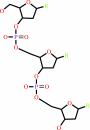 DNA(n)
|
+
|
2'-deoxyribonucleoside 5'-triphosphate
|
=
|
DNA(n+1)
Bound ligand (Het Group name = )
matches with 55.56% similarity
|
+
|
 diphosphate
|
|
|
|
|
|
|
|
|
|
Enzyme class 3:
|
|
E.C.2.7.7.7
- DNA-directed Dna polymerase.
|
|
|
|
|
|
|
Reaction:
|
|
DNA(n) + a 2'-deoxyribonucleoside 5'-triphosphate = DNA(n+1) + diphosphate
|
|
|
|
|
|
DNA(n)
|
+
|
2'-deoxyribonucleoside 5'-triphosphate
|
=
|
DNA(n+1)
|
+
|
diphosphate
|
|
|
|
|
|
|
|
|
|
Enzyme class 4:
|
|
E.C.3.1.-.-
|
|
|
|
|
|
|
Enzyme class 5:
|
|
E.C.3.1.13.2
- exoribonuclease H.
|
|
|
|
|
|
|
Reaction:
|
|
Exonucleolytic cleavage to 5'-phosphomonoester oligonucleotides in both 5'- to 3'- and 3'- to 5'-directions.
|
|
|
|
|
|
Enzyme class 6:
|
|
E.C.3.1.26.13
- retroviral ribonuclease H.
|
|
|
|
|
|
|
Enzyme class 7:
|
|
E.C.3.4.23.16
- HIV-1 retropepsin.
|
|
|
|
|
|
|
Reaction:
|
|
Specific for a P1 residue that is hydrophobic, and P1' variable, but often Pro.
|
|
|
|
|
|
|
|
|
Note, where more than one E.C. class is given (as above), each may
correspond to a different protein domain or, in the case of polyprotein
precursors, to a different mature protein.
|
|
|
|
Molecule diagrams generated from .mol files obtained from the
KEGG ftp site
|
|
|
|
|
|
|
|
|
|
|
|
|
|
 |
|
|
|
|
|
|
| |
|
|
| |
|
DOI no:
|
J Virol
87:4176-4184
(2013)
|
|
PubMed id:
|
|
|
|
|
|
| |
|
Structural and thermodynamic basis of amprenavir/darunavir and atazanavir resistance in HIV-1 protease with mutations at residue 50.
|
|
S.Mittal,
R.M.Bandaranayake,
N.M.King,
M.Prabu-Jeyabalan,
M.N.Nalam,
E.A.Nalivaika,
N.K.Yilmaz,
C.A.Schiffer.
|
|
|
|
|
| |
ABSTRACT
|
|
|
|
| |
|
|
Drug resistance occurs through a series of subtle changes that maintain
substrate recognition but no longer permit inhibitor binding. In HIV-1 protease,
mutations at I50 are associated with such subtle changes that confer
differential resistance to specific inhibitors. Residue I50 is located at the
protease flap tips, closing the active site upon ligand binding. Under selective
drug pressure, I50V/L substitutions emerge in patients, compromising drug
susceptibility and leading to treatment failure. The I50V substitution is often
associated with amprenavir (APV) and darunavir (DRV) resistance, while the I50L
substitution is observed in patients failing atazanavir (ATV) therapy. To
explain how APV, DRV, and ATV susceptibility are influenced by mutations at
residue 50 in HIV-1 protease, structural and binding thermodynamics studies were
carried out on I50V/L-substituted protease variants in the compensatory mutation
A71V background. Reduced affinity to both I50V/A71V and I50L/A71V double mutants
is largely due to decreased binding entropy, which is compensated for by
enhanced enthalpy for ATV binding to I50V variants and APV binding to I50L
variants, leading to hypersusceptibility in these two cases. Analysis of the
crystal structures showed that the substitutions at residue 50 affect how APV,
DRV, and ATV bind the protease with altered van der Waals interactions and that
the selection of I50V versus I50L is greatly influenced by the chemical moieties
at the P1 position for APV/DRV and the P2 position for ATV. Thus, the varied
inhibitor susceptibilities of I50V/L protease variants are largely a direct
consequence of the interdependent changes in protease inhibitor interactions.
|
|
|
|
|
|
|
|
|
|
|
|
|
|
|
|
|
|
 |
 |
 |
|


 Links
Links


