 |
PDBsum entry 3cyw

|
|
|
|
|
 |
Contents |
 |
|
|
|
|
|
|
|
|
|
|
|
|
|
|
* Residue conservation analysis
|
|
|
|
|
|
|
|
|
|
|
Enzyme class 1:
|
|
E.C.2.7.7.-
- ?????
|
|
|
|
|
|
|
Enzyme class 2:
|
|
E.C.2.7.7.49
- RNA-directed Dna polymerase.
|
|
|
|
|
|
|
Reaction:
|
|
DNA(n) + a 2'-deoxyribonucleoside 5'-triphosphate = DNA(n+1) + diphosphate
|
|
|
|
|
|
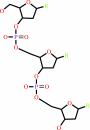 DNA(n)
|
+
|
2'-deoxyribonucleoside 5'-triphosphate
|
=
|
DNA(n+1)
|
+
|
 diphosphate
|
|
|
|
|
|
|
|
|
|
Enzyme class 3:
|
|
E.C.2.7.7.7
- DNA-directed Dna polymerase.
|
|
|
|
|
|
|
Reaction:
|
|
DNA(n) + a 2'-deoxyribonucleoside 5'-triphosphate = DNA(n+1) + diphosphate
|
|
|
|
|
|
DNA(n)
|
+
|
2'-deoxyribonucleoside 5'-triphosphate
|
=
|
DNA(n+1)
|
+
|
diphosphate
|
|
|
|
|
|
|
|
|
|
Enzyme class 4:
|
|
E.C.3.1.-.-
|
|
|
|
|
|
|
Enzyme class 5:
|
|
E.C.3.1.13.2
- exoribonuclease H.
|
|
|
|
|
|
|
Reaction:
|
|
Exonucleolytic cleavage to 5'-phosphomonoester oligonucleotides in both 5'- to 3'- and 3'- to 5'-directions.
|
|
|
|
|
|
Enzyme class 6:
|
|
E.C.3.1.26.13
- retroviral ribonuclease H.
|
|
|
|
|
|
|
Enzyme class 7:
|
|
E.C.3.4.23.16
- HIV-1 retropepsin.
|
|
|
|
|
|
|
Reaction:
|
|
Specific for a P1 residue that is hydrophobic, and P1' variable, but often Pro.
|
|
|
|
|
|
|
|
|
Note, where more than one E.C. class is given (as above), each may
correspond to a different protein domain or, in the case of polyprotein
precursors, to a different mature protein.
|
|
|
|
Molecule diagrams generated from .mol files obtained from the
KEGG ftp site
|
|
|
|
|
|
|
|
|
|
|
|
|
|
 |
|
|
|
|
|
|
| |
|
|
| |
|
DOI no:
|
J Mol Biol
381:102-115
(2008)
|
|
PubMed id:
|
|
|
|
|
|
| |
|
Effect of flap mutations on structure of HIV-1 protease and inhibition by saquinavir and darunavir.
|
|
F.Liu,
A.Y.Kovalevsky,
Y.Tie,
A.K.Ghosh,
R.W.Harrison,
I.T.Weber.
|
|
|
|
|
| |
ABSTRACT
|
|
|
|
| |
|
|
HIV-1 (human immunodeficiency virus type 1) protease (PR) and its mutants are
important antiviral drug targets. The PR flap region is critical for binding
substrates or inhibitors and catalytic activity. Hence, mutations of flap
residues frequently contribute to reduced susceptibility to PR inhibitors in
drug-resistant HIV. Structural and kinetic analyses were used to investigate the
role of flap residues Gly48, Ile50, and Ile54 in the development of drug
resistance. The crystal structures of flap mutants PR(I50V) (PR with I50V
mutation), PR(I54V) (PR with I54V mutation), and PR(I54M) (PR with I54M
mutation) complexed with saquinavir (SQV) as well as PR(G48V) (PR with G48V
mutation), PR(I54V), and PR(I54M) complexed with darunavir (DRV) were determined
at resolutions of 1.05-1.40 A. The PR mutants showed changes in flap
conformation, interactions with adjacent residues, inhibitor binding, and the
conformation of the 80s loop relative to the wild-type PR. The PR contacts with
DRV were closer in PR(G48V)-DRV than in the wild-type PR-DRV, whereas they were
longer in PR(I54M)-DRV. The relative inhibition of PR(I54V) and that of PR(I54M)
were similar for SQV and DRV. PR(G48V) was about twofold less susceptible to SQV
than to DRV, whereas the opposite was observed for PR(I50V). The observed
inhibition was in agreement with the association of G48V and I50V with clinical
resistance to SQV and DRV, respectively. This analysis of structural and kinetic
effects of the mutants will assist in the development of more effective
inhibitors for drug-resistant HIV.
|
|
|
|
|
|
| |
Selected figure(s)
|
|
|
|
| |
|
|

|
|

|
|
Figure 3.
Fig. 3. F[o] − F[c] omit maps of SQV (upper panel) and DRV
(lower panel) contoured at 3.3 σ. SQV is colored by atom type
from complex PR[I54V]–SQV. DRV is from complex PR[I54V]–DRV,
showing alternate conformations of 60%/40% occupancy. The major
conformation is colored by atom type, whereas the minor
conformation is shown in pink.
|
|
Figure 5.
Fig. 5. PR[I54M] interactions with inhibitors. (a) Major
orientation of SQV. (b) Major orientation of DRV. Hydrogen bonds
are indicated in red; CH–π interactions, in blue; and
C–H…O interactions, in purple. Interatomic distances are
shown in angstrom. Note that the water-mediated interaction of
the NH2 of DRV with the Asp30 side chain is replaced by a direct
hydrogen bond in the wild-type PR and the other mutant
structures.
|
|
|
|
|
|
| |
The above figures are
reprinted
by permission from Elsevier:
J Mol Biol
(2008,
381,
102-115)
copyright 2008.
|
|
| |
Figures were
selected
by an automated process.
|
|
|
|
|
|
|
|
|
|
|
|
|
|
|
|
 |
 |
 |
|
Literature references that cite this PDB file's key reference
|
|
|
| |
PubMed id
|
|
Reference
|
|
|
|
|
|
M.K.Singh,
K.Streu,
A.J.McCrone,
and
B.N.Dominy
(2011).
The evolution of catalytic function in the HIV-1 protease.
|
| |
J Mol Biol,
408,
792-805.
|
|
|
|
|
|
|
C.H.Shen,
Y.F.Wang,
A.Y.Kovalevsky,
R.W.Harrison,
and
I.T.Weber
(2010).
Amprenavir complexes with HIV-1 protease and its drug-resistant mutants altering hydrophobic clusters.
|
| |
FEBS J,
277,
3699-3714.
|
|
|
PDB codes:
|
|
|
|
|
|
|
|
J.M.Sayer,
J.Agniswamy,
I.T.Weber,
and
J.M.Louis
(2010).
Autocatalytic maturation, physical/chemical properties, and crystal structure of group N HIV-1 protease: relevance to drug resistance.
|
| |
Protein Sci,
19,
2055-2072.
|
|
|
PDB code:
|
|
|
|
|
|
|
|
P.Dirauf,
H.Meiselbach,
and
H.Sticht
(2010).
Effects of the V82A and I54V mutations on the dynamics and ligand binding properties of HIV-1 protease.
|
| |
J Mol Model,
16,
1577-1583.
|
|
|
|
|
|
|
R.Ishima,
Q.Gong,
Y.Tie,
I.T.Weber,
and
J.M.Louis
(2010).
Highly conserved glycine 86 and arginine 87 residues contribute differently to the structure and activity of the mature HIV-1 protease.
|
| |
Proteins,
78,
1015-1025.
|
|
|
PDB codes:
|
|
|
|
|
|
|
|
S.Qin,
D.D.Minh,
J.A.McCammon,
and
H.X.Zhou
(2010).
Method to Predict Crowding Effects by Postprocessing Molecular Dynamics Trajectories: Application to the Flap Dynamics of HIV-1 Protease.
|
| |
J Phys Chem Lett,
1,
107-110.
|
|
|
|
|
|
|
K.G.Sasková,
M.Kozísek,
P.Rezácová,
J.Brynda,
T.Yashina,
R.M.Kagan,
and
J.Konvalinka
(2009).
Molecular characterization of clinical isolates of human immunodeficiency virus resistant to the protease inhibitor darunavir.
|
| |
J Virol,
83,
8810-8818.
|
|
|
PDB codes:
|
|
|
|
|
|
|
|
P.M.Colman
(2009).
New antivirals and drug resistance.
|
| |
Annu Rev Biochem,
78,
95.
|
|
|
|
|
|
The most recent references are shown first.
Citation data come partly from CiteXplore and partly
from an automated harvesting procedure. Note that this is likely to be
only a partial list as not all journals are covered by
either method. However, we are continually building up the citation data
so more and more references will be included with time.
Where a reference describes a PDB structure, the PDB
codes are
shown on the right.
|
|


 Links
Links


