 |
PDBsum entry 2imw

|
|
|
|
|
|

|

|

|

|
|

|
|

|
|

|
|

|
|

|
|

|
|

|
|
|
 |

|

|
|
|
|
|
|
|
|
|
|
|
|
|
|
|
|
|
|
|
|
|
|
|
|
|
|
|
|
|
|
|
|
|
|
|
|
Transferase/DNA
|
PDB id
|
|
|
|
2imw
|
|
|
|
|
|
|
|
|
|
|
|
|
|
|

|

|

|
|
|
|
|
|
|
|
 |
Contents |
 |
|
|
|
|
|
|
|
|
|
|
|
|
|
|
|
|
* Residue conservation analysis
|
|
|
|
|
|
|
|
|
|
|
Enzyme class:
|
|
E.C.2.7.7.7
- DNA-directed Dna polymerase.
|
|
|
|
|
|
|
Reaction:
|
|
DNA(n) + a 2'-deoxyribonucleoside 5'-triphosphate = DNA(n+1) + diphosphate
|
|
|
|
|
|
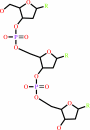 DNA(n)
|
+
|
2'-deoxyribonucleoside 5'-triphosphate
|
=
|
DNA(n+1)
|
+
|
 diphosphate
|
|
|
|
|
|
|
|
|
|
|
|
|
Molecule diagrams generated from .mol files obtained from the
KEGG ftp site
|
|
|
|
|
|
|
|
|
|
|
|
|
|
 |
|
|
|
|
|
|
| |
|
|
| |
|
DOI no:
|
J Mol Biol
365:590-602
(2007)
|
|
PubMed id:
|
|
|
|
|
|
| |
|
Mechanism of template-independent nucleotide incorporation catalyzed by a template-dependent DNA polymerase.
|
|
K.A.Fiala,
J.A.Brown,
H.Ling,
A.K.Kshetry,
J.Zhang,
J.S.Taylor,
W.Yang,
Z.Suo.
|
|
|
|
|
| |
ABSTRACT
|
|
|
|
| |
|
|
Numerous template-dependent DNA polymerases are capable of catalyzing
template-independent nucleotide additions onto blunt-end DNA. Such non-canonical
activity has been hypothesized to increase the genomic hypermutability of
retroviruses including human immunodeficiency viruses. Here, we employed
pre-steady state kinetics and X-ray crystallography to establish a mechanism for
blunt-end additions catalyzed by Sulfolobus solfataricus Dpo4. Our kinetic
studies indicated that the first blunt-end dATP incorporation was 80-fold more
efficient than the second, and among natural deoxynucleotides, dATP was the
preferred substrate due to its stronger intrahelical base-stacking ability. Such
base-stacking contributions are supported by the 41-fold higher ground-state
binding affinity of a nucleotide analog, pyrene nucleoside 5'-triphosphate,
which lacks hydrogen bonding ability but possesses four conjugated aromatic
rings. A 2.05 A resolution structure of Dpo4*(blunt-end DNA)*ddATP revealed that
the base and sugar of the incoming ddATP, respectively, stack against the
5'-base of the opposite strand and the 3'-base of the elongating strand. This
unprecedented base-stacking pattern can be applied to subsequent blunt-end
additions only if all incorporated dAMPs are extrahelical, leading to
predominantly single non-templated dATP incorporation.
|
|
|
|
|
|
| |
Selected figure(s)
|
|
|
|
| |
|
|

|
|

|
|
Figure 4.
Figure 4. Crystal structure of Dpo4•blunt-end X-1•ddATP
(2.05 Å). (a) Overall ternary structure. Dpo4 was shown in
grey ribbons while DNA and ddATP were shown as ball-and-stick
models. The ddATP is highlighted in magenta. The Ca^2+ ion was
shown in a green sphere. (b) The zoomed in view of the active
site including ddATP and the blunt-end base-pair. The residues
in contact with ddATP were shown as ball-and-stick models (grey
for atom C, red for atom O, yellow for atom S). Only the side
chain and main chain atoms involved were shown. (c) 2F[o] - F[c]
electron density map contoured at 1.2 σ (light-blue) of the
active site. The amino acid residues, two blunt-end DNA
base-pairs, and incoming ddATP were shown as ball-and-stick
models. Figure 4. Crystal structure of Dpo4•blunt-end
X-1•ddATP (2.05 Å). (a) Overall ternary structure. Dpo4
was shown in grey ribbons while DNA and ddATP were shown as
ball-and-stick models. The ddATP is highlighted in magenta. The
Ca^2+ ion was shown in a green sphere. (b) The zoomed in view of
the active site including ddATP and the blunt-end base-pair. The
residues in contact with ddATP were shown as ball-and-stick
models (grey for atom C, red for atom O, yellow for atom S).
Only the side chain and main chain atoms involved were shown.
(c) 2F[o] - F[c] electron density map contoured at 1.2 σ
(light-blue) of the active site. The amino acid residues, two
blunt-end DNA base-pairs, and incoming ddATP were shown as
ball-and-stick models.
|
|
Figure 5.
Figure 5. Proposed mechanisms of blunt-end additions of (a)
dPTP and (b) dATP. dATP and dPTP are represented by A and P in
different colors, respectively. The Watson-Crick hydrogen bonds
were drawn as dashed lines while the base-stacking interactions
were shadowed in green. The stacking interactions between the
2′-deoxyribose (R) of an incoming nucleotide and the
5′-terminal base A are displayed in a green box. The van der
Waals interactions between an incoming nucleotide and Dpo4
active site residues were not shown for clarity. Figure 5.
Proposed mechanisms of blunt-end additions of (a) dPTP and (b)
dATP. dATP and dPTP are represented by A and P in different
colors, respectively. The Watson-Crick hydrogen bonds were drawn
as dashed lines while the base-stacking interactions were
shadowed in green. The stacking interactions between the
2′-deoxyribose (R) of an incoming nucleotide and the
5′-terminal base A are displayed in a green box. The van der
Waals interactions between an incoming nucleotide and Dpo4
active site residues were not shown for clarity.
|
|
|
|
|
|
| |
The above figures are
reprinted
from an Open Access publication published by Elsevier:
J Mol Biol
(2007,
365,
590-602)
copyright 2007.
|
|
| |
Figures were
selected
by an automated process.
|
|
|
|
|
|
|
|
|
|
|
|
|
|
|
|
 |
 |
 |
|
Literature references that cite this PDB file's key reference
|
|
|
| |
PubMed id
|
|
Reference
|
|
|
|
|
|
J.A.Brown,
L.Zhang,
S.M.Sherrer,
J.S.Taylor,
P.M.Burgers,
and
Z.Suo
(2010).
Pre-Steady-State Kinetic Analysis of Truncated and Full-Length Saccharomyces cerevisiae DNA Polymerase Eta.
|
| |
J Nucleic Acids,
2010,
0.
|
|
|
|
|
|
|
S.Obeid,
N.Blatter,
R.Kranaster,
A.Schnur,
K.Diederichs,
W.Welte,
and
A.Marx
(2010).
Replication through an abasic DNA lesion: structural basis for adenine selectivity.
|
| |
EMBO J,
29,
1738-1747.
|
|
|
PDB codes:
|
|
|
|
|
|
|
|
H.A.Dahlmann,
V.G.Vaidyanathan,
and
S.J.Sturla
(2009).
Investigating the biochemical impact of DNA damage with structure-based probes: abasic sites, photodimers, alkylation adducts, and oxidative lesions.
|
| |
Biochemistry,
48,
9347-9359.
|
|
|
|
|
|
|
S.M.Sherrer,
J.A.Brown,
L.R.Pack,
V.P.Jasti,
J.D.Fowler,
A.K.Basu,
and
Z.Suo
(2009).
Mechanistic Studies of the Bypass of a Bulky Single-base Lesion Catalyzed by a Y-family DNA Polymerase.
|
| |
J Biol Chem,
284,
6379-6388.
|
|
|
|
|
|
|
H.Fang,
and
J.S.Taylor
(2008).
Serial analysis of mutation spectra (SAMS): a new approach for the determination of mutation spectra of site-specific DNA damage and their sequence dependence.
|
| |
Nucleic Acids Res,
36,
6004-6012.
|
|
|
|
|
|
|
J.A.Brown,
S.A.Newmister,
K.A.Fiala,
and
Z.Suo
(2008).
Mechanism of double-base lesion bypass catalyzed by a Y-family DNA polymerase.
|
| |
Nucleic Acids Res,
36,
3867-3878.
|
|
|
|
|
|
|
K.A.Fiala,
C.D.Hypes,
and
Z.Suo
(2007).
Mechanism of abasic lesion bypass catalyzed by a Y-family DNA polymerase.
|
| |
J Biol Chem,
282,
8188-8198.
|
|
|
|
|
|
The most recent references are shown first.
Citation data come partly from CiteXplore and partly
from an automated harvesting procedure. Note that this is likely to be
only a partial list as not all journals are covered by
either method. However, we are continually building up the citation data
so more and more references will be included with time.
Where a reference describes a PDB structure, the PDB
codes are
shown on the right.
|
|


 Links
Links


