 |
PDBsum entry 2bdw

|
|
|
|
|
 |
Contents |
 |
|
|
|
|
|
|
|
|
|
|
* Residue conservation analysis
|
|
|
|
|
|
|
|
|
|
|
Enzyme class:
|
|
E.C.2.7.11.17
- calcium/calmodulin-dependent protein kinase.
|
|
|
|
|
|
|
Reaction:
|
|
|
1.
|
L-seryl-[protein] + ATP = O-phospho-L-seryl-[protein] + ADP + H+
|
|
2.
|
L-threonyl-[protein] + ATP = O-phospho-L-threonyl-[protein] + ADP + H+
|
|
|
|
|
|
|
L-seryl-[protein]
|
+
|
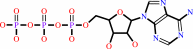 ATP
ATP
|
=
|
O-phospho-L-seryl-[protein]
|
+
|
 ADP
ADP
|
+
|
H(+)
|
|
|
|
|
|
|
L-threonyl-[protein]
|
+
|
ATP
|
=
|
O-phospho-L-threonyl-[protein]
|
+
|
ADP
|
+
|
H(+)
|
|
|
|
|
|
|
|
|
|
Cofactor:
|
|
Ca(2+)
|
|
|
|
|
|
|
|
|
Molecule diagrams generated from .mol files obtained from the
KEGG ftp site
|
|
|
|
|
|
|
|
|
|
|
|
|
|
 |
|
|
|
|
|
|
| |
|
|
| |
|
DOI no:
|
Cell
123:849-860
(2005)
|
|
PubMed id:
|
|
|
|
|
|
| |
|
Structure of the autoinhibited kinase domain of CaMKII and SAXS analysis of the holoenzyme.
|
|
O.S.Rosenberg,
S.Deindl,
R.J.Sung,
A.C.Nairn,
J.Kuriyan.
|
|
|
|
|
| |
ABSTRACT
|
|
|
|
| |
|
|
Ca2+/calmodulin-dependent protein kinase-II (CaMKII) is unique among protein
kinases for its dodecameric assembly and its complex response to Ca2+. The
crystal structure of the autoinhibited kinase domain of CaMKII, determined at
1.8 A resolution, reveals an unexpected dimeric organization in which the
calmodulin-responsive regulatory segments form a coiled-coil strut that blocks
peptide and ATP binding to the otherwise intrinsically active kinase domains. A
threonine residue in the regulatory segment, which when phosphorylated renders
CaMKII calmodulin independent, is held apart from the catalytic sites by the
organization of the dimer. This ensures a strict Ca2+ dependence for initial
activation. The structure of the kinase dimer, when combined with small-angle
X-ray scattering data for the holoenzyme, suggests that inactive CaMKII forms
tightly packed autoinhibited assemblies that convert upon activation into
clusters of loosely tethered and independent kinase domains.
|
|
|
|
|
|
| |
Selected figure(s)
|
|
|
|
| |
|
|

|
|

|
|
Figure 2.
Figure 2. Details of the Interaction between the Kinase
Domain and the Regulatory Segment
|
|
Figure 3.
Figure 3. An Allosteric Mechanism Affecting the ATP Binding
Site
|
|
|
|
|
|
| |
The above figures are
reprinted
by permission from Cell Press:
Cell
(2005,
123,
849-860)
copyright 2005.
|
|
| |
Figures were
selected
by an automated process.
|
|
|
|
|
|
|
|
|
|
|
|
|
|
|
|
 |
 |
 |
|
Literature references that cite this PDB file's key reference
|
|
|
| |
PubMed id
|
|
Reference
|
|
|
|
|
|
S.Classen,
G.L.Hura,
J.M.Holton,
R.P.Rambo,
I.Rodic,
P.J.McGuire,
K.Dyer,
M.Hammel,
G.Meigs,
K.A.Frankel,
and
J.A.Tainer
(2013).
Implementation and performance of SIBYLS: a dual endstation small-angle X-ray scattering and macromolecular crystallography beamline at the Advanced Light Source.
|
| |
J Appl Crystallogr,
46,
1.
|
|
|
|
|
|
|
D.W.Song,
J.G.Lee,
H.S.Youn,
S.H.Eom,
and
d.o. .H.Kim
(2011).
Ryanodine receptor assembly: A novel systems biology approach to 3D mapping.
|
| |
Prog Biophys Mol Biol,
105,
145-161.
|
|
|
|
|
|
|
J.Snijder,
R.J.Rose,
R.Raijmakers,
and
A.J.Heck
(2011).
Site-specific methionine oxidation in calmodulin affects structural integrity and interaction with Ca2+/calmodulin-dependent protein kinase II.
|
| |
J Struct Biol,
174,
187-195.
|
|
|
|
|
|
|
L.Hoffman,
R.A.Stein,
R.J.Colbran,
and
H.S.Mchaourab
(2011).
Conformational changes underlying calcium/calmodulin-dependent protein kinase II activation.
|
| |
EMBO J,
30,
1251-1262.
|
|
|
|
|
|
|
P.Gosselin,
N.Oulhen,
M.Jam,
J.Ronzca,
P.Cormier,
M.Czjzek,
and
B.Cosson
(2011).
The translational repressor 4E-BP called to order by eIF4E: new structural insights by SAXS.
|
| |
Nucleic Acids Res,
39,
3496-3503.
|
|
|
|
|
|
|
W.Lucchesi,
K.Mizuno,
and
K.P.Giese
(2011).
Novel insights into CaMKII function and regulation during memory formation.
|
| |
Brain Res Bull,
85,
2-8.
|
|
|
|
|
|
|
A.K.Wernimont,
J.D.Artz,
P.Finerty,
Y.H.Lin,
M.Amani,
A.Allali-Hassani,
G.Senisterra,
M.Vedadi,
W.Tempel,
F.Mackenzie,
I.Chau,
S.Lourido,
L.D.Sibley,
and
R.Hui
(2010).
Structures of apicomplexan calcium-dependent protein kinases reveal mechanism of activation by calcium.
|
| |
Nat Struct Mol Biol,
17,
596-601.
|
|
|
PDB codes:
|
|
|
|
|
|
|
|
C.E.Flores,
R.Cachope,
S.Nannapaneni,
S.Ene,
A.C.Nairn,
and
A.E.Pereda
(2010).
Variability of distribution of Ca(2+)/calmodulin-dependent kinase II at mixed synapses on the mauthner cell: colocalization and association with connexin 35.
|
| |
J Neurosci,
30,
9488-9499.
|
|
|
|
|
|
|
I.Buard,
S.J.Coultrap,
R.K.Freund,
Y.S.Lee,
M.L.Dell'Acqua,
A.J.Silva,
and
K.U.Bayer
(2010).
CaMKII "autonomy" is required for initiating but not for maintaining neuronal long-term information storage.
|
| |
J Neurosci,
30,
8214-8220.
|
|
|
|
|
|
|
L.H.Chao,
P.Pellicena,
S.Deindl,
L.A.Barclay,
H.Schulman,
and
J.Kuriyan
(2010).
Intersubunit capture of regulatory segments is a component of cooperative CaMKII activation.
|
| |
Nat Struct Mol Biol,
17,
264-272.
|
|
|
PDB codes:
|
|
|
|
|
|
|
|
L.Min,
W.Wu,
R.E.Joseph,
D.B.Fulton,
L.Berg,
and
A.H.Andreotti
(2010).
Disrupting the intermolecular self-association of Itk enhances T cell signaling.
|
| |
J Immunol,
184,
4228-4235.
|
|
|
|
|
|
|
P.Opazo,
S.Labrecque,
C.M.Tigaret,
A.Frouin,
P.W.Wiseman,
P.De Koninck,
and
D.Choquet
(2010).
CaMKII triggers the diffusional trapping of surface AMPARs through phosphorylation of stargazin.
|
| |
Neuron,
67,
239-252.
|
|
|
|
|
|
|
P.Rellos,
A.C.Pike,
F.H.Niesen,
E.Salah,
W.H.Lee,
F.von Delft,
and
S.Knapp
(2010).
Structure of the CaMKIIdelta/calmodulin complex reveals the molecular mechanism of CaMKII kinase activation.
|
| |
PLoS Biol,
8,
e1000426.
|
|
|
PDB codes:
|
|
|
|
|
|
|
|
S.Pepke,
T.Kinzer-Ursem,
S.Mihalas,
and
M.B.Kennedy
(2010).
A dynamic model of interactions of Ca2+, calmodulin, and catalytic subunits of Ca2+/calmodulin-dependent protein kinase II.
|
| |
PLoS Comput Biol,
6,
e1000675.
|
|
|
|
|
|
|
T.Aiba,
G.G.Hesketh,
T.Liu,
R.Carlisle,
M.C.Villa-Abrille,
B.O'Rourke,
F.G.Akar,
and
G.F.Tomaselli
(2010).
Na+ channel regulation by Ca2+/calmodulin and Ca2+/calmodulin-dependent protein kinase II in guinea-pig ventricular myocytes.
|
| |
Cardiovasc Res,
85,
454-463.
|
|
|
|
|
|
|
C.Thaler,
S.V.Koushik,
H.L.Puhl,
P.S.Blank,
and
S.S.Vogel
(2009).
Structural rearrangement of CaMKIIalpha catalytic domains encodes activation.
|
| |
Proc Natl Acad Sci U S A,
106,
6369-6374.
|
|
|
|
|
|
|
D.W.Pettigrew
(2009).
Oligomeric interactions provide alternatives to direct steric modes of control of sugar kinase/actin/hsp70 superfamily functions by heterotropic allosteric effectors: inhibition of E. coli glycerol kinase.
|
| |
Arch Biochem Biophys,
492,
29-39.
|
|
|
|
|
|
|
H.Sanabria,
M.T.Swulius,
S.J.Kolodziej,
J.Liu,
and
M.N.Waxham
(2009).
{beta}CaMKII regulates actin assembly and structure.
|
| |
J Biol Chem,
284,
9770-9780.
|
|
|
|
|
|
|
J.S.Oakhill,
J.W.Scott,
and
B.E.Kemp
(2009).
Structure and function of AMP-activated protein kinase.
|
| |
Acta Physiol (Oxf),
196,
3.
|
|
|
|
|
|
|
K.A.Skelding,
and
J.A.Rostas
(2009).
Regulation of CaMKII in vivo: the importance of targeting and the intracellular microenvironment.
|
| |
Neurochem Res,
34,
1792-1804.
|
|
|
|
|
|
|
M.J.Byrne,
J.A.Putkey,
M.N.Waxham,
and
Y.Kubota
(2009).
Dissecting cooperative calmodulin binding to CaM kinase II: a detailed stochastic model.
|
| |
J Comput Neurosci,
27,
621-638.
|
|
|
|
|
|
|
R.S.Vest,
H.O'Leary,
and
K.U.Bayer
(2009).
Differential regulation by ATP versus ADP further links CaMKII aggregation to ischemic conditions.
|
| |
FEBS Lett,
583,
3577-3581.
|
|
|
|
|
|
|
R.Scholz,
M.Suter,
T.Weimann,
C.Polge,
P.V.Konarev,
R.F.Thali,
R.D.Tuerk,
B.Viollet,
T.Wallimann,
U.Schlattner,
and
D.Neumann
(2009).
Homo-oligomerization and activation of AMP-activated protein kinase are mediated by the kinase domain alphaG-helix.
|
| |
J Biol Chem,
284,
27425-27437.
|
|
|
|
|
|
|
S.J.Lee,
and
R.Yasuda
(2009).
Spatiotemporal Regulation of Signaling in and out of Dendritic Spines: CaMKII and Ras.
|
| |
Open Neurosci J,
3,
117-127.
|
|
|
|
|
|
|
T.I.Evans,
and
M.A.Shea
(2009).
Energetics of calmodulin domain interactions with the calmodulin binding domain of CaMKII.
|
| |
Proteins,
76,
47-61.
|
|
|
|
|
|
|
Y.L.Hashambhoy,
R.L.Winslow,
and
J.L.Greenstein
(2009).
CaMKII-induced shift in modal gating explains L-type Ca(2+) current facilitation: a modeling study.
|
| |
Biophys J,
96,
1770-1785.
|
|
|
|
|
|
|
Y.Zhou,
W.Yang,
M.M.Lurtz,
Y.Chen,
J.Jiang,
Y.Huang,
C.F.Louis,
and
J.J.Yang
(2009).
Calmodulin mediates the Ca2+-dependent regulation of Cx44 gap junctions.
|
| |
Biophys J,
96,
2832-2848.
|
|
|
|
|
|
|
Z.Naor
(2009).
Signaling by G-protein-coupled receptor (GPCR): studies on the GnRH receptor.
|
| |
Front Neuroendocrinol,
30,
10-29.
|
|
|
|
|
|
|
A.C.Pike,
P.Rellos,
F.H.Niesen,
A.Turnbull,
A.W.Oliver,
S.A.Parker,
B.E.Turk,
L.H.Pearl,
and
S.Knapp
(2008).
Activation segment dimerization: a mechanism for kinase autophosphorylation of non-consensus sites.
|
| |
EMBO J,
27,
704-714.
|
|
|
PDB codes:
|
|
|
|
|
|
|
|
A.Forest,
M.T.Swulius,
J.K.Tse,
J.M.Bradshaw,
T.Gaertner,
and
M.N.Waxham
(2008).
Role of the N- and C-lobes of calmodulin in the activation of Ca(2+)/calmodulin-dependent protein kinase II.
|
| |
Biochemistry,
47,
10587-10599.
|
|
|
|
|
|
|
A.Ishida,
N.Sueyoshi,
Y.Shigeri,
and
I.Kameshita
(2008).
Negative regulation of multifunctional Ca2+/calmodulin-dependent protein kinases: physiological and pharmacological significance of protein phosphatases.
|
| |
Br J Pharmacol,
154,
729-740.
|
|
|
|
|
|
|
E.Ozkirimli,
S.S.Yadav,
W.T.Miller,
and
C.B.Post
(2008).
An electrostatic network and long-range regulation of Src kinases.
|
| |
Protein Sci,
17,
1871-1880.
|
|
|
|
|
|
|
E.Y.Kim,
C.H.Rumpf,
Y.Fujiwara,
E.S.Cooley,
F.Van Petegem,
and
D.L.Minor
(2008).
Structures of CaV2 Ca2+/CaM-IQ domain complexes reveal binding modes that underlie calcium-dependent inactivation and facilitation.
|
| |
Structure,
16,
1455-1467.
|
|
|
PDB codes:
|
|
|
|
|
|
|
|
G.A.Wayman,
Y.S.Lee,
H.Tokumitsu,
A.J.Silva,
A.Silva,
and
T.R.Soderling
(2008).
Calmodulin-kinases: modulators of neuronal development and plasticity.
|
| |
Neuron,
59,
914-931.
|
|
|
|
|
|
|
H.R.Kim,
S.Appel,
S.Vetterkind,
S.S.Gangopadhyay,
and
K.G.Morgan
(2008).
Smooth muscle signalling pathways in health and disease.
|
| |
J Cell Mol Med,
12,
2165-2180.
|
|
|
|
|
|
|
J.M.Davies,
A.T.Brunger,
and
W.I.Weis
(2008).
Improved structures of full-length p97, an AAA ATPase: implications for mechanisms of nucleotide-dependent conformational change.
|
| |
Structure,
16,
715-726.
|
|
|
PDB codes:
|
|
|
|
|
|
|
|
J.R.Erickson,
M.L.Joiner,
X.Guan,
W.Kutschke,
J.Yang,
C.V.Oddis,
R.K.Bartlett,
J.S.Lowe,
S.E.O'Donnell,
N.Aykin-Burns,
M.C.Zimmerman,
K.Zimmerman,
A.J.Ham,
R.M.Weiss,
D.R.Spitz,
M.A.Shea,
R.J.Colbran,
P.J.Mohler,
and
M.E.Anderson
(2008).
A dynamic pathway for calcium-independent activation of CaMKII by methionine oxidation.
|
| |
Cell,
133,
462-474.
|
|
|
|
|
|
|
M.J.Boulware,
and
J.S.Marchant
(2008).
Timing in cellular Ca2+ signaling.
|
| |
Curr Biol,
18,
R769-R776.
|
|
|
|
|
|
|
P.K.Shetty,
F.L.Huang,
and
K.P.Huang
(2008).
Ischemia-elicited oxidative modulation of Ca2+/calmodulin-dependent protein kinase II.
|
| |
J Biol Chem,
283,
5389-5401.
|
|
|
|
|
|
|
S.S.Gangopadhyay,
C.Gallant,
E.J.Sundberg,
W.S.Lane,
and
K.G.Morgan
(2008).
Regulation of Ca2+/calmodulin kinase II by a small C-terminal domain phosphatase.
|
| |
Biochem J,
412,
507-516.
|
|
|
|
|
|
|
V.Lucić,
G.J.Greif,
and
M.B.Kennedy
(2008).
Detailed state model of CaMKII activation and autophosphorylation.
|
| |
Eur Biophys J,
38,
83-98.
|
|
|
|
|
|
|
B.LeBoeuf,
T.R.Gruninger,
and
L.R.Garcia
(2007).
Food deprivation attenuates seizures through CaMKII and EAG K+ channels.
|
| |
PLoS Genet,
3,
1622-1632.
|
|
|
|
|
|
|
C.D.Putnam,
M.Hammel,
G.L.Hura,
and
J.A.Tainer
(2007).
X-ray solution scattering (SAXS) combined with crystallography and computation: defining accurate macromolecular structures, conformations and assemblies in solution.
|
| |
Q Rev Biophys,
40,
191-285.
|
|
|
|
|
|
|
C.E.Grueter,
R.J.Colbran,
and
M.E.Anderson
(2007).
CaMKII, an emerging molecular driver for calcium homeostasis, arrhythmias, and cardiac dysfunction.
|
| |
J Mol Med,
85,
5.
|
|
|
|
|
|
|
C.V.Robinson,
A.Sali,
and
W.Baumeister
(2007).
The molecular sociology of the cell.
|
| |
Nature,
450,
973-982.
|
|
|
|
|
|
|
D.L.Minor
(2007).
The neurobiologist's guide to structural biology: a primer on why macromolecular structure matters and how to evaluate structural data.
|
| |
Neuron,
54,
511-533.
|
|
|
|
|
|
|
J.Lipfert,
R.Das,
V.B.Chu,
M.Kudaravalli,
N.Boyd,
D.Herschlag,
and
S.Doniach
(2007).
Structural transitions and thermodynamics of a glycine-dependent riboswitch from Vibrio cholerae.
|
| |
J Mol Biol,
365,
1393-1406.
|
|
|
|
|
|
|
J.Lipfert,
and
S.Doniach
(2007).
Small-angle X-ray scattering from RNA, proteins, and protein complexes.
|
| |
Annu Rev Biophys Biomol Struct,
36,
307-327.
|
|
|
|
|
|
|
M.Graupner,
and
N.Brunel
(2007).
STDP in a bistable synapse model based on CaMKII and associated signaling pathways.
|
| |
PLoS Comput Biol,
3,
e221.
|
|
|
|
|
|
|
M.H.Cho,
X.Cao,
D.Wang,
and
J.Z.Tsien
(2007).
Dentate gyrus-specific manipulation of beta-Ca2+/calmodulin-dependent kinase II disrupts memory consolidation.
|
| |
Proc Natl Acad Sci U S A,
104,
16317-16322.
|
|
|
|
|
|
|
R.S.Vest,
K.D.Davies,
H.O'Leary,
J.D.Port,
and
K.U.Bayer
(2007).
Dual mechanism of a natural CaMKII inhibitor.
|
| |
Mol Biol Cell,
18,
5024-5033.
|
|
|
|
|
|
|
T.A.McKinsey,
and
D.A.Kass
(2007).
Small-molecule therapies for cardiac hypertrophy: moving beneath the cell surface.
|
| |
Nat Rev Drug Discov,
6,
617-635.
|
|
|
|
|
|
|
T.Pang,
B.Xiong,
J.Y.Li,
B.Y.Qiu,
G.Z.Jin,
J.K.Shen,
and
J.Li
(2007).
Conserved alpha-helix acts as autoinhibitory sequence in AMP-activated protein kinase alpha subunits.
|
| |
J Biol Chem,
282,
495-506.
|
|
|
|
|
|
|
Y.Zhou,
W.Yang,
M.M.Lurtz,
Y.Ye,
Y.Huang,
H.W.Lee,
Y.Chen,
C.F.Louis,
and
J.J.Yang
(2007).
Identification of the calmodulin binding domain of connexin 43.
|
| |
J Biol Chem,
282,
35005-35017.
|
|
|
|
|
|
|
D.Korkin,
F.P.Davis,
F.Alber,
T.Luong,
M.Y.Shen,
V.Lucic,
M.B.Kennedy,
and
A.Sali
(2006).
Structural modeling of protein interactions by analogy: application to PSD-95.
|
| |
PLoS Comput Biol,
2,
e153.
|
|
|
|
|
|
|
E.E.Irvine,
L.S.von Hertzen,
F.Plattner,
and
K.P.Giese
(2006).
alphaCaMKII autophosphorylation: a fast track to memory.
|
| |
Trends Neurosci,
29,
459-465.
|
|
|
|
|
|
|
H.O'Leary,
E.Lasda,
and
K.U.Bayer
(2006).
CaMKIIbeta association with the actin cytoskeleton is regulated by alternative splicing.
|
| |
Mol Biol Cell,
17,
4656-4665.
|
|
|
|
|
|
|
J.M.Shifman,
M.H.Choi,
S.Mihalas,
S.L.Mayo,
and
M.B.Kennedy
(2006).
Ca2+/calmodulin-dependent protein kinase II (CaMKII) is activated by calmodulin with two bound calciums.
|
| |
Proc Natl Acad Sci U S A,
103,
13968-13973.
|
|
|
|
|
|
|
K.U.Bayer,
E.LeBel,
G.L.McDonald,
H.O'Leary,
H.Schulman,
and
P.De Koninck
(2006).
Transition from reversible to persistent binding of CaMKII to postsynaptic sites and NR2B.
|
| |
J Neurosci,
26,
1164-1174.
|
|
|
|
|
|
|
M.E.Anderson,
L.S.Higgins,
and
H.Schulman
(2006).
Disease mechanisms and emerging therapies: protein kinases and their inhibitors in myocardial disease.
|
| |
Nat Clin Pract Cardiovasc Med,
3,
437-445.
|
|
|
|
|
|
|
M.V.Petoukhov,
and
D.I.Svergun
(2006).
Joint use of small-angle X-ray and neutron scattering to study biological macromolecules in solution.
|
| |
Eur Biophys J,
35,
567-576.
|
|
|
|
|
|
|
O.S.Rosenberg,
S.Deindl,
L.R.Comolli,
A.Hoelz,
K.H.Downing,
A.C.Nairn,
and
J.Kuriyan
(2006).
Oligomerization states of the association domain and the holoenyzme of Ca2+/CaM kinase II.
|
| |
FEBS J,
273,
682-694.
|
|
|
PDB code:
|
|
|
|
|
|
|
|
P.Pellicena,
and
J.Kuriyan
(2006).
Protein-protein interactions in the allosteric regulation of protein kinases.
|
| |
Curr Opin Struct Biol,
16,
702-709.
|
|
|
|
|
|
The most recent references are shown first.
Citation data come partly from CiteXplore and partly
from an automated harvesting procedure. Note that this is likely to be
only a partial list as not all journals are covered by
either method. However, we are continually building up the citation data
so more and more references will be included with time.
Where a reference describes a PDB structure, the PDB
codes are
shown on the right.
|
|


 Links
Links


