 |
PDBsum entry 2r8k

|
|
|
|
|
|

|

|

|

|
|

|
|

|
|

|
|

|
|

|
|

|
|

|
|

|
|
|
 |

|

|
|
|
|
|
|
|
|
|
|
|
|
|
|
|
|
|
|
|
|
|
|
|
|
|
|
|
|
|
|
|
|
|
|
|
|
|
Replication, transferase/DNA
|
PDB id
|
|
|
|
2r8k
|
|
|
|
|
|
|
|
|
|
|
|
|
|
|

|

|

|
|
|
|
|
|
|
|
 |
Contents |
 |
|
|
|
|
|
|
|
|
|
|
|
|
|
|
* Residue conservation analysis
|
|
|
|
|
|
PDB id:
|
|
|
|
| Name: |
|
Replication, transferase/DNA
|
|
|
Title:
|
|
Structure of the eukaryotic DNA polymerase eta in complex with 1,2- d(gpg)-cisplatin containing DNA
|
|
Structure:
|
|
5'-d( Dgp Dtp Dgp Dgp Dtp Dgp Dap Dgp Dc)-3'. Chain: q, p. Engineered: yes. 5'-d(p Dgp Dgp Dcp Dtp Dcp Dap Dcp Dcp Dap Dc)-3'. Chain: u, t. Engineered: yes. DNA polymerase eta. Chain: a, b. Fragment: catalytic domain.
|
|
Source:
|
|
Synthetic: yes. Saccharomyces cerevisiae. Baker's yeast. Organism_taxid: 4932. Strain: yph499 (atcc 76625). Gene: rad30, dbh1. Expressed in: escherichia coli. Expression_system_taxid: 562.
|
|
Resolution:
|
|
|
3.30Å
|
R-factor:
|
0.230
|
R-free:
|
0.267
|
|
|
Authors:
|
|
T.Carell,A.Alt,K.Lammens
|
Key ref:

|
|
A.Alt
et al.
(2007).
Bypass of DNA lesions generated during anticancer treatment with cisplatin by DNA polymerase eta.
Science,
318,
967-970.
PubMed id:
DOI:

|
|
|
Date:
|
|
|
11-Sep-07
|
Release date:
|
11-Dec-07
|
|
|
|
|
|
|
PROCHECK
|

|
|
|
|
|
Headers
|
|
|
|
References
|
|
|
|
|
|

|
|
Q04049
(POLH_YEAST) -
DNA polymerase eta from Saccharomyces cerevisiae (strain ATCC 204508 / S288c)
|
|
|
|
Seq:
Struc:
|
|
|
|
632 a.a.
511 a.a.
|
|

|

|
|
|
|
|
|
|
|
|
|
|
|
Key: |
 |
PfamA domain |
|
|
 |
Secondary structure |
|
 |
CATH domain |
|
|
|
|
|
|
|
|

|
|
|
|
G-T-G-G-T-G-A-G-C
9 bases
|
|
|
|
G-G-C-T-C-A-C-C-A-C
10 bases
|
|
|
|
G-T-G-G-T-G-A-G-C
9 bases
|
|
|
|
G-G-C-T-C-A-C-C-A-C
10 bases
|
|
|
|
|
|
|
|
|
|
|
|
|
|
Enzyme class:
|
|
E.C.2.7.7.7
- DNA-directed Dna polymerase.
|
|
|
|
|
|
|
Reaction:
|
|
DNA(n) + a 2'-deoxyribonucleoside 5'-triphosphate = DNA(n+1) + diphosphate
|
|
|
|
|
|
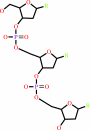 DNA(n)
|
+
|
2'-deoxyribonucleoside 5'-triphosphate
|
=
|
DNA(n+1)
|
+
|
 diphosphate
|
|
|
|
|
|
|
|
|
|
|
|
|
Molecule diagrams generated from .mol files obtained from the
KEGG ftp site
|
|
|
|
|
|
|
|
|
|
|
|
|
|
 |
|
|
|
|
|
|
| |
|
|
| |
|
DOI no:
|
Science
318:967-970
(2007)
|
|
PubMed id:
|
|
|
|
|
|
| |
|
Bypass of DNA lesions generated during anticancer treatment with cisplatin by DNA polymerase eta.
|
|
A.Alt,
K.Lammens,
C.Chiocchini,
A.Lammens,
J.C.Pieck,
D.Kuch,
K.P.Hopfner,
T.Carell.
|
|
|
|
|
| |
ABSTRACT
|
|
|
|
| |
|
|
DNA polymerase eta (Pol eta) is a eukaryotic lesion bypass polymerase that helps
organisms to survive exposure to ultraviolet (UV) radiation, and tumor cells to
gain resistance against cisplatin-based chemotherapy. It allows cells to
replicate across cross-link lesions such as 1,2-d(GpG) cisplatin adducts (Pt-GG)
and UV-induced cis-syn thymine dimers. We present structural and biochemical
analysis of how Pol eta copies Pt-GG-containing DNA. The damaged DNA is bound in
an open DNA binding rim. Nucleotidyl transfer requires the DNA to rotate into an
active conformation, driven by hydrogen bonding of the templating base to the
dNTP. For the 3'dG of the Pt-GG, this step is accomplished by a Watson-Crick
base pair to dCTP and is biochemically efficient and accurate. In contrast,
bypass of the 5'dG of the Pt-GG is less efficient and promiscuous for dCTP and
dATP as a result of the presence of the rigid Pt cross-link. Our analysis
reveals the set of structural features that enable Pol eta to replicate across
strongly distorting DNA lesions.
|
|
|
|
|
|
| |
Selected figure(s)
|
|
|
|
| |
|
|

|
|

|
|
Figure 1.
Fig. 1. Pol  structure in
ternary complex with lesion containing DNA. (A) In the 3'dG
elongation complex, the cisplatin (magenta) is shown with the
platinum anomalous electron density contoured at 10 structure in
ternary complex with lesion containing DNA. (A) In the 3'dG
elongation complex, the cisplatin (magenta) is shown with the
platinum anomalous electron density contoured at 10  .
The primer and template strands of the DNA (brown) and the
Watson-Crick H-bonded dCTP (magenta) are depicted as sticks. The
two metal ions are shown as gray spheres. (B) View of the
1,2-d(GpG) cisplatin lesion superimposed with the simulated
annealed composit-omit density map contoured at 1.0 sigma. (C)
The catalytic residues in the active site. R73 orients the dCTP
for H-bonding with the 3'desoxyguanine of the lesion. (D)
Schematics of protein-DNA contacts representing the
pre-elongation, 3'dG elongation, and 5'dG elongation complex.
Direct hydrogen-bonds are indicated by solid lines. DNA contacts
with the symmetry-related molecule are not shown. .
The primer and template strands of the DNA (brown) and the
Watson-Crick H-bonded dCTP (magenta) are depicted as sticks. The
two metal ions are shown as gray spheres. (B) View of the
1,2-d(GpG) cisplatin lesion superimposed with the simulated
annealed composit-omit density map contoured at 1.0 sigma. (C)
The catalytic residues in the active site. R73 orients the dCTP
for H-bonding with the 3'desoxyguanine of the lesion. (D)
Schematics of protein-DNA contacts representing the
pre-elongation, 3'dG elongation, and 5'dG elongation complex.
Direct hydrogen-bonds are indicated by solid lines. DNA contacts
with the symmetry-related molecule are not shown.
|
|
Figure 2.
Fig. 2. The 3'dG elongation process of Pol (A) The catalytic
residues, the metal ions and the dCTP are shown for the
pre-elongation complex. Phe^35 stacks upon the dNTPs
deoxyribose. The dNTP is unpaired. (B) Detailed view of the
lesion in the pre-elongation complex (cyan) superpositioned with
the lesion in the 3'dG elongation state (magenta). For clarity,
the finger domain has been omitted and the DNA molecules (cyan
and magenta) are viewed in a simplified form. Watson-Crick base
pairing revolves the DNA to position the 3'OH of the primer for
nucleophilic attack on the  -phosphate of the
dNTP. (C) The DNA revolves from the pre-elongation state into
the first elongation state, forming a Watson-Crick base pair.
This aligns the 3'OH of the primer for nucleotidyl transfer. The
protein of the pre-elongation complex is omitted for clarity,
and the protein of the 3'dG elongation state is depicted in
gray. The DNA molecules are color coded as in Fig. 2B. -phosphate of the
dNTP. (C) The DNA revolves from the pre-elongation state into
the first elongation state, forming a Watson-Crick base pair.
This aligns the 3'OH of the primer for nucleotidyl transfer. The
protein of the pre-elongation complex is omitted for clarity,
and the protein of the 3'dG elongation state is depicted in
gray. The DNA molecules are color coded as in Fig. 2B.
|
|
|
|
|
|
| |
The above figures are
reprinted
by permission from the AAAs:
Science
(2007,
318,
967-970)
copyright 2007.
|
|
| |
Figures were
selected
by an automated process.
|
|
|
|
|
|
|
|
|
|
|
|
|
|
|
|
 |
 |
 |
|
Literature references that cite this PDB file's key reference
|
|
|
| |
PubMed id
|
|
Reference
|
|
|
|
|
|
A.Ummat,
O.Rechkoblit,
R.Jain,
J.Roy Choudhury,
R.E.Johnson,
T.D.Silverstein,
A.Buku,
S.Lone,
L.Prakash,
S.Prakash,
and
A.K.Aggarwal
(2012).
Structural basis for cisplatin DNA damage tolerance by human polymerase η during cancer chemotherapy.
|
| |
Nat Struct Mol Biol,
19,
628-632.
|
|
|
PDB code:
|
|
|
|
|
|
|
|
S.M.Sherrer,
K.A.Fiala,
J.D.Fowler,
S.A.Newmister,
J.M.Pryor,
and
Z.Suo
(2011).
Quantitative analysis of the efficiency and mutagenic spectra of abasic lesion bypass catalyzed by human Y-family DNA polymerases.
|
| |
Nucleic Acids Res,
39,
609-622.
|
|
|
|
|
|
|
A.Basu,
and
S.Krishnamurthy
(2010).
Cellular responses to Cisplatin-induced DNA damage.
|
| |
J Nucleic Acids,
2010,
0.
|
|
|
|
|
|
|
A.Katafuchi,
A.Sassa,
N.Niimi,
P.Grúz,
H.Fujimoto,
C.Masutani,
F.Hanaoka,
T.Ohta,
and
T.Nohmi
(2010).
Critical amino acids in human DNA polymerases eta and kappa involved in erroneous incorporation of oxidized nucleotides.
|
| |
Nucleic Acids Res,
38,
859-867.
|
|
|
|
|
|
|
B.D.Freudenthal,
L.Gakhar,
S.Ramaswamy,
and
M.T.Washington
(2010).
Structure of monoubiquitinated PCNA and implications for translesion synthesis and DNA polymerase exchange.
|
| |
Nat Struct Mol Biol,
17,
479-484.
|
|
|
PDB codes:
|
|
|
|
|
|
|
|
B.Köberle,
M.T.Tomicic,
S.Usanova,
and
B.Kaina
(2010).
Cisplatin resistance: preclinical findings and clinical implications.
|
| |
Biochim Biophys Acta,
1806,
172-182.
|
|
|
|
|
|
|
C.Biertümpfel,
Y.Zhao,
Y.Kondo,
S.Ramón-Maiques,
M.Gregory,
J.Y.Lee,
C.Masutani,
A.R.Lehmann,
F.Hanaoka,
and
W.Yang
(2010).
Structure and mechanism of human DNA polymerase eta.
|
| |
Nature,
465,
1044-1048.
|
|
|
PDB codes:
|
|
|
|
|
|
|
|
J.A.Brown,
L.Zhang,
S.M.Sherrer,
J.S.Taylor,
P.M.Burgers,
and
Z.Suo
(2010).
Pre-Steady-State Kinetic Analysis of Truncated and Full-Length Saccharomyces cerevisiae DNA Polymerase Eta.
|
| |
J Nucleic Acids,
2010,
0.
|
|
|
|
|
|
|
J.D.Pata
(2010).
Structural diversity of the Y-family DNA polymerases.
|
| |
Biochim Biophys Acta,
1804,
1124-1135.
|
|
|
|
|
|
|
J.K.Hicks,
C.L.Chute,
M.T.Paulsen,
R.L.Ragland,
N.G.Howlett,
Q.Guéranger,
T.W.Glover,
and
C.E.Canman
(2010).
Differential roles for DNA polymerases eta, zeta, and REV1 in lesion bypass of intrastrand versus interstrand DNA cross-links.
|
| |
Mol Cell Biol,
30,
1217-1230.
|
|
|
|
|
|
|
J.Xie,
R.Litman,
S.Wang,
M.Peng,
S.Guillemette,
T.Rooney,
and
S.B.Cantor
(2010).
Targeting the FANCJ-BRCA1 interaction promotes a switch from recombination to poleta-dependent bypass.
|
| |
Oncogene,
29,
2499-2508.
|
|
|
|
|
|
|
M.T.Washington,
K.D.Carlson,
B.D.Freudenthal,
and
J.M.Pryor
(2010).
Variations on a theme: eukaryotic Y-family DNA polymerases.
|
| |
Biochim Biophys Acta,
1804,
1113-1123.
|
|
|
|
|
|
|
O.Rechkoblit,
A.Kolbanovskiy,
L.Malinina,
N.E.Geacintov,
S.Broyde,
and
D.J.Patel
(2010).
Mechanism of error-free and semitargeted mutagenic bypass of an aromatic amine lesion by Y-family polymerase Dpo4.
|
| |
Nat Struct Mol Biol,
17,
379-388.
|
|
|
PDB codes:
|
|
|
|
|
|
|
|
R.L.Eoff,
J.Y.Choi,
and
F.P.Guengerich
(2010).
Mechanistic Studies with DNA Polymerases Reveal Complex Outcomes following Bypass of DNA Damage.
|
| |
J Nucleic Acids,
2010,
0.
|
|
|
|
|
|
|
S.Broyde,
and
D.J.Patel
(2010).
DNA repair: How to accurately bypass damage.
|
| |
Nature,
465,
1023-1024.
|
|
|
|
|
|
|
S.Chandani,
C.Jacobs,
and
E.L.Loechler
(2010).
Architecture of y-family DNA polymerases relevant to translesion DNA synthesis as revealed in structural and molecular modeling studies.
|
| |
J Nucleic Acids,
2010,
0.
|
|
|
|
|
|
|
S.Chijiwa,
C.Masutani,
F.Hanaoka,
S.Iwai,
and
I.Kuraoka
(2010).
Polymerization by DNA polymerase eta is blocked by cis-diamminedichloroplatinum(II) 1,3-d(GpTpG) cross-link: implications for cytotoxic effects in nucleotide excision repair-negative tumor cells.
|
| |
Carcinogenesis,
31,
388-393.
|
|
|
|
|
|
|
S.Schorr,
S.Schneider,
K.Lammens,
K.P.Hopfner,
and
T.Carell
(2010).
Mechanism of replication blocking and bypass of Y-family polymerase {eta} by bulky acetylaminofluorene DNA adducts.
|
| |
Proc Natl Acad Sci U S A,
107,
20720-20725.
|
|
|
PDB codes:
|
|
|
|
|
|
|
|
S.Schorr,
and
T.Carell
(2010).
Mechanism of acetylaminofluorene-dG induced frameshifting by polymerase η.
|
| |
Chembiochem,
11,
2534-2537.
|
|
|
|
|
|
|
T.D.Silverstein,
R.E.Johnson,
R.Jain,
L.Prakash,
S.Prakash,
and
A.K.Aggarwal
(2010).
Structural basis for the suppression of skin cancers by DNA polymerase eta.
|
| |
Nature,
465,
1039-1043.
|
|
|
PDB codes:
|
|
|
|
|
|
|
|
T.Sekimoto,
T.Oda,
F.M.Pozo,
Y.Murakumo,
C.Masutani,
F.Hanaoka,
and
T.Yamashita
(2010).
The molecular chaperone Hsp90 regulates accumulation of DNA polymerase eta at replication stalling sites in UV-irradiated cells.
|
| |
Mol Cell,
37,
79-89.
|
|
|
|
|
|
|
A.Irimia,
R.L.Eoff,
F.P.Guengerich,
and
M.Egli
(2009).
Structural and functional elucidation of the mechanism promoting error-prone synthesis by human DNA polymerase kappa opposite the 7,8-dihydro-8-oxo-2'-deoxyguanosine adduct.
|
| |
J Biol Chem,
284,
22467-22480.
|
|
|
PDB codes:
|
|
|
|
|
|
|
|
J.J.Perry,
K.Hitomi,
and
J.A.Tainer
(2009).
Flexibility promotes fidelity.
|
| |
Structure,
17,
633-634.
|
|
|
|
|
|
|
K.Donny-Clark,
R.Shapiro,
and
S.Broyde
(2009).
Accommodation of an N-(deoxyguanosin-8-yl)-2-acetylaminofluorene adduct in the active site of human DNA polymerase iota: Hoogsteen or Watson-Crick base pairing?
|
| |
Biochemistry,
48,
7.
|
|
|
|
|
|
|
K.N.Kirouac,
and
H.Ling
(2009).
Structural basis of error-prone replication and stalling at a thymine base by human DNA polymerase iota.
|
| |
EMBO J,
28,
1644-1654.
|
|
|
PDB codes:
|
|
|
|
|
|
|
|
K.Y.Seo,
J.Yin,
P.Donthamsetti,
S.Chandani,
C.H.Lee,
and
E.L.Loechler
(2009).
Amino acid architecture that influences dNTP insertion efficiency in Y-family DNA polymerase V of E. coli.
|
| |
J Mol Biol,
392,
270-282.
|
|
|
|
|
|
|
L.S.Waters,
B.K.Minesinger,
M.E.Wiltrout,
S.D'Souza,
R.V.Woodruff,
and
G.C.Walker
(2009).
Eukaryotic translesion polymerases and their roles and regulation in DNA damage tolerance.
|
| |
Microbiol Mol Biol Rev,
73,
134-154.
|
|
|
|
|
|
|
M.G.Pence,
P.Blans,
C.N.Zink,
T.Hollis,
J.C.Fishbein,
and
F.W.Perrino
(2009).
Lesion bypass of N2-ethylguanine by human DNA polymerase iota.
|
| |
J Biol Chem,
284,
1732-1740.
|
|
|
PDB codes:
|
|
|
|
|
|
|
|
O.Nováková,
J.Malina,
J.Kaspárková,
A.Halámiková,
V.Bernard,
F.Intini,
G.Natile,
and
V.Brabec
(2009).
Energetics, conformation, and recognition of DNA duplexes modified by methylated analogues of [PtCl(dien)]+.
|
| |
Chemistry,
15,
6211-6221.
|
|
|
|
|
|
|
O.Rechkoblit,
L.Malinina,
Y.Cheng,
N.E.Geacintov,
S.Broyde,
and
D.J.Patel
(2009).
Impact of conformational heterogeneity of OxoG lesions and their pairing partners on bypass fidelity by Y family polymerases.
|
| |
Structure,
17,
725-736.
|
|
|
PDB codes:
|
|
|
|
|
|
|
|
R.L.Eoff,
R.Sanchez-Ponce,
and
F.P.Guengerich
(2009).
Conformational changes during nucleotide selection by Sulfolobus solfataricus DNA polymerase Dpo4.
|
| |
J Biol Chem,
284,
21090-21099.
|
|
|
|
|
|
|
S.Chandani,
and
E.L.Loechler
(2009).
Y-Family DNA polymerases may use two different dNTP shapes for insertion: a hypothesis and its implications.
|
| |
J Mol Graph Model,
27,
759-769.
|
|
|
|
|
|
|
S.Shachar,
O.Ziv,
S.Avkin,
S.Adar,
J.Wittschieben,
T.Reissner,
S.Chaney,
E.C.Friedberg,
Z.Wang,
T.Carell,
N.Geacintov,
and
Z.Livneh
(2009).
Two-polymerase mechanisms dictate error-free and error-prone translesion DNA synthesis in mammals.
|
| |
EMBO J,
28,
383-393.
|
|
|
|
|
|
|
T.J.O'Brien,
P.Witcher,
B.Brooks,
and
S.R.Patierno
(2009).
DNA polymerase zeta is essential for hexavalent chromium-induced mutagenesis.
|
| |
Mutat Res,
663,
77-83.
|
|
|
|
|
|
|
J.A.Brown,
S.A.Newmister,
K.A.Fiala,
and
Z.Suo
(2008).
Mechanism of double-base lesion bypass catalyzed by a Y-family DNA polymerase.
|
| |
Nucleic Acids Res,
36,
3867-3878.
|
|
|
|
|
|
|
J.Cramer,
G.Rangam,
A.Marx,
and
T.Restle
(2008).
Varied active-site constraints in the klenow fragment of E. coli DNA polymerase I and the lesion-bypass Dbh DNA polymerase.
|
| |
Chembiochem,
9,
1243-1250.
|
|
|
|
|
|
|
L.Jia,
N.E.Geacintov,
and
S.Broyde
(2008).
The N-clasp of human DNA polymerase kappa promotes blockage or error-free bypass of adenine- or guanine-benzo[a]pyrenyl lesions.
|
| |
Nucleic Acids Res,
36,
6571-6584.
|
|
|
|
|
|
|
S.Broyde,
L.Wang,
O.Rechkoblit,
N.E.Geacintov,
and
D.J.Patel
(2008).
Lesion processing: high-fidelity versus lesion-bypass DNA polymerases.
|
| |
Trends Biochem Sci,
33,
209-219.
|
|
|
|
|
|
|
S.H.Kim,
and
W.M.Michael
(2008).
Regulated proteolysis of DNA polymerase eta during the DNA-damage response in C. elegans.
|
| |
Mol Cell,
32,
757-766.
|
|
|
|
|
|
|
S.Kumar,
M.Bakhtina,
and
M.D.Tsai
(2008).
Altered order of substrate binding by DNA polymerase X from African Swine Fever virus.
|
| |
Biochemistry,
47,
7875-7887.
|
|
|
|
|
|
The most recent references are shown first.
Citation data come partly from CiteXplore and partly
from an automated harvesting procedure. Note that this is likely to be
only a partial list as not all journals are covered by
either method. However, we are continually building up the citation data
so more and more references will be included with time.
Where a reference describes a PDB structure, the PDB
code is
shown on the right.
|
|


 Links
Links


