 |
PDBsum entry 2r5p

|
|
|
|
|
 |
Contents |
 |
|
|
|
|
|
|
|
|
|
|
|
|
|
|
* Residue conservation analysis
|
|
|
|
|
|
|
|
|
|
|
Enzyme class 1:
|
|
E.C.2.7.7.-
- ?????
|
|
|
|
|
|
|
Enzyme class 2:
|
|
E.C.2.7.7.49
- RNA-directed Dna polymerase.
|
|
|
|
|
|
|
Reaction:
|
|
DNA(n) + a 2'-deoxyribonucleoside 5'-triphosphate = DNA(n+1) + diphosphate
|
|
|
|
|
|
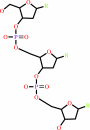 DNA(n)
|
+
|
2'-deoxyribonucleoside 5'-triphosphate
|
=
|
DNA(n+1)
|
+
|
 diphosphate
|
|
|
|
|
|
|
|
|
|
Enzyme class 3:
|
|
E.C.2.7.7.7
- DNA-directed Dna polymerase.
|
|
|
|
|
|
|
Reaction:
|
|
DNA(n) + a 2'-deoxyribonucleoside 5'-triphosphate = DNA(n+1) + diphosphate
|
|
|
|
|
|
DNA(n)
|
+
|
2'-deoxyribonucleoside 5'-triphosphate
|
=
|
DNA(n+1)
|
+
|
diphosphate
|
|
|
|
|
|
|
|
|
|
Enzyme class 4:
|
|
E.C.3.1.-.-
|
|
|
|
|
|
|
Enzyme class 5:
|
|
E.C.3.1.13.2
- exoribonuclease H.
|
|
|
|
|
|
|
Reaction:
|
|
Exonucleolytic cleavage to 5'-phosphomonoester oligonucleotides in both 5'- to 3'- and 3'- to 5'-directions.
|
|
|
|
|
|
Enzyme class 6:
|
|
E.C.3.1.26.13
- retroviral ribonuclease H.
|
|
|
|
|
|
|
Enzyme class 7:
|
|
E.C.3.4.23.16
- HIV-1 retropepsin.
|
|
|
|
|
|
|
Reaction:
|
|
Specific for a P1 residue that is hydrophobic, and P1' variable, but often Pro.
|
|
|
|
|
|
|
|
|
Note, where more than one E.C. class is given (as above), each may
correspond to a different protein domain or, in the case of polyprotein
precursors, to a different mature protein.
|
|
|
|
Molecule diagrams generated from .mol files obtained from the
KEGG ftp site
|
|
|
|
|
|
|
|
|
|
|
|
|
|
 |
|
|
|
|
|
|
| |
|
|
| |
|
|
Biochemistry
47:731-743
(2008)
|
|
PubMed id:
|
|
|
|
|
|
| |
|
The contribution of naturally occurring polymorphisms in altering the biochemical and structural characteristics of HIV-1 subtype C protease.
|
|
R.M.Coman,
A.H.Robbins,
M.A.Fernandez,
C.T.Gilliland,
A.A.Sochet,
M.M.Goodenow,
R.McKenna,
B.M.Dunn.
|
|
|
|
|
| |
ABSTRACT
|
|
|
|
| |
|
|
Fourteen subtype B and C protease variants have been engineered in an effort to
study whether the preexistent baseline polymorphisms, by themselves or in
combination with drug resistance mutations, differentially alter the biochemical
and structural features of the subtype C protease when compared with those of
subtype B protease. The kinetic studies performed in this work showed that the
preexistent polymorphisms in subtype C protease, by themselves, do not provide
for a greater level of resistance. Inhibition analysis with eight clinically
used protease inhibitors revealed that the natural polymorphisms found in
subtype C protease, in combination with drug resistance mutations, can influence
enzymatic catalytic efficiency and inhibitor resistance. Structural analyses of
the subtype C protease bound to nelfinavir and indinavir showed that these
inhibitors form similar interactions with the residues in the active site of
subtype B and C proteases. It also revealed that the naturally occurring
polymorphisms could alter the position of the outer loops of the subtype C
protease, especially the 60's loop.
|
|
|
|
|
|
|
|
|
|
|
|
|
|
|
|
|
|
 |
 |
 |
|
Literature references that cite this PDB file's key reference
|
|
|
| |
PubMed id
|
|
Reference
|
|
|
|
|
|
B.Chaplin,
G.Eisen,
J.Idoko,
D.Onwujekwe,
E.Idigbe,
I.Adewole,
W.Gashau,
S.Meloni,
A.D.Sarr,
J.L.Sankalé,
E.Ekong,
R.L.Murphy,
and
P.Kanki
(2011).
Impact of HIV type 1 subtype on drug resistance mutations in Nigerian patients failing first-line therapy.
|
| |
AIDS Res Hum Retroviruses,
27,
71-80.
|
|
|
|
|
|
|
A.H.Robbins,
R.M.Coman,
E.Bracho-Sanchez,
M.A.Fernandez,
C.T.Gilliland,
M.Li,
M.Agbandje-McKenna,
A.Wlodawer,
B.M.Dunn,
and
R.McKenna
(2010).
Structure of the unbound form of HIV-1 subtype A protease: comparison with unbound forms of proteases from other HIV subtypes.
|
| |
Acta Crystallogr D Biol Crystallogr,
66,
233-242.
|
|
|
PDB code:
|
|
|
|
|
|
|
|
J.M.Sayer,
J.Agniswamy,
I.T.Weber,
and
J.M.Louis
(2010).
Autocatalytic maturation, physical/chemical properties, and crystal structure of group N HIV-1 protease: relevance to drug resistance.
|
| |
Protein Sci,
19,
2055-2072.
|
|
|
PDB code:
|
|
|
|
|
|
|
|
S.Gonzalez,
C.Gondwe,
D.C.Tully,
V.Minhas,
D.Shea,
C.Kankasa,
T.M'soka,
and
C.Wood
(2010).
Short communication: antiretroviral therapy resistance mutations present in the HIV type 1 subtype C pol and env regions from therapy-naive patients in Zambia.
|
| |
AIDS Res Hum Retroviruses,
26,
795-803.
|
|
|
|
|
|
|
S.Shityakov,
and
T.Dandekar
(2010).
Lead expansion and virtual screening of Indinavir derivate HIV-1 protease inhibitors using pharmacophoric - shape similarity scoring function.
|
| |
Bioinformation,
4,
295-299.
|
|
|
|
|
|
|
J.L.Kear,
M.E.Blackburn,
A.M.Veloro,
B.M.Dunn,
and
G.E.Fanucci
(2009).
Subtype polymorphisms among HIV-1 protease variants confer altered flap conformations and flexibility.
|
| |
J Am Chem Soc,
131,
14650-14651.
|
|
|
|
|
|
|
S.K.Ho,
E.E.Perez,
S.L.Rose,
R.M.Coman,
A.C.Lowe,
W.Hou,
C.Ma,
R.M.Lawrence,
B.M.Dunn,
J.W.Sleasman,
and
M.M.Goodenow
(2009).
Genetic determinants in HIV-1 Gag and Env V3 are related to viral response to combination antiretroviral therapy with a protease inhibitor.
|
| |
AIDS,
23,
1631-1640.
|
|
|
|
|
|
|
F.Liu,
A.Y.Kovalevsky,
Y.Tie,
A.K.Ghosh,
R.W.Harrison,
and
I.T.Weber
(2008).
Effect of flap mutations on structure of HIV-1 protease and inhibition by saquinavir and darunavir.
|
| |
J Mol Biol,
381,
102-115.
|
|
|
PDB codes:
|
|
|
|
|
|
|
|
S.Mosebi,
L.Morris,
H.W.Dirr,
and
Y.Sayed
(2008).
Active-site mutations in the South african human immunodeficiency virus type 1 subtype C protease have a significant impact on clinical inhibitor binding: kinetic and thermodynamic study.
|
| |
J Virol,
82,
11476-11479.
|
|
|
|
|
|
The most recent references are shown first.
Citation data come partly from CiteXplore and partly
from an automated harvesting procedure. Note that this is likely to be
only a partial list as not all journals are covered by
either method. However, we are continually building up the citation data
so more and more references will be included with time.
Where a reference describes a PDB structure, the PDB
code is
shown on the right.
|
|


 Links
Links


