
|
|
|
|
|
 |
Contents |
 |
|
|
|
|
|
|
|
|
|
|
|
 297 a.a.
|
|
|
|
|
|
|
|
|
|
|

 256 a.a.
|
|
|
|
|
|
|
|
|
|
|
 266 a.a.
|
|
|
|
|
|
|
|
|
|
|
|
|
* Residue conservation analysis
|
|
|
|
|
|
PDB id:
|
|
|
|
| Name: |
|
Kinase
|
|
|
Title:
|
|
Structure of human thr160-phospho cdk2/cyclin a complexed with a 6- cyclohexylmethyloxy-2-anilino-purine inhibitor
|
|
Structure:
|
|
Cell division protein kinase 2. Chain: a, c. Synonym: p33 protein kinase, cdk2. Engineered: yes. Other_details: phosphorylated on thr160. Cyclin a2. Chain: b, d. Fragment: residues 174-432. Synonym: cyclin a, ccna2, ccna, ccn1.
|
|
Source:
|
|
Homo sapiens. Human. Organism_taxid: 9606. Expressed in: escherichia coli. Expression_system_taxid: 562. Expression_system_taxid: 562
|
|
Biol. unit:
|
|
 Dimer (from PDB file)
|
|
Resolution:
|
|
|
2.00Å
|
R-factor:
|
0.216
|
R-free:
|
0.253
|
|
|
Authors:
|
|
D.J.Pratt,J.A.Endicott,M.E.M.Noble
|
|
Key ref:
|
|
I.R.Hardcastle
et al.
(2004).
N2-substituted O6-cyclohexylmethylguanine derivatives: potent inhibitors of cyclin-dependent kinases 1 and 2.
J Med Chem,
47,
3710-3722.
PubMed id:
DOI:
|
|
|
Date:
|
|
|
26-Jun-03
|
Release date:
|
13-Jul-04
|
|
|
|
|
|
|
PROCHECK
|

|
|
|
|
|
Headers
|
|
|
|
References
|
|
|
|
|
|

|
|
P24941
(CDK2_HUMAN) -
Cyclin-dependent kinase 2 from Homo sapiens
|
|
|
|
Seq:
Struc:
|
|
|
|
298 a.a.
297 a.a.*
|
|

|

|

|
|
|
|
|
|
|
|
|
|
|
|
|
|
|
|
|
Enzyme class:
|
|
Chains A, C:
E.C.2.7.11.22
- cyclin-dependent kinase.
|
|
|
|
|
|
|
Reaction:
|
|
|
1.
|
L-seryl-[protein] + ATP = O-phospho-L-seryl-[protein] + ADP + H+
|
|
2.
|
L-threonyl-[protein] + ATP = O-phospho-L-threonyl-[protein] + ADP + H+
|
|
|
|
|
|
|
L-seryl-[protein]
|
+
|
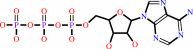 ATP
ATP
|
=
|
O-phospho-L-seryl-[protein]
|
+
|
 ADP
ADP
|
+
|
H(+)
|
|
|
|
|
|
|
L-threonyl-[protein]
|
+
|
ATP
|
=
|
O-phospho-L-threonyl-[protein]
|
+
|
ADP
|
+
|
H(+)
|
|
|
|
|
|
|
|
|
|
|
|
|
Molecule diagrams generated from .mol files obtained from the
KEGG ftp site
|
|
|
|
|
|
|
|
|
|
|
|
|
|
 |
|
|
|
|
|
|
| |
|
|
| |
|
DOI no:
|
J Med Chem
47:3710-3722
(2004)
|
|
PubMed id:
|
|
|
|
|
|
| |
|
N2-substituted O6-cyclohexylmethylguanine derivatives: potent inhibitors of cyclin-dependent kinases 1 and 2.
|
|
I.R.Hardcastle,
C.E.Arris,
J.Bentley,
F.T.Boyle,
Y.Chen,
N.J.Curtin,
J.A.Endicott,
A.E.Gibson,
B.T.Golding,
R.J.Griffin,
P.Jewsbury,
J.Menyerol,
V.Mesguiche,
D.R.Newell,
M.E.Noble,
D.J.Pratt,
L.Z.Wang,
H.J.Whitfield.
|
|
|
|
|
| |
ABSTRACT
|
|
|
|
| |
|
|
The adenosine 5'-triphosphate (ATP) competitive cyclin-dependent kinase
inhibitor O(6)-cyclohexylmethylguanine (NU2058, 1) has been employed as the lead
in a structure-based drug discovery program resulting in the discovery of the
potent CDK1 and -2 inhibitor NU6102 (3, IC(50) = 9.5 nM and 5.4 nM vs
CDK1/cyclinB and CDK2/cyclinA3, respectively). The SAR for this series have been
explored further by the synthesis and evaluation of 45 N(2)-substituted
analogues of NU2058. These studies have confirmed the requirement for the
hydrogen bonding N(2)-NH group and the requirement for an aromatic
N(2)-substituent to confer potency in the series. Additional potency is
conferred by the presence of a group capable of donating a hydrogen bond at the
4'-position, for example, the 4'-hydroxy derivative (25, IC(50) = 94 nM and 69
nM vs CDK1/cyclinB and CDK2/cyclinA3, respectively), 4'-monomethylsulfonamide
derivative (28, IC(50) = 9 nM and 7.0 nM vs CDK1/cyclinB and CDK2/cyclinA3,
respectively), and 4'-carboxamide derivative (34, IC(50) = 67 nM and 64 nM vs
CDK1/cyclinB and CDK2/cyclinA3, respectively). X-ray crystal structures have
been obtained for key compounds and have been used to explain the observed
trends in activity.
|
|
|
|
|
|
|
|
|
|
|
|
|
|
|
|
|
|
 |
 |
 |
|
Literature references that cite this PDB file's key reference
|
|
|
| |
PubMed id
|
|
Reference
|
|
|
|
|
|
C.Wong,
R.J.Griffin,
I.R.Hardcastle,
J.S.Northen,
L.Z.Wang,
and
B.T.Golding
(2010).
Synthesis of sulfonamide-based kinase inhibitors from sulfonates by exploiting the abrogated SN2 reactivity of 2,2,2-trifluoroethoxysulfonates.
|
| |
Org Biomol Chem,
8,
2457-2464.
|
|
|
|
|
|
|
F.Marchetti,
C.Cano,
N.J.Curtin,
B.T.Golding,
R.J.Griffin,
K.Haggerty,
D.R.Newell,
R.J.Parsons,
S.L.Payne,
L.Z.Wang,
and
I.R.Hardcastle
(2010).
Synthesis and biological evaluation of 5-substituted O4-alkylpyrimidines as CDK2 inhibitors.
|
| |
Org Biomol Chem,
8,
2397-2407.
|
|
|
|
|
|
|
O.Sperandio,
L.Mouawad,
E.Pinto,
B.O.Villoutreix,
D.Perahia,
and
M.A.Miteva
(2010).
How to choose relevant multiple receptor conformations for virtual screening: a test case of Cdk2 and normal mode analysis.
|
| |
Eur Biophys J,
39,
1365-1372.
|
|
|
|
|
|
|
J.Xiang,
H.Yang,
C.Che,
H.Zou,
H.Yang,
Y.Wei,
J.Quan,
H.Zhang,
Z.Yang,
and
S.Lin
(2009).
Identifying tumor cell growth inhibitors by combinatorial chemistry and zebrafish assays.
|
| |
PLoS ONE,
4,
e4361.
|
|
|
|
|
|
|
A.C.Rigas,
C.N.Robson,
and
N.J.Curtin
(2007).
Therapeutic potential of CDK inhibitor NU2058 in androgen-independent prostate cancer.
|
| |
Oncogene,
26,
7611-7619.
|
|
|
|
|
|
|
F.Marchetti,
K.L.Sayle,
J.Bentley,
W.Clegg,
N.J.Curtin,
J.A.Endicott,
B.T.Golding,
R.J.Griffin,
K.Haggerty,
R.W.Harrington,
V.Mesguiche,
D.R.Newell,
M.E.Noble,
R.J.Parsons,
D.J.Pratt,
L.Z.Wang,
and
I.R.Hardcastle
(2007).
Structure-based design of 2-arylamino-4-cyclohexylmethoxy-5-nitroso-6-aminopyrimidine inhibitors of cyclin-dependent kinase 2.
|
| |
Org Biomol Chem,
5,
1577-1585.
|
|
|
|
|
|
|
J.H.Alzate-Morales,
R.Contreras,
A.Soriano,
I.Tuñon,
and
E.Silla
(2007).
A computational study of the protein-ligand interactions in CDK2 inhibitors: using quantum mechanics/molecular mechanics interaction energy as a predictor of the biological activity.
|
| |
Biophys J,
92,
430-439.
|
|
|
|
|
|
|
J.Sridhar,
N.Akula,
and
N.Pattabiraman
(2006).
Selectivity and potency of cyclin-dependent kinase inhibitors.
|
| |
AAPS J,
8,
E204-E221.
|
|
|
|
|
|
The most recent references are shown first.
Citation data come partly from CiteXplore and partly
from an automated harvesting procedure. Note that this is likely to be
only a partial list as not all journals are covered by
either method. However, we are continually building up the citation data
so more and more references will be included with time.
|
 |
|


 Links
Links


