 |
PDBsum entry 1kfs

|
|
|
|
|
|

|

|

|

|
|

|
|

|
|

|
|

|
|

|
|
|
 |

|

|
|
|
|
|
|
|
|
|
|
|
|
|
|
|
|
|
|
|
|
|
|
|
|
|
|
|
|
|
|
|
|
|
|
Transferase/DNA
|
PDB id
|
|
|
|
1kfs
|
|
|
|
|
|
|
|
|
|
|
|
|
|
|

|

|

|
|
|
|
|
|
|
|
 |
Contents |
 |
|
|
|
|
|
|
|
|
|
|
|
|
|
|
* Residue conservation analysis
|
|
|
|
|
|
|
|
|
|
|
Enzyme class:
|
|
E.C.2.7.7.7
- DNA-directed Dna polymerase.
|
|
|
|
|
|
|
Reaction:
|
|
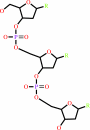
DNA(n) + a 2'-deoxyribonucleoside 5'-triphosphate = DNA(n+1) + diphosphate
|
|
|
|
|
|
 DNA(n)
|
+
|
2'-deoxyribonucleoside 5'-triphosphate
|
=
|
DNA(n+1)
|
+
|
 diphosphate
|
|
|
|
|
|
|
|
|
|
|
|
|
Molecule diagrams generated from .mol files obtained from the
KEGG ftp site
|
|
|
|
|
|
|
|
|
|
|
|
|
|
 |
|
|
|
|
|
|
| |
|
|
| |
|
DOI no:
|
J Mol Biol
277:363-377
(1998)
|
|
PubMed id:
|
|
|
|
|
|
| |
|
Structural principles for the inhibition of the 3'-5' exonuclease activity of Escherichia coli DNA polymerase I by phosphorothioates.
|
|
C.A.Brautigam,
T.A.Steitz.
|
|
|
|
|
| |
ABSTRACT
|
|
|
|
| |
|
|
A two-metal-ion catalytic mechanism has previously been proposed for several
phosphoryl-transfer enzymes. In order to extend the structural basis of this
mechanism, crystal structures of three single-stranded DNA substrates bound to
the 3'-5' exonucleolytic active site of the large fragment of DNA polymerase I
from Escherichia coli have been elucidated. The first is a 2.1 A resolution
structure of a Michaelis complex between the large fragment (or Klenow fragment,
KF) and a single-stranded DNA substrate, stabilized by low pH and
flash-freezing. The positions and identities of the catalytic metal ions, a Zn2+
at site A and a Mg2+ at site B, have been clearly established. The structural
and kinetic consequences of sulfur substitutions in the scissile phosphate have
been explored. A complex with the Rp isomer of phosphorothioate DNA, refined at
2.2 A resolution, shows Zn2+ bound to both metal sites and a mispositioning of
the substrate and attacking nucleophile. The complex with the Sp
phosphorothioate at 2. 3 A resolution reveals that metal ions do not bind in the
active site, having been displaced by a bulky sulfur atom. Steady-state kinetic
experiments show that catalyzed hydrolysis of the Rp isomer was reduced only
about 15-fold, while no enzyme activity could be detected with the Sp
phosphorothioate, consistent with the structural observations. Furthermore, Mn2+
could not rescue the activity of the exonuclease on the Sp phosphorothioate.
Taken together, these studies confirm and extend the proposed two-metal-ion
exonuclease mechanism and provide a structural context to explain the effects of
sulfur substitutions on this and other phosphoryl-transfer enzymes. These
experiments also suggest that the possibility of metal-ion exclusion be taken
into account when interpreting the results of Mn2+ rescue experiments.
|
|
|
|
|
|
| |
Selected figure(s)
|
|
|
|
| |
|
|

|
|

|
|
Figure 2.
Figure 2. the configurations of the oxygen (or sulfur)
atoms about the scissile phosphate of normal or phos-
phorothioate DNA. The phosphates are shown in the
orientation that will occur in all other Figures. (a) Nor-
mal, or all-oxygen phosphate. The pro-R and pro-S pos-
itions are marked. The negative charge is distributed
between the non-bridging oxygens. (b) Rp phosphor-
othioate phosphate. Note that the sulfur atom has only
a single covalent bond to the phosphorus atom and is
negatively charged. The pro-S oxygen features a double
bond to phosphorus. (c) The Sp phosphorothioate.
|
|
Figure 5.
Figure 5. Schematic drawing of the
R isomer structure. The same color-
ing scheme as in Figure 4 is used,
with the pro-R sulfur and ``attack''
water highlighted in yellow and
purple, respectively. The two Zn
ions are about 4.0 Å apart.
|
|
|
|
|
|
| |
The above figures are
reprinted
by permission from Elsevier:
J Mol Biol
(1998,
277,
363-377)
copyright 1998.
|
|
| |
Figures were
selected
by an automated process.
|
|
|
|
|
|
|
|
|
|
|
|
|
|
|
|
 |
 |
 |
|
Literature references that cite this PDB file's key reference
|
|
|
| |
PubMed id
|
|
Reference
|
|
|
|
|
|
J.Orans,
E.A.McSweeney,
R.R.Iyer,
M.A.Hast,
H.W.Hellinga,
P.Modrich,
and
L.S.Beese
(2011).
Structures of human exonuclease 1 DNA complexes suggest a unified mechanism for nuclease family.
|
| |
Cell,
145,
212-223.
|
|
|
PDB codes:
|
|
|
|
|
|
|
|
W.Yang
(2011).
Nucleases: diversity of structure, function and mechanism.
|
| |
Q Rev Biophys,
44,
1.
|
|
|
|
|
|
|
G.Pastor-Palacios,
E.Azuara-Liceaga,
and
L.G.Brieba
(2010).
A nuclear family A DNA polymerase from Entamoeba histolytica bypasses thymine glycol.
|
| |
PLoS Negl Trop Dis,
4,
e786.
|
|
|
|
|
|
|
J.E.Deweese,
and
N.Osheroff
(2010).
The use of divalent metal ions by type II topoisomerases.
|
| |
Metallomics,
2,
450-459.
|
|
|
|
|
|
|
M.Wojcik,
and
W.J.Stec
(2010).
The effect of divalent cations on the catalytic activity of the human plasma 3'-exonuclease.
|
| |
Biometals,
23,
1113-1121.
|
|
|
|
|
|
|
A.Schwartz,
M.Rabhi,
F.Jacquinot,
E.Margeat,
A.R.Rahmouni,
and
M.Boudvillain
(2009).
A stepwise 2'-hydroxyl activation mechanism for the bacterial transcription termination factor Rho helicase.
|
| |
Nat Struct Mol Biol,
16,
1309-1316.
|
|
|
|
|
|
|
C.A.Wakeman,
A.Ramesh,
and
W.C.Winkler
(2009).
Multiple metal-binding cores are required for metalloregulation by M-box riboswitch RNAs.
|
| |
J Mol Biol,
392,
723-735.
|
|
|
|
|
|
|
Y.Santoso,
and
A.N.Kapanidis
(2009).
Probing biomolecular structures and dynamics of single molecules using in-gel alternating-laser excitation.
|
| |
Anal Chem,
81,
9561-9570.
|
|
|
|
|
|
|
A.Lagunavicius,
Z.Kiveryte,
V.Zimbaite-Ruskuliene,
T.Radzvilavicius,
and
A.Janulaitis
(2008).
Duality of polynucleotide substrates for Phi29 DNA polymerase: 3'-->5' RNase activity of the enzyme.
|
| |
RNA,
14,
503-513.
|
|
|
|
|
|
|
B.Nawrot,
N.Paul,
B.Rebowska,
and
W.J.Stec
(2008).
Significance of stereochemistry of 3'-terminal phosphorothioate-modified primer in DNA polymerase-mediated chain extension.
|
| |
Mol Biotechnol,
40,
119-126.
|
|
|
|
|
|
|
J.E.Deweese,
A.B.Burgin,
and
N.Osheroff
(2008).
Human topoisomerase IIalpha uses a two-metal-ion mechanism for DNA cleavage.
|
| |
Nucleic Acids Res,
36,
4883-4893.
|
|
|
|
|
|
|
J.K.Lassila,
and
D.Herschlag
(2008).
Promiscuous sulfatase activity and thio-effects in a phosphodiesterase of the alkaline phosphatase superfamily.
|
| |
Biochemistry,
47,
12853-12859.
|
|
|
|
|
|
|
M.Brucet,
J.Querol-Audí,
K.Bertlik,
J.Lloberas,
I.Fita,
and
A.Celada
(2008).
Structural and biochemical studies of TREX1 inhibition by metals. Identification of a new active histidine conserved in DEDDh exonucleases.
|
| |
Protein Sci,
17,
2059-2069.
|
|
|
PDB codes:
|
|
|
|
|
|
|
|
P.A.Sigala,
D.A.Kraut,
J.M.Caaveiro,
B.Pybus,
E.A.Ruben,
D.Ringe,
G.A.Petsko,
and
D.Herschlag
(2008).
Testing geometrical discrimination within an enzyme active site: constrained hydrogen bonding in the ketosteroid isomerase oxyanion hole.
|
| |
J Am Chem Soc,
130,
13696-13708.
|
|
|
PDB codes:
|
|
|
|
|
|
|
|
R.D.Busam
(2008).
Structure of Escherichia coli exonuclease I in complex with thymidine 5'-monophosphate.
|
| |
Acta Crystallogr D Biol Crystallogr,
64,
206-210.
|
|
|
PDB code:
|
|
|
|
|
|
|
|
A.T.Jonstrup,
K.R.Andersen,
L.B.Van,
and
D.E.Brodersen
(2007).
The 1.4-A crystal structure of the S. pombe Pop2p deadenylase subunit unveils the configuration of an active enzyme.
|
| |
Nucleic Acids Res,
35,
3153-3164.
|
|
|
PDB code:
|
|
|
|
|
|
|
|
B.Nawrot,
K.Widera,
M.Wojcik,
B.Rebowska,
G.Nowak,
and
W.J.Stec
(2007).
Mapping of the functional phosphate groups in the catalytic core of deoxyribozyme 10-23.
|
| |
FEBS J,
274,
1062-1072.
|
|
|
|
|
|
|
C.Ferrer-Orta,
A.Arias,
R.Pérez-Luque,
C.Escarmís,
E.Domingo,
and
N.Verdaguer
(2007).
Sequential structures provide insights into the fidelity of RNA replication.
|
| |
Proc Natl Acad Sci U S A,
104,
9463-9468.
|
|
|
PDB codes:
|
|
|
|
|
|
|
|
G.Luo,
M.Wang,
W.H.Konigsberg,
and
X.S.Xie
(2007).
Single-molecule and ensemble fluorescence assays for a functionally important conformational change in T7 DNA polymerase.
|
| |
Proc Natl Acad Sci U S A,
104,
12610-12615.
|
|
|
|
|
|
|
G.Sasnauskas,
B.A.Connolly,
S.E.Halford,
and
V.Siksnys
(2007).
Site-specific DNA transesterification catalyzed by a restriction enzyme.
|
| |
Proc Natl Acad Sci U S A,
104,
2115-2120.
|
|
|
|
|
|
|
I.Artsimovitch,
and
D.G.Vassylyev
(2007).
Merging the RNA and DNA worlds.
|
| |
Nat Struct Mol Biol,
14,
1122-1123.
|
|
|
|
|
|
|
J.M.Choi,
S.Y.Kang,
W.J.Bae,
K.S.Jin,
M.Ree,
and
Y.Cho
(2007).
Probing the roles of active site residues in the 3'-5' exonuclease of the Werner syndrome protein.
|
| |
J Biol Chem,
282,
9941-9951.
|
|
|
|
|
|
|
A.P.So,
R.F.Turner,
and
C.A.Haynes
(2006).
Minimizing loss of sequence information in SAGE ditags by modulating the temperature dependent 3' --> 5' exonuclease activity of DNA polymerases on 3'-terminal isoheptyl amino groups.
|
| |
Biotechnol Bioeng,
94,
54-65.
|
|
|
|
|
|
|
D.Lim,
G.G.Gregorio,
C.Bingman,
E.Martinez-Hackert,
W.A.Hendrickson,
and
S.P.Goff
(2006).
Crystal structure of the moloney murine leukemia virus RNase H domain.
|
| |
J Virol,
80,
8379-8389.
|
|
|
PDB code:
|
|
|
|
|
|
|
|
J.A.Jansen,
T.J.McCarthy,
G.A.Soukup,
and
J.K.Soukup
(2006).
Backbone and nucleobase contacts to glucosamine-6-phosphate in the glmS ribozyme.
|
| |
Nat Struct Mol Biol,
13,
517-523.
|
|
|
|
|
|
|
J.J.Perry,
S.M.Yannone,
L.G.Holden,
C.Hitomi,
A.Asaithamby,
S.Han,
P.K.Cooper,
D.J.Chen,
and
J.A.Tainer
(2006).
WRN exonuclease structure and molecular mechanism imply an editing role in DNA end processing.
|
| |
Nat Struct Mol Biol,
13,
414-422.
|
|
|
PDB codes:
|
|
|
|
|
|
|
|
S.F.Midtgaard,
J.Assenholt,
A.T.Jonstrup,
L.B.Van,
T.H.Jensen,
and
D.E.Brodersen
(2006).
Structure of the nuclear exosome component Rrp6p reveals an interplay between the active site and the HRDC domain.
|
| |
Proc Natl Acad Sci U S A,
103,
11898-11903.
|
|
|
PDB codes:
|
|
|
|
|
|
|
|
W.Yang,
J.Y.Lee,
and
M.Nowotny
(2006).
Making and breaking nucleic acids: two-Mg2+-ion catalysis and substrate specificity.
|
| |
Mol Cell,
22,
5.
|
|
|
|
|
|
|
P.Haeberli,
I.Berger,
P.S.Pallan,
and
M.Egli
(2005).
Syntheses of 4'-thioribonucleosides and thermodynamic stability and crystal structure of RNA oligomers with incorporated 4'-thiocytosine.
|
| |
Nucleic Acids Res,
33,
3965-3975.
|
|
|
PDB code:
|
|
|
|
|
|
|
|
A.Lupták,
and
J.A.Doudna
(2004).
Distinct sites of phosphorothioate substitution interfere with folding and splicing of the Anabaena group I intron.
|
| |
Nucleic Acids Res,
32,
2272-2280.
|
|
|
|
|
|
|
I.Benzaghou,
I.Bougie,
and
M.Bisaillon
(2004).
Effect of metal ion binding on the structural stability of the hepatitis C virus RNA polymerase.
|
| |
J Biol Chem,
279,
49755-49761.
|
|
|
|
|
|
|
M.Steiniger-White,
I.Rayment,
and
W.S.Reznikoff
(2004).
Structure/function insights into Tn5 transposition.
|
| |
Curr Opin Struct Biol,
14,
50-57.
|
|
|
PDB code:
|
|
|
|
|
|
|
|
P.A.Pribil,
S.J.Wardle,
and
D.B.Haniford
(2004).
Enhancement and rescue of target capture in Tn10 transposition by site-specific modifications in target DNA.
|
| |
Mol Microbiol,
52,
1173-1186.
|
|
|
|
|
|
|
Y.G.Ren,
L.A.Kirsebom,
and
A.Virtanen
(2004).
Coordination of divalent metal ions in the active site of poly(A)-specific ribonuclease.
|
| |
J Biol Chem,
279,
48702-48706.
|
|
|
|
|
|
|
Y.S.Kovacheva,
S.B.Tzokov,
I.A.Murray,
and
J.A.Grasby
(2004).
The role of phosphate groups in the VS ribozyme-substrate interaction.
|
| |
Nucleic Acids Res,
32,
6240-6250.
|
|
|
|
|
|
|
Y.Shen,
X.F.Tang,
H.Yokoyama,
E.Matsui,
and
I.Matsui
(2004).
A 21-amino acid peptide from the cysteine cluster II of the family D DNA polymerase from Pyrococcus horikoshii stimulates its nuclease activity which is Mre11-like and prefers manganese ion as the cofactor.
|
| |
Nucleic Acids Res,
32,
158-168.
|
|
|
|
|
|
|
C.P.Da Costa,
A.Okruszek,
and
H.Sigel
(2003).
Complex formation of divalent metal ions with uridine 5'-O-thiomonophosphate or methyl thiophosphate: comparison of complex stabilities with those of the parent phosphate ligands.
|
| |
Chembiochem,
4,
593-602.
|
|
|
|
|
|
|
D.Di Giusto,
and
G.C.King
(2003).
Single base extension (SBE) with proofreading polymerases and phosphorothioate primers: improved fidelity in single-substrate assays.
|
| |
Nucleic Acids Res,
31,
e7.
|
|
|
|
|
|
|
I.Bougie,
S.Charpentier,
and
M.Bisaillon
(2003).
Characterization of the metal ion binding properties of the hepatitis C virus RNA polymerase.
|
| |
J Biol Chem,
278,
3868-3875.
|
|
|
|
|
|
|
V.Sosunov,
E.Sosunova,
A.Mustaev,
I.Bass,
V.Nikiforov,
and
A.Goldfarb
(2003).
Unified two-metal mechanism of RNA synthesis and degradation by RNA polymerase.
|
| |
EMBO J,
22,
2234-2244.
|
|
|
|
|
|
|
E.L.Christian,
N.M.Kaye,
and
M.E.Harris
(2002).
Evidence for a polynuclear metal ion binding site in the catalytic domain of ribonuclease P RNA.
|
| |
EMBO J,
21,
2253-2262.
|
|
|
|
|
|
|
S.Lovell,
I.Y.Goryshin,
W.R.Reznikoff,
and
I.Rayment
(2002).
Two-metal active site binding of a Tn5 transposase synaptic complex.
|
| |
Nat Struct Biol,
9,
278-281.
|
|
|
PDB codes:
|
|
|
|
|
|
|
|
S.M.Crary,
J.C.Kurz,
and
C.A.Fierke
(2002).
Specific phosphorothioate substitutions probe the active site of Bacillus subtilis ribonuclease P.
|
| |
RNA,
8,
933-947.
|
|
|
|
|
|
|
V.M.Petrov,
S.S.Ng,
and
J.D.Karam
(2002).
Protein determinants of RNA binding by DNA polymerase of the T4-related bacteriophage RB69.
|
| |
J Biol Chem,
277,
33041-33048.
|
|
|
|
|
|
|
W.C.Lam,
E.H.Thompson,
O.Potapova,
X.C.Sun,
C.M.Joyce,
and
D.P.Millar
(2002).
3'-5' exonuclease of Klenow fragment: role of amino acid residues within the single-stranded DNA binding region in exonucleolysis and duplex DNA melting.
|
| |
Biochemistry,
41,
3943-3951.
|
|
|
|
|
|
|
Y.G.Ren,
J.Martínez,
and
A.Virtanen
(2002).
Identification of the active site of poly(A)-specific ribonuclease by site-directed mutagenesis and Fe(2+)-mediated cleavage.
|
| |
J Biol Chem,
277,
5982-5987.
|
|
|
|
|
|
|
Z.Morávek,
S.Neidle,
and
B.Schneider
(2002).
Protein and drug interactions in the minor groove of DNA.
|
| |
Nucleic Acids Res,
30,
1182-1191.
|
|
|
|
|
|
|
P.Guga,
K.Domański,
and
W.J.Stec
(2001).
Oxathiaphospholane Approach to the Synthesis of P-Chiral, Isotopomeric Deoxy(ribonucleoside phosphorothioate)s and Phosphates Labeled with an Oxygen Isotope This work was financially supported by the State Committee for Scientific Research (KBN, Poland, Grant 4P05F00617, to W.J.S.), and, in part, by the Human Science Promotion Foundation (Japan, to H. Takaku and W.J.S.).
|
| |
Angew Chem Int Ed Engl,
40,
610-613.
|
|
|
|
|
|
|
S.Cogoi,
V.Rapozzi,
F.Quadrifoglio,
and
L.Xodo
(2001).
Anti-gene effect in live cells of AG motif triplex-forming oligonucleotides containing an increasing number of phosphorothioate linkages.
|
| |
Biochemistry,
40,
1135-1143.
|
|
|
|
|
|
|
Y.Takagi,
M.Warashina,
W.J.Stec,
K.Yoshinari,
and
K.Taira
(2001).
Recent advances in the elucidation of the mechanisms of action of ribozymes.
|
| |
Nucleic Acids Res,
29,
1815-1834.
|
|
|
|
|
|
|
A.K.Kennedy,
D.B.Haniford,
and
K.Mizuuchi
(2000).
Single active site catalysis of the successive phosphoryl transfer steps by DNA transposases: insights from phosphorothioate stereoselectivity.
|
| |
Cell,
101,
295-305.
|
|
|
|
|
|
|
B.C.Thomas,
X.Li,
and
P.Gegenheimer
(2000).
Chloroplast ribonuclease P does not utilize the ribozyme-type pre-tRNA cleavage mechanism.
|
| |
RNA,
6,
545-553.
|
|
|
|
|
|
|
D.Dertinger,
L.S.Behlen,
and
O.C.Uhlenbeck
(2000).
Using phosphorothioate-substituted RNA to investigate the thermodynamic role of phosphates in a sequence specific RNA-protein complex.
|
| |
Biochemistry,
39,
55-63.
|
|
|
|
|
|
|
E.L.Christian,
N.M.Kaye,
and
M.E.Harris
(2000).
Helix P4 is a divalent metal ion binding site in the conserved core of the ribonuclease P ribozyme.
|
| |
RNA,
6,
511-519.
|
|
|
|
|
|
|
F.Eckstein
(2000).
Phosphorothioate oligodeoxynucleotides: what is their origin and what is unique about them?
|
| |
Antisense Nucleic Acid Drug Dev,
10,
117-121.
|
|
|
|
|
|
|
J.M.Warnecke,
E.J.Sontheimer,
J.A.Piccirilli,
and
R.K.Hartmann
(2000).
Active site constraints in the hydrolysis reaction catalyzed by bacterial RNase P: analysis of precursor tRNAs with a single 3'-S-phosphorothiolate internucleotide linkage.
|
| |
Nucleic Acids Res,
28,
720-727.
|
|
|
|
|
|
|
K.Klumpp,
L.Doan,
N.A.Roberts,
and
B.Handa
(2000).
RNA and DNA hydrolysis are catalyzed by the influenza virus endonuclease.
|
| |
J Biol Chem,
275,
6181-6188.
|
|
|
|
|
|
|
K.Yoshinari,
and
K.Taira
(2000).
A further investigation and reappraisal of the thio effect in the cleavage reaction catalyzed by a hammerhead ribozyme.
|
| |
Nucleic Acids Res,
28,
1730-1742.
|
|
|
|
|
|
|
M.E.Glasner,
C.C.Yen,
E.H.Ekland,
and
D.P.Bartel
(2000).
Recognition of nucleoside triphosphates during RNA-catalyzed primer extension.
|
| |
Biochemistry,
39,
15556-15562.
|
|
|
|
|
|
|
S.O.Shan,
and
D.Herschlag
(2000).
An unconventional origin of metal-ion rescue and inhibition in the Tetrahymena group I ribozyme reaction.
|
| |
RNA,
6,
795-813.
|
|
|
|
|
|
|
C.M.Dupureur,
and
L.M.Hallman
(1999).
Effects of divalent metal ions on the activity and conformation of native and 3-fluorotyrosine-PvuII endonucleases.
|
| |
Eur J Biochem,
261,
261-268.
|
|
|
|
|
|
|
J.Jäger,
and
J.D.Pata
(1999).
Getting a grip: polymerases and their substrate complexes.
|
| |
Curr Opin Struct Biol,
9,
21-28.
|
|
|
|
|
|
|
M.Teplova,
S.T.Wallace,
V.Tereshko,
G.Minasov,
A.M.Symons,
P.D.Cook,
M.Manoharan,
and
M.Egli
(1999).
Structural origins of the exonuclease resistance of a zwitterionic RNA.
|
| |
Proc Natl Acad Sci U S A,
96,
14240-14245.
|
|
|
PDB codes:
|
|
|
|
|
|
|
|
S.Basu,
and
S.A.Strobel
(1999).
Thiophilic metal ion rescue of phosphorothioate interference within the Tetrahymena ribozyme P4-P6 domain.
|
| |
RNA,
5,
1399-1407.
|
|
|
|
|
|
|
S.Wang,
K.Karbstein,
A.Peracchi,
L.Beigelman,
and
D.Herschlag
(1999).
Identification of the hammerhead ribozyme metal ion binding site responsible for rescue of the deleterious effect of a cleavage site phosphorothioate.
|
| |
Biochemistry,
38,
14363-14378.
|
|
|
|
|
|
|
T.A.Steitz
(1999).
DNA polymerases: structural diversity and common mechanisms.
|
| |
J Biol Chem,
274,
17395-17398.
|
|
|
|
|
|
|
Y.Zhao,
D.Jeruzalmi,
I.Moarefi,
L.Leighton,
R.Lasken,
and
J.Kuriyan
(1999).
Crystal structure of an archaebacterial DNA polymerase.
|
| |
Structure,
7,
1189-1199.
|
|
|
PDB codes:
|
|
|
|
|
|
|
|
C.S.Vörtler,
O.Fedorova,
T.Persson,
U.Kutzke,
and
F.Eckstein
(1998).
Determination of 2'-hydroxyl and phosphate groups important for aminoacylation of Escherichia coli tRNAAsp: a nucleotide analogue interference study.
|
| |
RNA,
4,
1444-1454.
|
|
|
|
|
|
|
H.Viadiu,
and
A.K.Aggarwal
(1998).
The role of metals in catalysis by the restriction endonuclease BamHI.
|
| |
Nat Struct Biol,
5,
910-916.
|
|
|
PDB codes:
|
|
|
|
|
|
|
|
M.Boudvillain,
and
A.M.Pyle
(1998).
Defining functional groups, core structural features and inter-domain tertiary contacts essential for group II intron self-splicing: a NAIM analysis.
|
| |
EMBO J,
17,
7091-7104.
|
|
|
|
|
|
|
N.C.Horton,
K.J.Newberry,
and
J.J.Perona
(1998).
Metal ion-mediated substrate-assisted catalysis in type II restriction endonucleases.
|
| |
Proc Natl Acad Sci U S A,
95,
13489-13494.
|
|
|
PDB code:
|
|
|
|
|
|
|
|
S.Doublié,
and
T.Ellenberger
(1998).
The mechanism of action of T7 DNA polymerase.
|
| |
Curr Opin Struct Biol,
8,
704-712.
|
|
|
|
|
|
The most recent references are shown first.
Citation data come partly from CiteXplore and partly
from an automated harvesting procedure. Note that this is likely to be
only a partial list as not all journals are covered by
either method. However, we are continually building up the citation data
so more and more references will be included with time.
Where a reference describes a PDB structure, the PDB
codes are
shown on the right.
|
|


 Links
Links


