 |
PDBsum entry 1xhz

|
|
|
|
|
|

|

|

|

|
|

|
|

|
|

|
|

|
|

|
|

|
|
|
 |

|

|
|
|
|
|
|
|
|
|
|
|
|
|
|
|
|
|
|
|
|
|
|
|
|
|
|
|
|
|
|
|
|
|
|
|
Transferase/DNA
|
PDB id
|
|
|
|
1xhz
|
|
|
|
|
|
|
|
|
|
|
|
|
|
|

|

|

|
|
|
|
|
|
|
|
 |
Contents |
 |
|
|
|
|
|
|
|
|
|
|
|
|
|
|
* Residue conservation analysis
|
|
|
|
|
|
PDB id:
|
|
|
|
| Name: |
|
Transferase/DNA
|
|
|
Title:
|
|
Phi29 DNA polymerase, orthorhombic crystal form, ssdna complex
|
|
Structure:
|
|
5'-d( Tp Tp Tp Tp T)-3'. Chain: e, f, g, h. Engineered: yes. DNA polymerase. Chain: a, b, c, d. Synonym: early protein gp2. Engineered: yes. Mutation: yes
|
|
Source:
|
|
Synthetic: yes. Bacillus phage phi29. Organism_taxid: 10756. Gene: 2. Expressed in: escherichia coli. Expression_system_taxid: 562
|
|
Biol. unit:
|
|
 Dimer (from
)
Dimer (from
)
|
|
Resolution:
|
|
|
2.70Å
|
R-factor:
|
0.219
|
R-free:
|
0.268
|
|
|
Authors:
|
|
S.Kamtekar,A.J.Berman,J.Wang,J.M.Lazaro,M.De Vega,L.Blanco,M.Salas, T.A.Steitz
|
Key ref:

|
|
S.Kamtekar
et al.
(2004).
Insights into strand displacement and processivity from the crystal structure of the protein-primed DNA polymerase of bacteriophage phi29.
Mol Cell,
16,
609-618.
PubMed id:
DOI:

|
|
|
Date:
|
|
|
21-Sep-04
|
Release date:
|
07-Dec-04
|
|
|
|
|
|
|
PROCHECK
|

|
|
|
|
|
Headers
|
|
|
|
References
|
|
|
|
|
|

|
|
P03680
(DPOL_BPPH2) -
DNA polymerase from Bacillus phage phi29
|
|
|
|
Seq:
Struc:
|
|
|
|
575 a.a.
571 a.a.*
|
|

|

|
|
|
|
|
|
|
|
|
|
|
|
Key: |
 |
PfamA domain |
|
|
 |
Secondary structure |
|
 |
CATH domain |
|
|
*
PDB and UniProt seqs differ
at 2 residue positions (black
crosses)
|
|
|
|
|
|
|
|

|
|
|
|
T-T-T-T-T
5 bases
|
|
|
|
T-T-T-T-T
5 bases
|
|
|
|
T-T-T-T-T
5 bases
|
|
|
|
|
|
|
|
|
|
|
|
|
|
Enzyme class 2:
|
|
E.C.2.7.7.7
- DNA-directed Dna polymerase.
|
|
|
|
|
|
|
Reaction:
|
|
DNA(n) + a 2'-deoxyribonucleoside 5'-triphosphate = DNA(n+1) + diphosphate
|
|
|
|
|
|
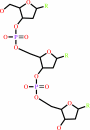 DNA(n)
|
+
|
2'-deoxyribonucleoside 5'-triphosphate
|
=
|
DNA(n+1)
|
+
|
 diphosphate
|
|
|
|
|
|
|
|
|
|
Enzyme class 3:
|
|
E.C.3.1.11.-
- ?????
|
|
|
|
|
|
|
|
|
|
Note, where more than one E.C. class is given (as above), each may
correspond to a different protein domain or, in the case of polyprotein
precursors, to a different mature protein.
|
|
|
|
Molecule diagrams generated from .mol files obtained from the
KEGG ftp site
|
|
|
|
|
|
|
|
|
|
|
|
|
|
 |
|
|
|
|
|
|
| |
|
|
| |
|
DOI no:
|
Mol Cell
16:609-618
(2004)
|
|
PubMed id:
|
|
|
|
|
|
| |
|
Insights into strand displacement and processivity from the crystal structure of the protein-primed DNA polymerase of bacteriophage phi29.
|
|
S.Kamtekar,
A.J.Berman,
J.Wang,
J.M.Lázaro,
M.de Vega,
L.Blanco,
M.Salas,
T.A.Steitz.
|
|
|
|
|
| |
ABSTRACT
|
|
|
|
| |
|
|
The DNA polymerase from phage phi29 is a B family polymerase that initiates
replication using a protein as a primer, attaching the first nucleotide of the
phage genome to the hydroxyl of a specific serine of the priming protein. The
crystal structure of phi29 DNA polymerase determined at 2.2 A resolution
provides explanations for its extraordinary processivity and strand displacement
activities. Homology modeling suggests that downstream template DNA passes
through a tunnel prior to entering the polymerase active site. This tunnel is
too small to accommodate double-stranded DNA and requires the separation of
template and nontemplate strands. Members of the B family of DNA polymerases
that use protein primers contain two sequence insertions: one forms a domain not
previously observed in polymerases, while the second resembles the specificity
loop of T7 RNA polymerase. The high processivity of phi29 DNA polymerase may be
explained by its topological encirclement of both the downstream template and
the upstream duplex DNA.
|
|
|
|
|
|
| |
Selected figure(s)
|
|
|
|
| |
|
|

|
|

|
|
Figure 1.
Figure 1. Ribbon Representation of the Domain Organization
of φ29 DNA PolymeraseThe exonuclease domain is shown in red,
the palm in pink, TPR1 in gold, the fingers in blue, TPR2 in
cyan, and the thumb in green. D249 and D458, which provide the
catalytic carboxylates of the polymerase active site, are shown
using space-filling spheres.
|
|
Figure 4.
Figure 4. Structures of TPR1 and TPR2, Domains that Are
Specific to Protein-Primed DNA Polymerases(A) TPR1 forms a
compact domain. This region is an insertion between the palm and
the fingers subdomains. The motif, identified on the basis of
sequence analysis (residues 302–358, gold), can be extended to
include residues 261–301 as well (brown), thereby forming a
subdomain with no homology to the palm subdomains of other B
family polymerases.(B) Structural analogy between TPR2 (cyan)
and the specificity loop (gold) of T7 RNA polymerase. The
fragments of both palms used for superposition are colored in
pink (φ29 DNA polymerase) and gray (T7 RNA polymerase). The
atoms of the residues containing the catalytic carboxylates are
shown as space-filling spheres.
|
|
|
|
|
|
| |
The above figures are
reprinted
by permission from Cell Press:
Mol Cell
(2004,
16,
609-618)
copyright 2004.
|
|
| |
Figures were
selected
by an automated process.
|
|
|
|
|
|
|
|
|
|
|
|
|
|
|
|
 |
 |
 |
|
Literature references that cite this PDB file's key reference
|
|
|
| |
PubMed id
|
|
Reference
|
|
|
|
|
|
T.G.Uil,
J.Vellinga,
J.de Vrij,
S.K.van den Hengel,
M.J.Rabelink,
S.J.Cramer,
J.J.Eekels,
Y.Ariyurek,
M.van Galen,
and
R.C.Hoeben
(2011).
Directed adenovirus evolution using engineered mutator viral polymerases.
|
| |
Nucleic Acids Res,
39,
e30.
|
|
|
|
|
|
|
T.Konry,
I.Smolina,
J.M.Yarmush,
D.Irimia,
and
M.L.Yarmush
(2011).
Ultrasensitive detection of low-abundance surface-marker protein using isothermal rolling circle amplification in a microfluidic nanoliter platform.
|
| |
Small,
7,
395-400.
|
|
|
|
|
|
|
M.de Vega,
J.M.Lázaro,
M.Mencía,
L.Blanco,
and
M.Salas
(2010).
Improvement of φ29 DNA polymerase amplification performance by fusion of DNA binding motifs.
|
| |
Proc Natl Acad Sci U S A,
107,
16506-16511.
|
|
|
|
|
|
|
N.Staiger,
and
A.Marx
(2010).
A DNA polymerase with increased reactivity for ribonucleotides and C5-modified deoxyribonucleotides.
|
| |
Chembiochem,
11,
1963-1966.
|
|
|
|
|
|
|
Z.Zhuang,
and
Y.Ai
(2010).
Processivity factor of DNA polymerase and its expanding role in normal and translesion DNA synthesis.
|
| |
Biochim Biophys Acta,
1804,
1081-1093.
|
|
|
|
|
|
|
B.Ibarra,
Y.R.Chemla,
S.Plyasunov,
S.B.Smith,
J.M.Lázaro,
M.Salas,
and
C.Bustamante
(2009).
Proofreading dynamics of a processive DNA polymerase.
|
| |
EMBO J,
28,
2794-2802.
|
|
|
|
|
|
|
B.S.Andrade,
A.G.Taranto,
A.Góes-Neto,
and
A.A.Duarte
(2009).
Comparative modeling of DNA and RNA polymerases from Moniliophthora perniciosa mitochondrial plasmid.
|
| |
Theor Biol Med Model,
6,
22.
|
|
|
|
|
|
|
D.Loakes,
and
P.Holliger
(2009).
Darwinian chemistry: towards the synthesis of a simple cell.
|
| |
Mol Biosyst,
5,
686-694.
|
|
|
|
|
|
|
I.Rodríguez,
J.M.Lázaro,
M.Salas,
and
M.de Vega
(2009).
Involvement of the TPR2 subdomain movement in the activities of phi29 DNA polymerase.
|
| |
Nucleic Acids Res,
37,
193-203.
|
|
|
|
|
|
|
R.Johne,
H.Müller,
A.Rector,
M.van Ranst,
and
H.Stevens
(2009).
Rolling-circle amplification of viral DNA genomes using phi29 polymerase.
|
| |
Trends Microbiol,
17,
205-211.
|
|
|
|
|
|
|
S.Hare,
P.Cherepanov,
and
J.Wang
(2009).
Application of general formulas for the correction of a lattice-translocation defect in crystals of a lentiviral integrase in complex with LEDGF.
|
| |
Acta Crystallogr D Biol Crystallogr,
65,
966-973.
|
|
|
|
|
|
|
T.Tenson,
and
V.Hauryliuk
(2009).
Does the ribosome have initiation and elongation modes of translation?
|
| |
Mol Microbiol,
72,
1310-1315.
|
|
|
|
|
|
|
Y.Tsai,
M.R.Sawaya,
and
T.O.Yeates
(2009).
Analysis of lattice-translocation disorder in the layered hexagonal structure of carboxysome shell protein CsoS1C.
|
| |
Acta Crystallogr D Biol Crystallogr,
65,
980-988.
|
|
|
PDB code:
|
|
|
|
|
|
|
|
A.Lagunavicius,
Z.Kiveryte,
V.Zimbaite-Ruskuliene,
T.Radzvilavicius,
and
A.Janulaitis
(2008).
Duality of polynucleotide substrates for Phi29 DNA polymerase: 3'-->5' RNase activity of the enzyme.
|
| |
RNA,
14,
503-513.
|
|
|
|
|
|
|
G.Lahoud,
V.Timoshchuk,
A.Lebedev,
K.Arar,
Y.M.Hou,
and
H.Gamper
(2008).
Properties of pseudo-complementary DNA substituted with weakly pairing analogs of guanine or cytosine.
|
| |
Nucleic Acids Res,
36,
6999-7008.
|
|
|
|
|
|
|
G.Lahoud,
V.Timoshchuk,
A.Lebedev,
M.de Vega,
M.Salas,
K.Arar,
Y.M.Hou,
and
H.Gamper
(2008).
Enzymatic synthesis of structure-free DNA with pseudo-complementary properties.
|
| |
Nucleic Acids Res,
36,
3409-3419.
|
|
|
|
|
|
|
J.Tang,
N.Olson,
P.J.Jardine,
S.Grimes,
D.L.Anderson,
and
T.S.Baker
(2008).
DNA poised for release in bacteriophage phi29.
|
| |
Structure,
16,
935-943.
|
|
|
|
|
|
|
R.J.Osborne,
and
C.A.Thornton
(2008).
Cell-free cloning of highly expanded CTG repeats by amplification of dimerized expanded repeats.
|
| |
Nucleic Acids Res,
36,
e24.
|
|
|
|
|
|
|
X.Zhu,
X.Xu,
and
I.A.Wilson
(2008).
Structure determination of the 1918 H1N1 neuraminidase from a crystal with lattice-translocation defects.
|
| |
Acta Crystallogr D Biol Crystallogr,
64,
843-850.
|
|
|
PDB code:
|
|
|
|
|
|
|
|
A.J.Berman,
S.Kamtekar,
J.L.Goodman,
J.M.Lázaro,
M.de Vega,
L.Blanco,
M.Salas,
and
T.A.Steitz
(2007).
Structures of phi29 DNA polymerase complexed with substrate: the mechanism of translocation in B-family polymerases.
|
| |
EMBO J,
26,
3494-3505.
|
|
|
PDB codes:
|
|
|
|
|
|
|
|
A.Kurzynska-Kokorniak,
V.K.Jamburuthugoda,
A.Bibillo,
and
T.H.Eickbush
(2007).
DNA-directed DNA polymerase and strand displacement activity of the reverse transcriptase encoded by the R2 retrotransposon.
|
| |
J Mol Biol,
374,
322-333.
|
|
|
|
|
|
|
M.Garcia-Diaz,
and
K.Bebenek
(2007).
Multiple functions of DNA polymerases.
|
| |
CRC Crit Rev Plant Sci,
26,
105-122.
|
|
|
|
|
|
|
M.Hogg,
P.Aller,
W.Konigsberg,
S.S.Wallace,
and
S.Doublié
(2007).
Structural and biochemical investigation of the role in proofreading of a beta hairpin loop found in the exonuclease domain of a replicative DNA polymerase of the B family.
|
| |
J Biol Chem,
282,
1432-1444.
|
|
|
PDB code:
|
|
|
|
|
|
|
|
M.Salas,
and
M.Salas
(2007).
40 years with bacteriophage ø29.
|
| |
Annu Rev Microbiol,
61,
1.
|
|
|
|
|
|
|
M.de Vega,
and
M.Salas
(2007).
A highly conserved Tyrosine residue of family B DNA polymerases contributes to dictate translesion synthesis past 8-oxo-7,8-dihydro-2'-deoxyguanosine.
|
| |
Nucleic Acids Res,
35,
5096-5107.
|
|
|
|
|
|
|
P.Pérez-Arnaiz,
E.Longás,
L.Villar,
J.M.Lázaro,
M.Salas,
and
M.de Vega
(2007).
Involvement of phage phi29 DNA polymerase and terminal protein subdomains in conferring specificity during initiation of protein-primed DNA replication.
|
| |
Nucleic Acids Res,
35,
7061-7073.
|
|
|
|
|
|
|
C.Dash,
J.P.Marino,
and
S.F.Le Grice
(2006).
Examining Ty3 polypurine tract structure and function by nucleoside analog interference.
|
| |
J Biol Chem,
281,
2773-2783.
|
|
|
|
|
|
|
D.T.Pride,
T.M.Wassenaar,
C.Ghose,
and
M.J.Blaser
(2006).
Evidence of host-virus co-evolution in tetranucleotide usage patterns of bacteriophages and eukaryotic viruses.
|
| |
BMC Genomics,
7,
8.
|
|
|
|
|
|
|
E.Longás,
M.de Vega,
J.M.Lázaro,
and
M.Salas
(2006).
Functional characterization of highly processive protein-primed DNA polymerases from phages Nf and GA-1, endowed with a potent strand displacement capacity.
|
| |
Nucleic Acids Res,
34,
6051-6063.
|
|
|
|
|
|
|
P.Pérez-Arnaiz,
J.M.Lázaro,
M.Salas,
and
M.de Vega
(2006).
Involvement of phi29 DNA polymerase thumb subdomain in the proper coordination of synthesis and degradation during DNA replication.
|
| |
Nucleic Acids Res,
34,
3107-3115.
|
|
|
|
|
|
|
S.J.Lee,
B.Marintcheva,
S.M.Hamdan,
and
C.C.Richardson
(2006).
The C-terminal residues of bacteriophage T7 gene 4 helicase-primase coordinate helicase and DNA polymerase activities.
|
| |
J Biol Chem,
281,
25841-25849.
|
|
|
|
|
|
|
S.Kamtekar,
A.J.Berman,
J.Wang,
J.M.Lázaro,
M.de Vega,
L.Blanco,
M.Salas,
and
T.A.Steitz
(2006).
The phi29 DNA polymerase:protein-primer structure suggests a model for the initiation to elongation transition.
|
| |
EMBO J,
25,
1335-1343.
|
|
|
PDB code:
|
|
|
|
|
|
|
|
T.A.Steitz
(2006).
Visualizing polynucleotide polymerase machines at work.
|
| |
EMBO J,
25,
3458-3468.
|
|
|
|
|
|
|
I.Rodríguez,
J.M.Lázaro,
L.Blanco,
S.Kamtekar,
A.J.Berman,
J.Wang,
T.A.Steitz,
M.Salas,
and
M.de Vega
(2005).
A specific subdomain in phi29 DNA polymerase confers both processivity and strand-displacement capacity.
|
| |
Proc Natl Acad Sci U S A,
102,
6407-6412.
|
|
|
|
|
|
|
J.S.Hartig,
S.Fernandez-Lopez,
and
E.T.Kool
(2005).
Guanine-rich DNA nanocircles for the synthesis and characterization of long cytosine-rich telomeric DNAs.
|
| |
Chembiochem,
6,
1458-1462.
|
|
|
|
|
|
|
J.Wang,
S.H.Rho,
H.H.Park,
and
S.H.Eom
(2005).
Correction of X-ray intensities from an HslV-HslU co-crystal containing lattice-translocation defects.
|
| |
Acta Crystallogr D Biol Crystallogr,
61,
932-941.
|
|
|
PDB code:
|
|
|
|
|
|
|
|
J.Wang,
S.Kamtekar,
A.J.Berman,
and
T.A.Steitz
(2005).
Correction of X-ray intensities from single crystals containing lattice-translocation defects.
|
| |
Acta Crystallogr D Biol Crystallogr,
61,
67-74.
|
|
|
PDB code:
|
|
|
|
|
|
|
|
S.Adhya,
L.Black,
D.Friedman,
G.Hatfull,
K.Kreuzer,
C.Merril,
A.Oppenheim,
F.Rohwer,
and
R.Young
(2005).
2004 ASM Conference on the New Phage Biology: the 'Phage Summit'.
|
| |
Mol Microbiol,
55,
1300-1314.
|
|
|
|
|
|
|
D.Jeruzalmi
(2004).
Chromosomal DNA replication on a protein "chip".
|
| |
Structure,
12,
2100-2102.
|
|
|
|
|
|
The most recent references are shown first.
Citation data come partly from CiteXplore and partly
from an automated harvesting procedure. Note that this is likely to be
only a partial list as not all journals are covered by
either method. However, we are continually building up the citation data
so more and more references will be included with time.
Where a reference describes a PDB structure, the PDB
code is
shown on the right.
|
|


 Links
Links


