
|
|
|
|
|
 |
Contents |
 |
|
|
|
|
|
|
|
|
|
|
|


 (+ 0 more)
570 a.a.
(+ 0 more)
570 a.a.
|
|
|
|
|
|
|
|
|
|
|


 (+ 0 more)
196 a.a.
(+ 0 more)
196 a.a.
|
|
|
|
|
|
|
|
|
* Residue conservation analysis
|
|
|
|
|
|
PDB id:
|
|
|
|
| Name: |
|
Transferase/replication
|
|
|
Title:
|
|
Bacteriophage phi29 DNA polymerase bound to terminal protein
|
|
Structure:
|
|
DNA polymerase. Chain: a, c, e, g, i, k. Synonym: early protein gp2. Engineered: yes. Mutation: yes. DNA terminal protein. Chain: b, d, f, h, j, l. Fragment: terminal protein. Synonym: protein gp3.
|
|
Source:
|
|
Bacillus phage phi29. Organism_taxid: 10756. Gene: 2. Expressed in: escherichia coli. Expression_system_taxid: 562. Gene: 3. Expressed in: bacillus subtilis. Expression_system_taxid: 1423
|
|
Biol. unit:
|
|
 Dimer (from
)
Dimer (from
)
|
|
Resolution:
|
|
|
3.00Å
|
R-factor:
|
0.203
|
R-free:
|
0.229
|
|
|
Authors:
|
|
S.Kamtekar,A.J.Berman,J.Wang,M.De Vega,L.Blanco,M.Salas,T.A.Steitz
|
Key ref:

|
|
S.Kamtekar
et al.
(2006).
The phi29 DNA polymerase:protein-primer structure suggests a model for the initiation to elongation transition.
EMBO J,
25,
1335-1343.
PubMed id:
DOI:

|
|
|
Date:
|
|
|
07-Nov-05
|
Release date:
|
14-Mar-06
|
|
|
|
|
|
|
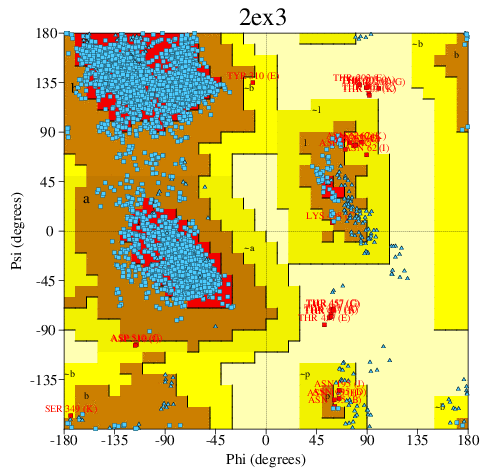
PROCHECK
|
|
|
|
|
|
Headers
|
|
|
|
References
|
|
|
|
|
|
|
|
|
|
|
|
Enzyme class 2:
|
|
Chains A, C, E, G, I, K:
E.C.2.7.7.7
- DNA-directed Dna polymerase.
|
|
|
|
|
|
|
Reaction:
|
|
DNA(n) + a 2'-deoxyribonucleoside 5'-triphosphate = DNA(n+1) + diphosphate
|
|
|
|
|
|
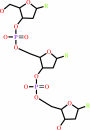 DNA(n)
|
+
|
2'-deoxyribonucleoside 5'-triphosphate
|
=
|
DNA(n+1)
|
+
|
 diphosphate
|
|
|
|
|
|
|
|
|
|
Enzyme class 3:
|
|
Chains A, C, E, G, I, K:
E.C.3.1.11.-
- ?????
|
|
|
|
|
|
|
Enzyme class 4:
|
|
Chains B, D, F, H, J, L:
E.C.?
|
|
|
|
|
|
|
|
|
|
Note, where more than one E.C. class is given (as above), each may
correspond to a different protein domain or, in the case of polyprotein
precursors, to a different mature protein.
|
|
|
|
Molecule diagrams generated from .mol files obtained from the
KEGG ftp site
|
|
|
|
|
|
|
|
|
|
|
|
|
|
 |
|
|
|
|
|
|
| |
|
|
| |
|
DOI no:
|
EMBO J
25:1335-1343
(2006)
|
|
PubMed id:
|
|
|
|
|
|
| |
|
The phi29 DNA polymerase:protein-primer structure suggests a model for the initiation to elongation transition.
|
|
S.Kamtekar,
A.J.Berman,
J.Wang,
J.M.Lázaro,
M.de Vega,
L.Blanco,
M.Salas,
T.A.Steitz.
|
|
|
|
|
| |
ABSTRACT
|
|
|
|
| |
|
|
The absolute requirement for primers in the initiation of DNA synthesis poses a
problem for replicating the ends of linear chromosomes. The DNA polymerase of
bacteriophage phi29 solves this problem by using a serine hydroxyl of terminal
protein to prime replication. The 3.0 A resolution structure shows one domain of
terminal protein making no interactions, a second binding the polymerase and a
third domain containing the priming serine occupying the same binding cleft in
the polymerase as duplex DNA does during elongation. Thus, the progressively
elongating DNA duplex product must displace this priming domain. Further, this
heterodimer of polymerase and terminal protein cannot accommodate upstream
template DNA, thereby explaining its specificity for initiating DNA synthesis
only at the ends of the bacteriophage genome. We propose a model for the
transition from the initiation to the elongation phases in which the priming
domain of terminal protein moves out of the active site as polymerase elongates
the primer strand. The model indicates that terminal protein should dissociate
from polymerase after the incorporation of approximately six nucleotides.
|
|
|
|
|
|
| |
Selected figure(s)
|
|
|
|
| |
|
|

|
|

|
|
Figure 1.
Figure 1 Electron density for a helix of terminal protein near
the active site of polymerase. On the left is a 3.5 Å
resolution map contoured at 1  using
data from the I23 crystal form. It was calculated using
amplitudes sharpened by a factor of 100 and experimentally
phased with solvent-flattened heavy-atom phases. Side chains
cannot be unambiguously assigned in this map. On the right is a
composite omit map contoured at 1 and
calculated to 3 Å using data from the C2 crystal form.
Side chain density is much better defined in this map. Figures
1, 2, 3A, 3B, and 4 were made using Pymol (http://www.pymol.org). using
data from the I23 crystal form. It was calculated using
amplitudes sharpened by a factor of 100 and experimentally
phased with solvent-flattened heavy-atom phases. Side chains
cannot be unambiguously assigned in this map. On the right is a
composite omit map contoured at 1 and
calculated to 3 Å using data from the C2 crystal form.
Side chain density is much better defined in this map. Figures
1, 2, 3A, 3B, and 4 were made using Pymol (http://www.pymol.org).
|
|
Figure 2.
Figure 2 The structure of the polymerase:terminal protein
heterodimer. (A) A ribbon representation, with polymerase
colored according to Kamtekar et al, 2004, and terminal protein
shown with cylindrical helices. (B) A view of the complex
rotated 90° from that shown in (A), with terminal protein
shown as cylinders underneath a transparent surface. (C) A C[
 ]trace
of polymerase from the polymerase:terminal protein complex (in
color) superimposed on the apo polymerase structure. Significant
differences in conformation occur only in a loop between
residues 304 and 314 (shown in magenta in the complex and in
black in the apo polymerase structure). The polymerase active
site is marked by the space-filling representations of the
carboxylates that coordinate the catalytic metal ions. (D)
Terminal protein in the same orientation as in (B). ]trace
of polymerase from the polymerase:terminal protein complex (in
color) superimposed on the apo polymerase structure. Significant
differences in conformation occur only in a loop between
residues 304 and 314 (shown in magenta in the complex and in
black in the apo polymerase structure). The polymerase active
site is marked by the space-filling representations of the
carboxylates that coordinate the catalytic metal ions. (D)
Terminal protein in the same orientation as in (B).
|
|
|
|
|
|
| |
The above figures are
reprinted
by permission from Macmillan Publishers Ltd:
EMBO J
(2006,
25,
1335-1343)
copyright 2006.
|
|
| |
Figures were
selected
by an automated process.
|
|
|
|
|
|
|
|
|
|
|
|
|
|
|
|
 |
 |
 |
|
Literature references that cite this PDB file's key reference
|
|
|
| |
PubMed id
|
|
Reference
|
|
|
|
|
|
A.Arias,
C.Perales,
C.Escarmís,
and
E.Domingo
(2010).
Deletion mutants of VPg reveal new cytopathology determinants in a picornavirus.
|
| |
PLoS One,
5,
e10735.
|
|
|
|
|
|
|
D.Muñoz-Espín,
I.Holguera,
D.Ballesteros-Plaza,
R.Carballido-López,
and
M.Salas
(2010).
Viral terminal protein directs early organization of phage DNA replication at the bacterial nucleoid.
|
| |
Proc Natl Acad Sci U S A,
107,
16548-16553.
|
|
|
|
|
|
|
S.Kolkenbrock,
B.Naumann,
M.Hippler,
and
S.Fetzner
(2010).
A novel replicative enzyme encoded by the linear Arthrobacter plasmid pAL1.
|
| |
J Bacteriol,
192,
4935-4943.
|
|
|
|
|
|
|
I.Rodríguez,
J.M.Lázaro,
M.Salas,
and
M.de Vega
(2009).
Involvement of the TPR2 subdomain movement in the activities of phi29 DNA polymerase.
|
| |
Nucleic Acids Res,
37,
193-203.
|
|
|
|
|
|
|
J.Pan,
L.Lin,
and
Y.J.Tao
(2009).
Self-guanylylation of birnavirus VP1 does not require an intact polymerase activity site.
|
| |
Virology,
395,
87-96.
|
|
|
|
|
|
|
T.Tenson,
and
V.Hauryliuk
(2009).
Does the ribosome have initiation and elongation modes of translation?
|
| |
Mol Microbiol,
72,
1310-1315.
|
|
|
|
|
|
|
E.Longás,
L.Villar,
J.M.Lázaro,
M.de Vega,
and
M.Salas
(2008).
Phage phi29 and Nf terminal protein-priming domain specifies the internal template nucleotide to initiate DNA replication.
|
| |
Proc Natl Acad Sci U S A,
105,
18290-18295.
|
|
|
|
|
|
|
J.S.Koti,
M.C.Morais,
R.Rajagopal,
B.A.Owen,
C.T.McMurray,
and
D.L.Anderson
(2008).
DNA packaging motor assembly intermediate of bacteriophage phi29.
|
| |
J Mol Biol,
381,
1114-1132.
|
|
|
|
|
|
|
K.J.Durniak,
S.Bailey,
and
T.A.Steitz
(2008).
The structure of a transcribing T7 RNA polymerase in transition from initiation to elongation.
|
| |
Science,
322,
553-557.
|
|
|
PDB codes:
|
|
|
|
|
|
|
|
K.Porter,
and
M.L.Dyall-Smith
(2008).
Transfection of haloarchaea by the DNAs of spindle and round haloviruses and the use of transposon mutagenesis to identify non-essential regions.
|
| |
Mol Microbiol,
70,
1236-1245.
|
|
|
|
|
|
|
Y.Xiang,
M.C.Morais,
D.N.Cohen,
V.D.Bowman,
D.L.Anderson,
and
M.G.Rossmann
(2008).
Crystal and cryoEM structural studies of a cell wall degrading enzyme in the bacteriophage phi29 tail.
|
| |
Proc Natl Acad Sci U S A,
105,
9552-9557.
|
|
|
PDB codes:
|
|
|
|
|
|
|
|
A.J.Berman,
S.Kamtekar,
J.L.Goodman,
J.M.Lázaro,
M.de Vega,
L.Blanco,
M.Salas,
and
T.A.Steitz
(2007).
Structures of phi29 DNA polymerase complexed with substrate: the mechanism of translocation in B-family polymerases.
|
| |
EMBO J,
26,
3494-3505.
|
|
|
PDB codes:
|
|
|
|
|
|
|
|
A.Stoll,
M.Redenbach,
and
J.Cullum
(2007).
Identification of essential genes for linear replication of an SCP1 composite plasmid.
|
| |
FEMS Microbiol Lett,
270,
146-154.
|
|
|
|
|
|
|
M.Garcia-Diaz,
and
K.Bebenek
(2007).
Multiple functions of DNA polymerases.
|
| |
CRC Crit Rev Plant Sci,
26,
105-122.
|
|
|
|
|
|
|
M.Salas,
and
M.Salas
(2007).
40 years with bacteriophage ø29.
|
| |
Annu Rev Microbiol,
61,
1.
|
|
|
|
|
|
|
M.Stahl,
M.Retzlaff,
M.Nassal,
and
J.Beck
(2007).
Chaperone activation of the hepadnaviral reverse transcriptase for template RNA binding is established by the Hsp70 and stimulated by the Hsp90 system.
|
| |
Nucleic Acids Res,
35,
6124-6136.
|
|
|
|
|
|
|
P.Pérez-Arnaiz,
E.Longás,
L.Villar,
J.M.Lázaro,
M.Salas,
and
M.de Vega
(2007).
Involvement of phage phi29 DNA polymerase and terminal protein subdomains in conferring specificity during initiation of protein-primed DNA replication.
|
| |
Nucleic Acids Res,
35,
7061-7073.
|
|
|
|
|
|
|
E.Longás,
M.de Vega,
J.M.Lázaro,
and
M.Salas
(2006).
Functional characterization of highly processive protein-primed DNA polymerases from phages Nf and GA-1, endowed with a potent strand displacement capacity.
|
| |
Nucleic Acids Res,
34,
6051-6063.
|
|
|
|
|
|
|
T.A.Steitz
(2006).
Visualizing polynucleotide polymerase machines at work.
|
| |
EMBO J,
25,
3458-3468.
|
|
|
|
|
|
|
Y.Xiang,
M.C.Morais,
A.J.Battisti,
S.Grimes,
P.J.Jardine,
D.L.Anderson,
and
M.G.Rossmann
(2006).
Structural changes of bacteriophage phi29 upon DNA packaging and release.
|
| |
EMBO J,
25,
5229-5239.
|
|
|
|
|
|
The most recent references are shown first.
Citation data come partly from CiteXplore and partly
from an automated harvesting procedure. Note that this is likely to be
only a partial list as not all journals are covered by
either method. However, we are continually building up the citation data
so more and more references will be included with time.
Where a reference describes a PDB structure, the PDB
codes are
shown on the right.
|
 |


 Links
Links


