 |
PDBsum entry 1t3r

|
|
|
|
|
 |
Contents |
 |
|
|
|
|
|
|
|
|
|
|
|
|
* Residue conservation analysis
|
|
|
|
|
|
|
|
|
|
|
Enzyme class 1:
|
|
E.C.2.7.7.-
- ?????
|
|
|
|
|
|
|
Enzyme class 2:
|
|
E.C.2.7.7.49
- RNA-directed Dna polymerase.
|
|
|
|
|
|
|
Reaction:
|
|
DNA(n) + a 2'-deoxyribonucleoside 5'-triphosphate = DNA(n+1) + diphosphate
|
|
|
|
|
|
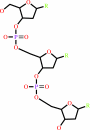 DNA(n)
|
+
|
2'-deoxyribonucleoside 5'-triphosphate
|
=
|
DNA(n+1)
Bound ligand (Het Group name = )
matches with 55.56% similarity
|
+
|
 diphosphate
|
|
|
|
|
|
|
|
|
|
Enzyme class 3:
|
|
E.C.2.7.7.7
- DNA-directed Dna polymerase.
|
|
|
|
|
|
|
Reaction:
|
|
DNA(n) + a 2'-deoxyribonucleoside 5'-triphosphate = DNA(n+1) + diphosphate
|
|
|
|
|
|
DNA(n)
|
+
|
2'-deoxyribonucleoside 5'-triphosphate
|
=
|
DNA(n+1)
|
+
|
diphosphate
|
|
|
|
|
|
|
|
|
|
Enzyme class 4:
|
|
E.C.3.1.-.-
|
|
|
|
|
|
|
Enzyme class 5:
|
|
E.C.3.1.13.2
- exoribonuclease H.
|
|
|
|
|
|
|
Reaction:
|
|
Exonucleolytic cleavage to 5'-phosphomonoester oligonucleotides in both 5'- to 3'- and 3'- to 5'-directions.
|
|
|
|
|
|
Enzyme class 6:
|
|
E.C.3.1.26.13
- retroviral ribonuclease H.
|
|
|
|
|
|
|
Enzyme class 7:
|
|
E.C.3.4.23.16
- HIV-1 retropepsin.
|
|
|
|
|
|
|
Reaction:
|
|
Specific for a P1 residue that is hydrophobic, and P1' variable, but often Pro.
|
|
|
|
|
|
|
|
|
Note, where more than one E.C. class is given (as above), each may
correspond to a different protein domain or, in the case of polyprotein
precursors, to a different mature protein.
|
|
|
|
Molecule diagrams generated from .mol files obtained from the
KEGG ftp site
|
|
|
|
|
|
|
|
|
|
|
|
|
|
 |
|
|
|
|
|
|
| |
|
|
| |
|
DOI no:
|
J Med Chem
48:1813-1822
(2005)
|
|
PubMed id:
|
|
|
|
|
|
| |
|
Discovery and selection of TMC114, a next generation HIV-1 protease inhibitor.
|
|
D.L.Surleraux,
A.Tahri,
W.G.Verschueren,
G.M.Pille,
H.A.de Kock,
T.H.Jonckers,
A.Peeters,
S.De Meyer,
H.Azijn,
R.Pauwels,
M.P.de Bethune,
N.M.King,
M.Prabu-Jeyabalan,
C.A.Schiffer,
P.B.Wigerinck.
|
|
|
|
|
| |
ABSTRACT
|
|
|
|
| |
|
|
The screening of known HIV-1 protease inhibitors against a panel of
multi-drug-resistant viruses revealed the potent activity of TMC126 on
drug-resistant mutants. In comparison to amprenavir, the improved affinity of
TMC126 is largely the result of one extra hydrogen bond to the backbone of the
protein in the P2 pocket. Modification of the substitution pattern on the
phenylsulfonamide P2' substituent of TMC126 created an interesting SAR, with the
close analogue TMC114 being found to have a similar antiviral activity against
the mutant and the wild-type viruses. X-ray and thermodynamic studies on both
wild-type and mutant enzymes showed an extremely high enthalpy driven affinity
of TMC114 for HIV-1 protease. In vitro selection of mutants resistant to TMC114
starting from wild-type virus proved to be extremely difficult; this was not the
case for other close analogues. Therefore, the extra H-bond to the backbone in
the P2 pocket cannot be the only explanation for the interesting antiviral
profile of TMC114. Absorption studies in animals indicated that TMC114 has
pharmacokinetic properties comparable to currently approved HIV-1 protease
inhibitors.
|
|
|
|
|
|
|
|
|
|
|
|
|
|
|
|
|
|
 |
 |
 |
|
Literature references that cite this PDB file's key reference
|
|
|
| |
PubMed id
|
|
Reference
|
|
|
|
|
|
C.H.Shen,
Y.F.Wang,
A.Y.Kovalevsky,
R.W.Harrison,
and
I.T.Weber
(2010).
Amprenavir complexes with HIV-1 protease and its drug-resistant mutants altering hydrophobic clusters.
|
| |
FEBS J,
277,
3699-3714.
|
|
|
PDB codes:
|
|
|
|
|
|
|
|
M.N.Nalam,
A.Ali,
M.D.Altman,
G.S.Reddy,
S.Chellappan,
V.Kairys,
A.Ozen,
H.Cao,
M.K.Gilson,
B.Tidor,
T.M.Rana,
and
C.A.Schiffer
(2010).
Evaluating the substrate-envelope hypothesis: structural analysis of novel HIV-1 protease inhibitors designed to be robust against drug resistance.
|
| |
J Virol,
84,
5368-5378.
|
|
|
PDB codes:
|
|
|
|
|
|
|
|
Y.Cai,
and
C.A.Schiffer
(2010).
Decomposing the energetic impact of drug resistant mutations in HIV-1 protease on binding DRV.
|
| |
J Chem Theory Comput,
6,
1358-1368.
|
|
|
|
|
|
|
A.J.Kandathil,
A.P.Joseph,
R.Kannangai,
N.Srinivasan,
O.C.Abraham,
S.A.Pulimood,
and
G.Sridharan
(2009).
Structural basis of drug resistance by genetic variants of HIV type 1 clade c protease from India.
|
| |
AIDS Res Hum Retroviruses,
25,
511-519.
|
|
|
|
|
|
|
A.K.Ghosh,
S.Kulkarni,
D.D.Anderson,
L.Hong,
A.Baldridge,
Y.F.Wang,
A.A.Chumanevich,
A.Y.Kovalevsky,
Y.Tojo,
M.Amano,
Y.Koh,
J.Tang,
I.T.Weber,
and
H.Mitsuya
(2009).
Design, synthesis, protein-ligand X-ray structure, and biological evaluation of a series of novel macrocyclic human immunodeficiency virus-1 protease inhibitors to combat drug resistance.
|
| |
J Med Chem,
52,
7689-7705.
|
|
|
PDB codes:
|
|
|
|
|
|
|
|
D.Descamps,
S.Lambert-Niclot,
A.G.Marcelin,
G.Peytavin,
B.Roquebert,
C.Katlama,
P.Yeni,
M.Felices,
V.Calvez,
and
F.Brun-Vézinet
(2009).
Mutations associated with virological response to darunavir/ritonavir in HIV-1-infected protease inhibitor-experienced patients.
|
| |
J Antimicrob Chemother,
63,
585-592.
|
|
|
|
|
|
|
E.S.Bolstad,
and
A.C.Anderson
(2009).
In pursuit of virtual lead optimization: pruning ensembles of receptor structures for increased efficiency and accuracy during docking.
|
| |
Proteins,
75,
62-74.
|
|
|
|
|
|
|
H.Van Marck,
I.Dierynck,
G.Kraus,
S.Hallenberger,
T.Pattery,
G.Muyldermans,
L.Geeraert,
L.Borozdina,
R.Bonesteel,
C.Aston,
E.Shaw,
Q.Chen,
C.Martinez,
V.Koka,
J.Lee,
E.Chi,
M.P.de Béthune,
and
K.Hertogs
(2009).
The impact of individual human immunodeficiency virus type 1 protease mutations on drug susceptibility is highly influenced by complex interactions with the background protease sequence.
|
| |
J Virol,
83,
9512-9520.
|
|
|
|
|
|
|
K.G.Sasková,
M.Kozísek,
P.Rezácová,
J.Brynda,
T.Yashina,
R.M.Kagan,
and
J.Konvalinka
(2009).
Molecular characterization of clinical isolates of human immunodeficiency virus resistant to the protease inhibitor darunavir.
|
| |
J Virol,
83,
8810-8818.
|
|
|
PDB codes:
|
|
|
|
|
|
|
|
K.McKeage,
C.M.Perry,
and
S.J.Keam
(2009).
Darunavir: A Review of its Use in the Management of HIV Infection in Adults.
|
| |
Drugs,
69,
477-503.
|
|
|
|
|
|
|
P.M.Colman
(2009).
New antivirals and drug resistance.
|
| |
Annu Rev Biochem,
78,
95.
|
|
|
|
|
|
|
P.S.Marinec,
C.G.Evans,
G.S.Gibbons,
M.A.Tarnowski,
D.L.Overbeek,
and
J.E.Gestwicki
(2009).
Synthesis of orthogonally reactive FK506 derivatives via olefin cross metathesis.
|
| |
Bioorg Med Chem,
17,
5763-5768.
|
|
|
|
|
|
|
P.S.Marinec,
L.Chen,
K.J.Barr,
M.W.Mutz,
G.R.Crabtree,
and
J.E.Gestwicki
(2009).
FK506-binding protein (FKBP) partitions a modified HIV protease inhibitor into blood cells and prolongs its lifetime in vivo.
|
| |
Proc Natl Acad Sci U S A,
106,
1336-1341.
|
|
|
|
|
|
|
R.N.Jorissen,
G.S.Reddy,
A.Ali,
M.D.Altman,
S.Chellappan,
S.G.Anjum,
B.Tidor,
C.A.Schiffer,
T.M.Rana,
and
M.K.Gilson
(2009).
Additivity in the analysis and design of HIV protease inhibitors.
|
| |
J Med Chem,
52,
737-754.
|
|
|
|
|
|
|
A.K.Ghosh,
S.Gemma,
A.Baldridge,
Y.F.Wang,
A.Y.Kovalevsky,
Y.Koh,
I.T.Weber,
and
H.Mitsuya
(2008).
Flexible cyclic ethers/polyethers as novel P2-ligands for HIV-1 protease inhibitors: design, synthesis, biological evaluation, and protein-ligand X-ray studies.
|
| |
J Med Chem,
51,
6021-6033.
|
|
|
PDB code:
|
|
|
|
|
|
|
|
A.K.Ghosh,
S.Gemma,
J.Takayama,
A.Baldridge,
S.Leshchenko-Yashchuk,
H.B.Miller,
Y.F.Wang,
A.Y.Kovalevsky,
Y.Koh,
I.T.Weber,
and
H.Mitsuya
(2008).
Potent HIV-1 protease inhibitors incorporating meso-bicyclic urethanes as P2-ligands: structure-based design, synthesis, biological evaluation and protein-ligand X-ray studies.
|
| |
Org Biomol Chem,
6,
3703-3713.
|
|
|
PDB code:
|
|
|
|
|
|
|
|
C.Coffinier,
S.E.Hudon,
R.Lee,
E.A.Farber,
C.Nobumori,
J.H.Miner,
D.A.Andres,
H.P.Spielmann,
C.A.Hrycyna,
L.G.Fong,
and
S.G.Young
(2008).
A potent HIV protease inhibitor, darunavir, does not inhibit ZMPSTE24 or lead to an accumulation of farnesyl-prelamin A in cells.
|
| |
J Biol Chem,
283,
9797-9804.
|
|
|
|
|
|
|
C.L.Tremblay
(2008).
Combating HIV resistance - focus on darunavir.
|
| |
Ther Clin Risk Manag,
4,
759-766.
|
|
|
|
|
|
|
E.Lefebvre,
and
C.A.Schiffer
(2008).
Resilience to resistance of HIV-1 protease inhibitors: profile of darunavir.
|
| |
AIDS Rev,
10,
131-142.
|
|
|
|
|
|
|
G.Verkhivker,
G.Tiana,
C.Camilloni,
D.Provasi,
and
R.A.Broglia
(2008).
Atomistic simulations of the HIV-1 protease folding inhibition.
|
| |
Biophys J,
95,
550-562.
|
|
|
|
|
|
|
S.de Meyer,
T.Vangeneugden,
B.van Baelen,
E.de Paepe,
H.van Marck,
G.Picchio,
E.Lefebvre,
and
M.P.de Béthune
(2008).
Resistance profile of darunavir: combined 24-week results from the POWER trials.
|
| |
AIDS Res Hum Retroviruses,
24,
379-388.
|
|
|
|
|
|
|
T.Hou,
W.A.McLaughlin,
and
W.Wang
(2008).
Evaluating the potency of HIV-1 protease drugs to combat resistance.
|
| |
Proteins,
71,
1163-1174.
|
|
|
|
|
|
|
A.K.Ghosh,
Z.L.Dawson,
and
H.Mitsuya
(2007).
Darunavir, a conceptually new HIV-1 protease inhibitor for the treatment of drug-resistant HIV.
|
| |
Bioorg Med Chem,
15,
7576-7580.
|
|
|
|
|
|
|
I.Dierynck,
M.De Wit,
E.Gustin,
I.Keuleers,
J.Vandersmissen,
S.Hallenberger,
and
K.Hertogs
(2007).
Binding kinetics of darunavir to human immunodeficiency virus type 1 protease explain the potent antiviral activity and high genetic barrier.
|
| |
J Virol,
81,
13845-13851.
|
|
|
|
|
|
|
M.Rittweger,
and
K.Arastéh
(2007).
Clinical pharmacokinetics of darunavir.
|
| |
Clin Pharmacokinet,
46,
739-756.
|
|
|
|
|
|
|
S.Chellappan,
V.Kairys,
M.X.Fernandes,
C.Schiffer,
and
M.K.Gilson
(2007).
Evaluation of the substrate envelope hypothesis for inhibitors of HIV-1 protease.
|
| |
Proteins,
68,
561-567.
|
|
|
|
|
|
|
S.Muzammil,
A.A.Armstrong,
L.W.Kang,
A.Jakalian,
P.R.Bonneau,
V.Schmelmer,
L.M.Amzel,
and
E.Freire
(2007).
Unique thermodynamic response of tipranavir to human immunodeficiency virus type 1 protease drug resistance mutations.
|
| |
J Virol,
81,
5144-5154.
|
|
|
PDB codes:
|
|
|
|
|
|
|
|
S.Rusconi,
N.Gianotti,
F.Adorni,
E.Boeri,
S.Menzo,
A.Gonnelli,
V.Micheli,
P.Meraviglia,
M.Trezzi,
E.Paolini,
A.Giacometti,
P.Corsi,
M.Di Pietro,
L.Monno,
G.Punzi,
and
M.Zazzi
(2007).
Determinants of HIV-1 genotypic resistance to darunavir (TMC114) in a large Italian resistance database (Antiretroviral Resistance Cohort Analysis).
|
| |
J Acquir Immune Defic Syndr,
46,
373-375.
|
|
|
|
|
|
|
Y.Mitsuya,
T.F.Liu,
S.Y.Rhee,
W.J.Fessel,
and
R.W.Shafer
(2007).
Prevalence of darunavir resistance-associated mutations: patterns of occurrence and association with past treatment.
|
| |
J Infect Dis,
196,
1177-1179.
|
|
|
|
|
|
|
A.K.Ghosh,
P.Ramu Sridhar,
N.Kumaragurubaran,
Y.Koh,
I.T.Weber,
and
H.Mitsuya
(2006).
Bis-tetrahydrofuran: a privileged ligand for darunavir and a new generation of hiv protease inhibitors that combat drug resistance.
|
| |
ChemMedChem,
1,
939-950.
|
|
|
|
|
|
|
A.Y.Kovalevsky,
F.Liu,
S.Leshchenko,
A.K.Ghosh,
J.M.Louis,
R.W.Harrison,
and
I.T.Weber
(2006).
Ultra-high resolution crystal structure of HIV-1 protease mutant reveals two binding sites for clinical inhibitor TMC114.
|
| |
J Mol Biol,
363,
161-173.
|
|
|
PDB codes:
|
|
|
|
|
|
|
|
A.Y.Kovalevsky,
Y.Tie,
F.Liu,
P.I.Boross,
Y.F.Wang,
S.Leshchenko,
A.K.Ghosh,
R.W.Harrison,
and
I.T.Weber
(2006).
Effectiveness of nonpeptide clinical inhibitor TMC-114 on HIV-1 protease with highly drug resistant mutations D30N, I50V, and L90M.
|
| |
J Med Chem,
49,
1379-1387.
|
|
|
PDB codes:
|
|
|
|
|
|
|
|
M.P.de Béthune,
and
K.Hertogs
(2006).
Screening and selecting for optimized antiretroviral drugs: rising to the challenge of drug resistance.
|
| |
Curr Med Res Opin,
22,
2603-2612.
|
|
|
|
|
|
|
P.Cígler,
M.Kozísek,
P.Rezácová,
J.Brynda,
Z.Otwinowski,
J.Pokorná,
J.Plesek,
B.Grüner,
L.Dolecková-Maresová,
M.Mása,
J.Sedlácek,
J.Bodem,
H.G.Kräusslich,
V.Král,
and
J.Konvalinka
(2005).
From nonpeptide toward noncarbon protease inhibitors: metallacarboranes as specific and potent inhibitors of HIV protease.
|
| |
Proc Natl Acad Sci U S A,
102,
15394-15399.
|
|
|
PDB code:
|
|
|
|
|
|
|
The most recent references are shown first.
Citation data come partly from CiteXplore and partly
from an automated harvesting procedure. Note that this is likely to be
only a partial list as not all journals are covered by
either method. However, we are continually building up the citation data
so more and more references will be included with time.
Where a reference describes a PDB structure, the PDB
codes are
shown on the right.
|
|


 Links
Links


