 |
PDBsum entry 1sdt

|
|
|
|
|
 |
Contents |
 |
|
|
|
|
|
|
|
|
|
|
|
|
|
|
* Residue conservation analysis
|
|
|
|
|
|
|
|
|
|
|
Enzyme class 1:
|
|
E.C.2.7.7.49
- RNA-directed Dna polymerase.
|
|
|
|
|
|
|
Reaction:
|
|
DNA(n) + a 2'-deoxyribonucleoside 5'-triphosphate = DNA(n+1) + diphosphate
|
|
|
|
|
|
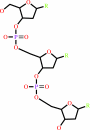 DNA(n)
|
+
|
2'-deoxyribonucleoside 5'-triphosphate
|
=
|
DNA(n+1)
|
+
|
 diphosphate
|
|
|
|
|
|
|
|
|
|
Enzyme class 2:
|
|
E.C.2.7.7.7
- DNA-directed Dna polymerase.
|
|
|
|
|
|
|
Reaction:
|
|
DNA(n) + a 2'-deoxyribonucleoside 5'-triphosphate = DNA(n+1) + diphosphate
|
|
|
|
|
|
DNA(n)
|
+
|
2'-deoxyribonucleoside 5'-triphosphate
|
=
|
DNA(n+1)
|
+
|
diphosphate
|
|
|
|
|
|
|
|
|
|
Enzyme class 3:
|
|
E.C.3.1.13.2
- exoribonuclease H.
|
|
|
|
|
|
|
Reaction:
|
|
Exonucleolytic cleavage to 5'-phosphomonoester oligonucleotides in both 5'- to 3'- and 3'- to 5'-directions.
|
|
|
|
|
|
Enzyme class 4:
|
|
E.C.3.1.26.13
- retroviral ribonuclease H.
|
|
|
|
|
|
|
Enzyme class 5:
|
|
E.C.3.4.23.16
- HIV-1 retropepsin.
|
|
|
|
|
|
|
Reaction:
|
|
Specific for a P1 residue that is hydrophobic, and P1' variable, but often Pro.
|
|
|
|
|
|
|
|
|
Note, where more than one E.C. class is given (as above), each may
correspond to a different protein domain or, in the case of polyprotein
precursors, to a different mature protein.
|
|
|
|
Molecule diagrams generated from .mol files obtained from the
KEGG ftp site
|
|
|
|
|
|
|
|
|
|
|
|
|
|
 |
|
|
|
|
|
|
| |
|
|
| |
|
DOI no:
|
Eur J Biochem
271:1516-1524
(2004)
|
|
PubMed id:
|
|
|
|
|
|
| |
|
Crystal structures of HIV protease V82A and L90M mutants reveal changes in the indinavir-binding site.
|
|
B.Mahalingam,
Y.F.Wang,
P.I.Boross,
J.Tozser,
J.M.Louis,
R.W.Harrison,
I.T.Weber.
|
|
|
|
|
| |
ABSTRACT
|
|
|
|
| |
|
|
The crystal structures of the wild-type HIV-1 protease (PR) and the two
resistant variants, PR(V82A) and PR(L90M), have been determined in complex with
the antiviral drug, indinavir, to gain insight into the molecular basis of drug
resistance. V82A and L90M correspond to an active site mutation and nonactive
site mutation, respectively. The inhibition (K(i)) of PR(V82A) and PR(L90M) was
3.3- and 0.16-fold, respectively, relative to the value for PR. They showed only
a modest decrease, of 10-15%, in their k(cat)/K(m) values relative to PR. The
crystal structures were refined to resolutions of 1.25-1.4 A to reveal critical
features associated with inhibitor resistance. PR(V82A) showed local changes in
residues 81-82 at the site of the mutation, while PR(L90M) showed local changes
near Met90 and an additional interaction with indinavir. These structural
differences concur with the kinetic data.
|
|
|
|
|
|
| |
Selected figure(s)
|
|
|
|
| |
|
|

|
|

|
|
Figure 3.
Fig. 3. Interaction of Met90'and Asp25' in PR[L90M]. (A)
The 2Fo–Fc electron density map showing Met90', Asp25' and
Thr26'in the PR[L90M] structure. The side chain of Met90' has
two conformations, and one conformation has a short separation
from the carbonyl oxygen of the catalytic Asp25'. (B) Comparison
of Met90' in PR[L90M] and Leu90' in the wild-type HIV-1 protease
(PR) relative to Asp25'. The PR residues are in black and the
PR[L90M] residues are in gray. Hydrogen bonds are indicated by
dashed lines, with the distances shown in Å.
|
|
Figure 6.
Fig. 6. Structural variation in residues 81–82 near
indinavir. Stereoview showing the benzyl group of indinavir
interacting with residues 81–82, using the major conformation
of Val82. The wild-type HIV-1 protease (PR) structure is in
black and the mutant is in gray bonds. Interatomic distances are
given in Å. (A) PR[V82A] superimposed on PR. (B) PR[L90M]
superimposed on PR.
|
|
|
|
|
|
| |
The above figures are
reprinted
by permission from the Federation of European Biochemical Societies:
Eur J Biochem
(2004,
271,
1516-1524)
copyright 2004.
|
|
| |
Figures were
selected
by an automated process.
|
|
|
|
|
|
|
|
|
|
|
|
|
|
|
|
 |
 |
 |
|
Literature references that cite this PDB file's key reference
|
|
|
| |
PubMed id
|
|
Reference
|
|
|
|
|
|
S.Karthik,
and
S.Senapati
(2011).
Dynamic flaps in HIV-1 protease adopt unique ordering at different stages in the catalytic cycle.
|
| |
Proteins,
79,
1830-1840.
|
|
|
|
|
|
|
C.H.Shen,
Y.F.Wang,
A.Y.Kovalevsky,
R.W.Harrison,
and
I.T.Weber
(2010).
Amprenavir complexes with HIV-1 protease and its drug-resistant mutants altering hydrophobic clusters.
|
| |
FEBS J,
277,
3699-3714.
|
|
|
PDB codes:
|
|
|
|
|
|
|
|
J.Zhang,
T.Hou,
W.Wang,
and
J.S.Liu
(2010).
Detecting and understanding combinatorial mutation patterns responsible for HIV drug resistance.
|
| |
Proc Natl Acad Sci U S A,
107,
1321-1326.
|
|
|
|
|
|
|
D.Das,
Y.Koh,
Y.Tojo,
A.K.Ghosh,
and
H.Mitsuya
(2009).
Prediction of potency of protease inhibitors using free energy simulations with polarizable quantum mechanics-based ligand charges and a hybrid water model.
|
| |
J Chem Inf Model,
49,
2851-2862.
|
|
|
|
|
|
|
C.Tang,
J.M.Louis,
A.Aniana,
J.Y.Suh,
and
G.M.Clore
(2008).
Visualizing transient events in amino-terminal autoprocessing of HIV-1 protease.
|
| |
Nature,
455,
693-696.
|
|
|
|
|
|
|
J.M.Sayer,
F.Liu,
R.Ishima,
I.T.Weber,
and
J.M.Louis
(2008).
Effect of the active site D25N mutation on the structure, stability, and ligand binding of the mature HIV-1 protease.
|
| |
J Biol Chem,
283,
13459-13470.
|
|
|
PDB codes:
|
|
|
|
|
|
|
|
C.Garriga,
M.J.Pérez-Elías,
R.Delgado,
L.Ruiz,
R.Nájera,
T.Pumarola,
M.d.e.l. .M.Alonso-Socas,
S.García-Bujalance,
and
L.Menéndez-Arias
(2007).
Mutational patterns and correlated amino acid substitutions in the HIV-1 protease after virological failure to nelfinavir- and lopinavir/ritonavir-based treatments.
|
| |
J Med Virol,
79,
1617-1628.
|
|
|
|
|
|
|
H.E.Klei,
K.Kish,
P.F.Lin,
Q.Guo,
J.Friborg,
R.E.Rose,
Y.Zhang,
V.Goldfarb,
D.R.Langley,
M.Wittekind,
and
S.Sheriff
(2007).
X-ray crystal structures of human immunodeficiency virus type 1 protease mutants complexed with atazanavir.
|
| |
J Virol,
81,
9525-9535.
|
|
|
PDB codes:
|
|
|
|
|
|
|
|
R.M.Coman,
A.Robbins,
M.M.Goodenow,
R.McKenna,
and
B.M.Dunn
(2007).
Expression, purification and preliminary X-ray crystallographic studies of the human immunodeficiency virus 1 subtype C protease.
|
| |
Acta Crystallogr Sect F Struct Biol Cryst Commun,
63,
320-323.
|
|
|
|
|
|
|
Y.F.Wang,
Y.Tie,
P.I.Boross,
J.Tozser,
A.K.Ghosh,
R.W.Harrison,
and
I.T.Weber
(2007).
Potent new antiviral compound shows similar inhibition and structural interactions with drug resistant mutants and wild type HIV-1 protease.
|
| |
J Med Chem,
50,
4509-4515.
|
|
|
PDB codes:
|
|
|
|
|
|
|
|
Y.Tie,
A.Y.Kovalevsky,
P.Boross,
Y.F.Wang,
A.K.Ghosh,
J.Tozser,
R.W.Harrison,
and
I.T.Weber
(2007).
Atomic resolution crystal structures of HIV-1 protease and mutants V82A and I84V with saquinavir.
|
| |
Proteins,
67,
232-242.
|
|
|
PDB codes:
|
|
|
|
|
|
|
|
A.Y.Kovalevsky,
F.Liu,
S.Leshchenko,
A.K.Ghosh,
J.M.Louis,
R.W.Harrison,
and
I.T.Weber
(2006).
Ultra-high resolution crystal structure of HIV-1 protease mutant reveals two binding sites for clinical inhibitor TMC114.
|
| |
J Mol Biol,
363,
161-173.
|
|
|
PDB codes:
|
|
|
|
|
|
|
|
A.Y.Kovalevsky,
Y.Tie,
F.Liu,
P.I.Boross,
Y.F.Wang,
S.Leshchenko,
A.K.Ghosh,
R.W.Harrison,
and
I.T.Weber
(2006).
Effectiveness of nonpeptide clinical inhibitor TMC-114 on HIV-1 protease with highly drug resistant mutations D30N, I50V, and L90M.
|
| |
J Med Chem,
49,
1379-1387.
|
|
|
PDB codes:
|
|
|
|
|
|
|
|
F.Liu,
P.I.Boross,
Y.F.Wang,
J.Tozser,
J.M.Louis,
R.W.Harrison,
and
I.T.Weber
(2005).
Kinetic, stability, and structural changes in high-resolution crystal structures of HIV-1 protease with drug-resistant mutations L24I, I50V, and G73S.
|
| |
J Mol Biol,
354,
789-800.
|
|
|
PDB codes:
|
|
|
|
|
|
|
|
Y.Tie,
P.I.Boross,
Y.F.Wang,
L.Gaddis,
F.Liu,
X.Chen,
J.Tozser,
R.W.Harrison,
and
I.T.Weber
(2005).
Molecular basis for substrate recognition and drug resistance from 1.1 to 1.6 angstroms resolution crystal structures of HIV-1 protease mutants with substrate analogs.
|
| |
FEBS J,
272,
5265-5277.
|
|
|
PDB codes:
|
|
|
|
|
|
|
The most recent references are shown first.
Citation data come partly from CiteXplore and partly
from an automated harvesting procedure. Note that this is likely to be
only a partial list as not all journals are covered by
either method. However, we are continually building up the citation data
so more and more references will be included with time.
Where a reference describes a PDB structure, the PDB
codes are
shown on the right.
|
|


 Links
Links


