
|
|
|
|
|
 |
Contents |
 |
|
|
|
|
|
|
|
|
|
|
|
|
* Residue conservation analysis
|
|
|
|
|
|
|
|
|
|
Enzyme class 1:
|
|
Chains A, B:
E.C.2.7.7.-
- ?????
|
|
|
|
|
|
|
Enzyme class 2:
|
|
Chains A, B:
E.C.2.7.7.49
- RNA-directed Dna polymerase.
|
|
|
|
|
|
|
Reaction:
|
|
DNA(n) + a 2'-deoxyribonucleoside 5'-triphosphate = DNA(n+1) + diphosphate
|
|
|
|
|
|
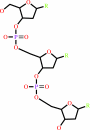 DNA(n)
|
+
|
2'-deoxyribonucleoside 5'-triphosphate
|
=
|
DNA(n+1)
|
+
|
 diphosphate
|
|
|
|
|
|
|
|
|
|
Enzyme class 3:
|
|
Chains A, B:
E.C.2.7.7.7
- DNA-directed Dna polymerase.
|
|
|
|
|
|
|
Reaction:
|
|
DNA(n) + a 2'-deoxyribonucleoside 5'-triphosphate = DNA(n+1) + diphosphate
|
|
|
|
|
|
DNA(n)
|
+
|
2'-deoxyribonucleoside 5'-triphosphate
|
=
|
DNA(n+1)
|
+
|
diphosphate
|
|
|
|
|
|
|
|
|
|
Enzyme class 4:
|
|
Chains A, B:
E.C.3.1.-.-
|
|
|
|
|
|
|
Enzyme class 5:
|
|
Chains A, B:
E.C.3.1.13.2
- exoribonuclease H.
|
|
|
|
|
|
|
Reaction:
|
|
Exonucleolytic cleavage to 5'-phosphomonoester oligonucleotides in both 5'- to 3'- and 3'- to 5'-directions.
|
|
|
|
|
|
Enzyme class 6:
|
|
Chains A, B:
E.C.3.1.26.13
- retroviral ribonuclease H.
|
|
|
|
|
|
|
Enzyme class 7:
|
|
Chains A, B:
E.C.3.4.23.47
- HIV-2 retropepsin.
|
|
|
|
|
|
|
|
|
|
Note, where more than one E.C. class is given (as above), each may
correspond to a different protein domain or, in the case of polyprotein
precursors, to a different mature protein.
|
|
|
|
Molecule diagrams generated from .mol files obtained from the
KEGG ftp site
|
|
|
|
|
|
|
|
|
|
|
|
|
|
 |
|
|
|
|
|
|
| |
|
|
| |
|
DOI no:
|
Proc Natl Acad Sci U S A
99:14410-14415
(2002)
|
|
PubMed id:
|
|
|
|
|
|
| |
|
Structure of HIV-2 reverse transcriptase at 2.35-A resolution and the mechanism of resistance to non-nucleoside inhibitors.
|
|
J.Ren,
L.E.Bird,
P.P.Chamberlain,
G.B.Stewart-Jones,
D.I.Stuart,
D.K.Stammers.
|
|
|
|
|
| |
ABSTRACT
|
|
|
|
| |
|
|
The HIV-2 serotype of HIV is a cause of disease in parts of the West African
population, and there is evidence for its spread to Europe and Asia. HIV-2
reverse transcriptase (RT) demonstrates an intrinsic resistance to
non-nucleoside RT inhibitors (NNRTIs), one of two classes of anti-AIDS drugs
that target the viral RT. We report the crystal structure of HIV-2 RT to 2.35 A
resolution, which reveals molecular details of the resistance to NNRTIs. HIV-2
RT has a similar overall fold to HIV-1 RT but has structural differences within
the "NNRTI pocket" at both conserved and nonconserved residues. The
structure points to the role of sequence differences that can give rise to
unfavorable inhibitor contacts or destabilization of part of the binding pocket
at positions 101, 106, 138, 181, 188, and 190. We also present evidence that the
conformation of Ile-181 compared with the HIV-1 Tyr-181 could be a significant
contributory factor to this inherent drug resistance of HIV-2 to NNRTIs. The
availability of a refined structure of HIV-2 RT will provide a stimulus for the
structure-based design of novel non-nucleoside inhibitors that could be used
against HIV-2 infection.
|
|
|
|
|
|
| |
Selected figure(s)
|
|
|
|
| |
|
|

|
|

|
|
Figure 2.
Fig 2. (A) Stereo diagram comparing the NNRTI site of an
unliganded HIV-1 RT and the corresponding region of HIV-2 RT.
The HIV-1 RT is colored in gray, and the main chain and side
chains of HIV-2 RT are shown in green and orange, respectively.
(B) Stereo diagram showing part of the HIV-2 RT p55 subunit
containing the Ile-181 and Leu-188 side chains (blue and green)
overlapped with the corresponding region of the p66 subunit in
the nevirapine-bound HIV-1 RT (orange and red). Nevirapine is
drawn as ball-and-sticks and colored by atoms. (C) Stereo
diagram showing a cavity located at the junction of the p68
palm, p68 connection, and p55 fingers domains (ribbon and coils
colored in green, red, and blue, respectively). Side chains of
the residues lining the cavity, a bound glycerol and a sulfate
are shown in ball-and-stick representation, and are colored by
atoms, with carbon atoms in cyan for the side chains and black
for the glycerol. Water molecules in the cavity are shown as
small red spheres. Larger red spheres label the C  position
of the three catalytic Asp residues at the polymerase active
site. Nevirapine colored in gray is shown to mark the NNRTI site
in HIV-1 RT. The dashed yellow sticks indicate the four H-bonds
from the glycerol to the carbonyl oxygen of Gly-99, the
main-chain nitrogen of Ala-101, and a water molecule. position
of the three catalytic Asp residues at the polymerase active
site. Nevirapine colored in gray is shown to mark the NNRTI site
in HIV-1 RT. The dashed yellow sticks indicate the four H-bonds
from the glycerol to the carbonyl oxygen of Gly-99, the
main-chain nitrogen of Ala-101, and a water molecule.
|
|
Figure 3.
Fig 3. Comparison of the structure around residues 181 and
188 of the p55 subunit in HIV-2 RT with that of p51 subunit in
HIV-1 RT. The main chains are shown as ribbons and coils, and
side chains as ball-and-stick representations, with HIV-1 RT
colored orange and red, and HIV-2 RT blue and green.
|
|
|
|
| |
Figures were
selected
by an automated process.
|
|
|
|
|
|
|
|
|
|
|
|
|
|
|
|
 |
 |
 |
|
Literature references that cite this PDB file's key reference
|
|
|
| |
PubMed id
|
|
Reference
|
|
|
|
|
|
S.Ibe,
and
W.Sugiura
(2011).
Clinical significance of HIV reverse-transcriptase inhibitor-resistance mutations.
|
| |
Future Microbiol,
6,
295-315.
|
|
|
|
|
|
|
A.Herschhorn,
and
A.Hizi
(2010).
Retroviral reverse transcriptases.
|
| |
Cell Mol Life Sci,
67,
2717-2747.
|
|
|
|
|
|
|
J.Drylewicz,
S.Eholie,
M.Maiga,
D.M.Zannou,
P.S.Sow,
D.K.Ekouevi,
K.Peterson,
E.Bissagnene,
F.Dabis,
R.Thiébaut,
F.Dabis,
C.Amani-Bosse,
F.O.Ba-Gomis,
E.Bissagnene,
M.Charurat,
E.Delaporte,
J.Drabo,
S.P.Eholie,
S.O.Koulé,
M.Maiga,
E.Messou,
A.Minga,
K.Peterson,
P.S.Sow,
H.Traoré,
M.D.Zannou,
G.Allou,
X.Anglaret,
A.Azondékon,
E.Balestre,
J.Bashi,
Ye-Diarra,
D.K.Ekouévi,
J.F.Eytard,
A.Jaquet,
A.Kouakoussui,
V.Leroy,
C.Lewden,
K.Malateste,
L.Renner,
A.Sasco,
H.S.Sy,
R.Thiébaut,
M.Timité-Konan,
and
H.Touré
(2010).
First-year lymphocyte T CD4+ response to antiretroviral therapy according to the HIV type in the IeDEA West Africa collaboration.
|
| |
AIDS,
24,
1043-1050.
|
|
|
|
|
|
|
K.Singh,
B.Marchand,
K.A.Kirby,
E.Michailidis,
and
S.G.Sarafianos
(2010).
Structural Aspects of Drug Resistance and Inhibition of HIV-1 Reverse Transcriptase.
|
| |
Viruses,
2,
606-638.
|
|
|
|
|
|
|
Q.Xu,
P.Abdubek,
T.Astakhova,
H.L.Axelrod,
C.Bakolitsa,
X.Cai,
D.Carlton,
C.Chen,
H.J.Chiu,
T.Clayton,
D.Das,
M.C.Deller,
L.Duan,
K.Ellrott,
C.L.Farr,
J.Feuerhelm,
J.C.Grant,
A.Grzechnik,
G.W.Han,
L.Jaroszewski,
K.K.Jin,
H.E.Klock,
M.W.Knuth,
P.Kozbial,
S.S.Krishna,
A.Kumar,
W.W.Lam,
D.Marciano,
M.D.Miller,
A.T.Morse,
E.Nigoghossian,
A.Nopakun,
L.Okach,
C.Puckett,
R.Reyes,
H.J.Tien,
C.B.Trame,
H.van den Bedem,
D.Weekes,
T.Wooten,
A.Yeh,
J.Zhou,
K.O.Hodgson,
J.Wooley,
M.A.Elsliger,
A.M.Deacon,
A.Godzik,
S.A.Lesley,
and
I.A.Wilson
(2010).
Structure of a membrane-attack complex/perforin (MACPF) family protein from the human gut symbiont Bacteroides thetaiotaomicron.
|
| |
Acta Crystallogr Sect F Struct Biol Cryst Commun,
66,
1297-1305.
|
|
|
PDB code:
|
|
|
|
|
|
|
|
Y.Gilleece,
D.R.Chadwick,
J.Breuer,
D.Hawkins,
E.Smit,
L.X.McCrae,
D.Pillay,
N.Smith,
J.Anderson,
J.Anderson,
Y.Gilleece,
J.Breuer,
D.Hawkins,
E.Smit,
L.X.McCrae,
D.Chadwick,
D.Pillay,
and
N.Smith
(2010).
British HIV Association guidelines for antiretroviral treatment of HIV-2-positive individuals 2010.
|
| |
HIV Med,
11,
611-619.
|
|
|
|
|
|
|
J.A.Bartlett,
and
J.F.Shao
(2009).
Successes, challenges, and limitations of current antiretroviral therapy in low-income and middle-income countries.
|
| |
Lancet Infect Dis,
9,
637-649.
|
|
|
|
|
|
|
M.L.Ntemgwa,
T.Toni,
B.G.Brenner,
M.Oliveira,
E.L.Asahchop,
D.Moisi,
and
M.A.Wainberg
(2009).
Nucleoside and nucleotide analogs select in culture for different patterns of drug resistance in human immunodeficiency virus types 1 and 2.
|
| |
Antimicrob Agents Chemother,
53,
708-715.
|
|
|
|
|
|
|
A.Hachiya,
E.N.Kodama,
S.G.Sarafianos,
M.M.Schuckmann,
Y.Sakagami,
M.Matsuoka,
M.Takiguchi,
H.Gatanaga,
and
S.Oka
(2008).
Amino acid mutation N348I in the connection subdomain of human immunodeficiency virus type 1 reverse transcriptase confers multiclass resistance to nucleoside and nonnucleoside reverse transcriptase inhibitors.
|
| |
J Virol,
82,
3261-3270.
|
|
|
|
|
|
|
A.J.Berdis
(2008).
DNA polymerases as therapeutic targets.
|
| |
Biochemistry,
47,
8253-8260.
|
|
|
|
|
|
|
D.Desbois,
B.Roquebert,
G.Peytavin,
F.Damond,
G.Collin,
A.Bénard,
P.Campa,
S.Matheron,
G.Chêne,
F.Brun-Vézinet,
and
D.Descamps
(2008).
In vitro phenotypic susceptibility of human immunodeficiency virus type 2 clinical isolates to protease inhibitors.
|
| |
Antimicrob Agents Chemother,
52,
1545-1548.
|
|
|
|
|
|
|
D.Grohmann,
V.Corradi,
M.Elbasyouny,
A.Baude,
F.Horenkamp,
S.D.Laufer,
F.Manetti,
M.Botta,
and
T.Restle
(2008).
Small molecule inhibitors targeting HIV-1 reverse transcriptase dimerization.
|
| |
Chembiochem,
9,
916-922.
|
|
|
|
|
|
|
G.S.Gottlieb,
S.P.Eholié,
J.N.Nkengasong,
S.Jallow,
S.Rowland-Jones,
H.C.Whittle,
and
P.S.Sow
(2008).
A call for randomized controlled trials of antiretroviral therapy for HIV-2 infection in West Africa.
|
| |
AIDS,
22,
2069.
|
|
|
|
|
|
|
J.Ruelle,
F.Roman,
A.T.Vandenbroucke,
C.Lambert,
K.Fransen,
F.Echahidi,
D.Piérard,
C.Verhofstede,
K.Van Laethem,
M.L.Delforge,
D.Vaira,
J.C.Schmit,
and
P.Goubau
(2008).
Transmitted drug resistance, selection of resistance mutations and moderate antiretroviral efficacy in HIV-2: analysis of the HIV-2 Belgium and Luxembourg database.
|
| |
BMC Infect Dis,
8,
21.
|
|
|
|
|
|
|
N.Garrett,
L.Xu,
E.Smit,
B.Ferns,
S.El-Gadi,
and
J.Anderson
(2008).
Raltegravir treatment response in an HIV-2 infected patient: a case report.
|
| |
AIDS,
22,
1091-1092.
|
|
|
|
|
|
|
P.A.Chan,
S.E.Wakeman,
T.Flanigan,
S.Cu-Uvin,
E.Kojic,
and
R.Kantor
(2008).
HIV-2 diagnosis and quantification in high-risk patients.
|
| |
AIDS Res Ther,
5,
18.
|
|
|
|
|
|
|
J.Ruelle,
M.Sanou,
H.F.Liu,
A.T.Vandenbroucke,
A.Duquenne,
and
P.Goubau
(2007).
Genetic polymorphisms and resistance mutations of HIV type 2 in antiretroviral-naive patients in Burkina Faso.
|
| |
AIDS Res Hum Retroviruses,
23,
955-964.
|
|
|
|
|
|
|
S.Yamazaki,
L.Tan,
G.Mayer,
J.S.Hartig,
J.N.Song,
S.Reuter,
T.Restle,
S.D.Laufer,
D.Grohmann,
H.G.Kräusslich,
J.Bajorath,
and
M.Famulok
(2007).
Aptamer displacement identifies alternative small-molecule target sites that escape viral resistance.
|
| |
Chem Biol,
14,
804-812.
|
|
|
|
|
|
|
A.Mescalchin,
W.Wünsche,
S.D.Laufer,
D.Grohmann,
T.Restle,
and
G.Sczakiel
(2006).
Specific binding of a hexanucleotide to HIV-1 reverse transcriptase: a novel class of bioactive molecules.
|
| |
Nucleic Acids Res,
34,
5631-5637.
|
|
|
|
|
|
|
P.L.Boyer,
S.G.Sarafianos,
P.K.Clark,
E.Arnold,
and
S.H.Hughes
(2006).
Why do HIV-1 and HIV-2 use different pathways to develop AZT resistance?
|
| |
PLoS Pathog,
2,
e10.
|
|
|
|
|
|
|
P.Colson,
M.Henry,
N.Tivoli,
H.Gallais,
J.A.Gastaut,
J.Moreau,
and
C.Tamalet
(2005).
Polymorphism and drug-selected mutations in the reverse transcriptase gene of HIV-2 from patients living in southeastern France.
|
| |
J Med Virol,
75,
381-390.
|
|
|
|
|
|
|
R.J.Hazen,
R.J.Harvey,
M.H.St Clair,
R.G.Ferris,
G.A.Freeman,
J.H.Tidwell,
L.T.Schaller,
J.R.Cowan,
S.A.Short,
K.R.Romines,
J.H.Chan,
and
L.R.Boone
(2005).
Anti-human immunodeficiency virus type 1 activity of the nonnucleoside reverse transcriptase inhibitor GW678248 in combination with other antiretrovirals against clinical isolate viruses and in vitro selection for resistance.
|
| |
Antimicrob Agents Chemother,
49,
4465-4473.
|
|
|
|
|
|
|
A.J.Marozsan,
E.Fraundorf,
A.Abraha,
H.Baird,
D.Moore,
R.Troyer,
I.Nankja,
and
E.J.Arts
(2004).
Relationships between infectious titer, capsid protein levels, and reverse transcriptase activities of diverse human immunodeficiency virus type 1 isolates.
|
| |
J Virol,
78,
11130-11141.
|
|
|
|
|
|
|
D.Das,
and
M.M.Georgiadis
(2004).
The crystal structure of the monomeric reverse transcriptase from Moloney murine leukemia virus.
|
| |
Structure,
12,
819-829.
|
|
|
PDB code:
|
|
|
|
|
|
|
|
J.Auwerx,
M.Stevens,
A.R.Van Rompay,
L.E.Bird,
J.Ren,
E.De Clercq,
B.Oberg,
D.K.Stammers,
A.Karlsson,
and
J.Balzarini
(2004).
The phenylmethylthiazolylthiourea nonnucleoside reverse transcriptase (RT) inhibitor MSK-076 selects for a resistance mutation in the active site of human immunodeficiency virus type 2 RT.
|
| |
J Virol,
78,
7427-7437.
|
|
|
|
|
|
|
P.Colson,
M.Henry,
C.Tourres,
D.Lozachmeur,
H.Gallais,
J.A.Gastaut,
J.Moreau,
and
C.Tamalet
(2004).
Polymorphism and drug-selected mutations in the protease gene of human immunodeficiency virus type 2 from patients living in Southern France.
|
| |
J Clin Microbiol,
42,
570-577.
|
|
|
|
|
|
|
Y.TakebE,
S.Kusagawa,
and
K.Motomura
(2004).
Molecular epidemiology of HIV: tracking AIDS pandemic.
|
| |
Pediatr Int,
46,
236-244.
|
|
|
|
|
|
|
Z.Ambrose,
V.Boltz,
S.Palmer,
J.M.Coffin,
S.H.Hughes,
and
V.N.Kewalramani
(2004).
In vitro characterization of a simian immunodeficiency virus-human immunodeficiency virus (HIV) chimera expressing HIV type 1 reverse transcriptase to study antiviral resistance in pigtail macaques.
|
| |
J Virol,
78,
13553-13561.
|
|
|
|
|
|
|
K.Post,
J.Guo,
K.J.Howard,
M.D.Powell,
J.T.Miller,
A.Hizi,
S.F.Le Grice,
and
J.G.Levin
(2003).
Human immunodeficiency virus type 2 reverse transcriptase activity in model systems that mimic steps in reverse transcription.
|
| |
J Virol,
77,
7623-7634.
|
|
|
|
|
|
|
Z.Sevilya,
S.Loya,
N.Adir,
and
A.Hizi
(2003).
The ribonuclease H activity of the reverse transcriptases of human immunodeficiency viruses type 1 and type 2 is modulated by residue 294 of the small subunit.
|
| |
Nucleic Acids Res,
31,
1481-1487.
|
|
|
|
|
|
The most recent references are shown first.
Citation data come partly from CiteXplore and partly
from an automated harvesting procedure. Note that this is likely to be
only a partial list as not all journals are covered by
either method. However, we are continually building up the citation data
so more and more references will be included with time.
Where a reference describes a PDB structure, the PDB
code is
shown on the right.
|
 |


 Links
Links


