 |
PDBsum entry 1hpx

|
|
|
|
|
|

|

|

|

|
|

|
|

|
|

|
|

|
|

|
|
|
 |

|

|
|
|
|
|
|
|
|
|
|
|
|
|
|
|
|
|
|
|
|
|
|
|
|
|
|
|
|
|
|
|
|
|
|
Hydrolase/hydrolase inhibitor
|
PDB id
|
|
|
|
1hpx
|
|
|
|
|
|
|
|
|
|
|
|
|
|
|

|

|

|
|
|
|
|
|
|
|
 |
Contents |
 |
|
|
|
|
|
|
|
|
|
|
|
|
* Residue conservation analysis
|
|
|
|
|
|
|
|
|
|
|
Enzyme class 1:
|
|
E.C.2.7.7.-
- ?????
|
|
|
|
|
|
|
Enzyme class 2:
|
|
E.C.2.7.7.49
- RNA-directed Dna polymerase.
|
|
|
|
|
|
|
Reaction:
|
|
DNA(n) + a 2'-deoxyribonucleoside 5'-triphosphate = DNA(n+1) + diphosphate
|
|
|
|
|
|
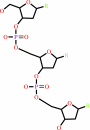 DNA(n)
|
+
|
2'-deoxyribonucleoside 5'-triphosphate
|
=
|
DNA(n+1)
|
+
|
 diphosphate
|
|
|
|
|
|
|
|
|
|
Enzyme class 3:
|
|
E.C.2.7.7.7
- DNA-directed Dna polymerase.
|
|
|
|
|
|
|
Reaction:
|
|
DNA(n) + a 2'-deoxyribonucleoside 5'-triphosphate = DNA(n+1) + diphosphate
|
|
|
|
|
|
DNA(n)
|
+
|
2'-deoxyribonucleoside 5'-triphosphate
|
=
|
DNA(n+1)
|
+
|
diphosphate
|
|
|
|
|
|
|
|
|
|
Enzyme class 4:
|
|
E.C.3.1.-.-
|
|
|
|
|
|
|
Enzyme class 5:
|
|
E.C.3.1.13.2
- exoribonuclease H.
|
|
|
|
|
|
|
Reaction:
|
|
Exonucleolytic cleavage to 5'-phosphomonoester oligonucleotides in both 5'- to 3'- and 3'- to 5'-directions.
|
|
|
|
|
|
Enzyme class 6:
|
|
E.C.3.1.26.13
- retroviral ribonuclease H.
|
|
|
|
|
|
|
Enzyme class 7:
|
|
E.C.3.4.23.16
- HIV-1 retropepsin.
|
|
|
|
|
|
|
Reaction:
|
|
Specific for a P1 residue that is hydrophobic, and P1' variable, but often Pro.
|
|
|
|
|
|
|
|
|
Note, where more than one E.C. class is given (as above), each may
correspond to a different protein domain or, in the case of polyprotein
precursors, to a different mature protein.
|
|
|
|
Molecule diagrams generated from .mol files obtained from the
KEGG ftp site
|
|
|
|
|
|
|
|
|
|
|
|
|
|
 |
|
|
|
|
|
|
| |
|
|
| |
|
DOI no:
|
Structure
3:581-590
(1995)
|
|
PubMed id:
|
|
|
|
|
|
| |
|
Structure of HIV-1 protease with KNI-272, a tight-binding transition-state analog containing allophenylnorstatine.
|
|
E.T.Baldwin,
T.N.Bhat,
S.Gulnik,
B.Liu,
I.A.Topol,
Y.Kiso,
T.Mimoto,
H.Mitsuya,
J.W.Erickson.
|
|
|
|
|
| |
ABSTRACT
|
|
|
|
| |
|
|
BACKGROUND: HIV-1 protease (HIV PR), an aspartic protease, cleaves Phe-Pro bonds
in the Gag and Gag-Pol viral polyproteins. Substrate-based peptide mimics
constitute a major class of inhibitors of HIV PR presently being developed for
AIDS treatment. One such compound, KNI-272, which incorporates
allophenylnorstatine (Apns)-thioproline (Thp) in place of Phe-Pro, has potent
antiviral activity and is undergoing clinical trials. The structure of the
enzyme-inhibitor complex should lead to an understanding of the structural basis
for its tight binding properties and provide a framework for interpreting the
emerging resistance to this drug. RESULTS: The three-dimensional crystal
structure of KNI-272 bound to HIV PR has been determined to 2.0 A resolution and
used to analyze structure-activity data and drug resistance for the
Arg8-->Gln and ILe84-->Val mutations in HIV PR. The conformationally
constrained Apns-Thp linkage is favorably recognized in its low energy trans
conformation, which results in a symmetric mode of binding to the active-site
aspartic acids and also explains the unusual preference of HIV PR for the S, or
syn, hydroxyl group of the Apns residue. The inhibitor recognizes the enzyme via
hydrogen bonds to three bridging water molecules, including one that is
coordinated directly to the catalytic Asp125 residue. CONCLUSIONS: The structure
of the HIV PR/KNI-272 complex illustrates the importance of limiting the
conformational degrees of freedom and of using protein-bound water molecules for
building potent inhibitors. The binding mode of HIV PR inhibitors can be
predicted from the stereochemical relationship between adjacent hydroxyl-bearing
and side chain bearing carbon atoms of the P1 substituent. Our structure also
provides a framework for designing analogs targeted to drug-resistant mutant
enzymes.
|
|
|
|
|
|
| |
Selected figure(s)
|
|
|
|
| |
|
|

|
|

|
|
Figure 5.
Figure 5. View of the active site showing the symmetric mode of
core binding for KNI-272. Bridging water molecules (red
spheres) are observed in the S3 and S3′ subsites; these waters
appear to stabilize the structure of the active-site pocket
while also providing flexibility. Atoms are colored by type;
carbons for the enzyme and inhibitor are pink and white,
respectively. Figure 5. View of the active site showing the
symmetric mode of core binding for KNI-272. Bridging water
molecules (red spheres) are observed in the S3 and S3′
subsites; these waters appear to stabilize the structure of the
active-site pocket while also providing flexibility. Atoms are
colored by type; carbons for the enzyme and inhibitor are pink
and white, respectively.
|
|
Figure 8.
Figure 8. Comparison of modeled epimer (R-hydroxyl) of
KNI-272 (blue) with the anti conformers epi-Ro-31-8959 (yellow)
and A-77003 (white). Nitrogen, oxygen and sulfur atoms are
colored by type. (a) Comparison of all three. (b) Comparison of
epi-KNI-272 and epi-Ro-31-8959 only. Figure 8. Comparison
of modeled epimer (R-hydroxyl) of KNI-272 (blue) with the anti
conformers epi-Ro-31-8959 (yellow) and A-77003 (white).
Nitrogen, oxygen and sulfur atoms are colored by type. (a)
Comparison of all three. (b) Comparison of epi-KNI-272 and
epi-Ro-31-8959 only.
|
|
|
|
|
|
| |
The above figures are
reprinted
by permission from Cell Press:
Structure
(1995,
3,
581-590)
copyright 1995.
|
|
| |
Figures were
selected
by an automated process.
|
|
|
|
|
|
|
|
|
|
|
|
|
|
|
|
 |
 |
 |
|
Literature references that cite this PDB file's key reference
|
|
|
| |
PubMed id
|
|
Reference
|
|
|
|
|
|
C.Gao,
M.S.Park,
and
H.A.Stern
(2010).
Accounting for ligand conformational restriction in calculations of protein-ligand binding affinities.
|
| |
Biophys J,
98,
901-910.
|
|
|
|
|
|
|
D.M.Krüger,
and
A.Evers
(2010).
Comparison of structure- and ligand-based virtual screening protocols considering hit list complementarity and enrichment factors.
|
| |
ChemMedChem,
5,
148-158.
|
|
|
|
|
|
|
D.Boda,
M.Valiskó,
D.Henderson,
D.Gillespie,
B.Eisenberg,
and
M.K.Gilson
(2009).
Ions and inhibitors in the binding site of HIV protease: comparison of Monte Carlo simulations and the linearized Poisson-Boltzmann theory.
|
| |
Biophys J,
96,
1293-1306.
|
|
|
|
|
|
|
H.Fan,
J.J.Irwin,
B.M.Webb,
G.Klebe,
B.K.Shoichet,
and
A.Sali
(2009).
Molecular docking screens using comparative models of proteins.
|
| |
J Chem Inf Model,
49,
2512-2527.
|
|
|
|
|
|
|
D.C.Bas,
D.M.Rogers,
and
J.H.Jensen
(2008).
Very fast prediction and rationalization of pKa values for protein-ligand complexes.
|
| |
Proteins,
73,
765-783.
|
|
|
|
|
|
|
H.Matsumura,
M.Adachi,
S.Sugiyama,
S.Okada,
M.Yamakami,
T.Tamada,
K.Hidaka,
Y.Hayashi,
T.Kimura,
Y.Kiso,
T.Kitatani,
S.Maki,
H.Y.Yoshikawa,
H.Adachi,
K.Takano,
S.Murakami,
T.Inoue,
R.Kuroki,
and
Y.Mori
(2008).
Crystallization and preliminary neutron diffraction studies of HIV-1 protease cocrystallized with inhibitor KNI-272.
|
| |
Acta Crystallogr Sect F Struct Biol Cryst Commun,
64,
1003-1006.
|
|
|
|
|
|
|
J.T.Nguyen,
Y.Hamada,
T.Kimura,
and
Y.Kiso
(2008).
Design of potent aspartic protease inhibitors to treat various diseases.
|
| |
Arch Pharm (Weinheim),
341,
523-535.
|
|
|
|
|
|
|
N.Kaushik-Basu,
A.Basu,
and
D.Harris
(2008).
Peptide inhibition of HIV-1: current status and future potential.
|
| |
BioDrugs,
22,
161-175.
|
|
|
|
|
|
|
Z.Li,
and
T.Lazaridis
(2007).
Water at biomolecular binding interfaces.
|
| |
Phys Chem Chem Phys,
9,
573-581.
|
|
|
|
|
|
|
H.B.Thorsteinsdottir,
T.Schwede,
V.Zoete,
and
M.Meuwly
(2006).
How inaccuracies in protein structure models affect estimates of protein-ligand interactions: computational analysis of HIV-I protease inhibitor binding.
|
| |
Proteins,
65,
407-423.
|
|
|
|
|
|
|
M.D.Prasanna,
J.Vondrasek,
A.Wlodawer,
H.Rodriguez,
and
T.N.Bhat
(2006).
Chemical compound navigator: a web-based chem-BLAST, chemical taxonomy-based search engine for browsing compounds.
|
| |
Proteins,
63,
907-917.
|
|
|
|
|
|
|
M.Prabu-Jeyabalan,
E.A.Nalivaika,
K.Romano,
and
C.A.Schiffer
(2006).
Mechanism of substrate recognition by drug-resistant human immunodeficiency virus type 1 protease variants revealed by a novel structural intermediate.
|
| |
J Virol,
80,
3607-3616.
|
|
|
PDB codes:
|
|
|
|
|
|
|
|
N.P.Todorov,
C.L.Buenemann,
and
I.L.Alberts
(2006).
De novo ligand design to an ensemble of protein structures.
|
| |
Proteins,
64,
43-59.
|
|
|
|
|
|
|
H.Li,
A.D.Robertson,
and
J.H.Jensen
(2005).
Very fast empirical prediction and rationalization of protein pKa values.
|
| |
Proteins,
61,
704-721.
|
|
|
|
|
|
|
K.Wittayanarakul,
O.Aruksakunwong,
S.Saen-oon,
W.Chantratita,
V.Parasuk,
P.Sompornpisut,
and
S.Hannongbua
(2005).
Insights into saquinavir resistance in the G48V HIV-1 protease: quantum calculations and molecular dynamic simulations.
|
| |
Biophys J,
88,
867-879.
|
|
|
|
|
|
|
M.Lepsík,
Z.Kríz,
and
Z.Havlas
(2004).
Efficiency of a second-generation HIV-1 protease inhibitor studied by molecular dynamics and absolute binding free energy calculations.
|
| |
Proteins,
57,
279-293.
|
|
|
|
|
|
|
H.Ohtaka,
A.Schön,
and
E.Freire
(2003).
Multidrug resistance to HIV-1 protease inhibition requires cooperative coupling between distal mutations.
|
| |
Biochemistry,
42,
13659-13666.
|
|
|
|
|
|
|
S.Sirois,
E.I.Proynov,
J.F.Truchon,
C.M.Tsoukas,
and
D.R.Salahub
(2003).
A density functional study of the hydrogen-bond network within the HIV-1 protease catalytic site cleft.
|
| |
J Comput Chem,
24,
1110-1119.
|
|
|
|
|
|
|
A.Fehér,
I.T.Weber,
P.Bagossi,
P.Boross,
B.Mahalingam,
J.M.Louis,
T.D.Copeland,
I.Y.Torshin,
R.W.Harrison,
and
J.Tözsér
(2002).
Effect of sequence polymorphism and drug resistance on two HIV-1 Gag processing sites.
|
| |
Eur J Biochem,
269,
4114-4120.
|
|
|
|
|
|
|
K.Yoshimura,
R.Kato,
M.F.Kavlick,
A.Nguyen,
V.Maroun,
K.Maeda,
K.A.Hussain,
A.K.Ghosh,
S.V.Gulnik,
J.W.Erickson,
and
H.Mitsuya
(2002).
A potent human immunodeficiency virus type 1 protease inhibitor, UIC-94003 (TMC-126), and selection of a novel (A28S) mutation in the protease active site.
|
| |
J Virol,
76,
1349-1358.
|
|
|
|
|
|
|
M.Prabu-Jeyabalan,
E.Nalivaika,
and
C.A.Schiffer
(2002).
Substrate shape determines specificity of recognition for HIV-1 protease: analysis of crystal structures of six substrate complexes.
|
| |
Structure,
10,
369-381.
|
|
|
PDB codes:
|
|
|
|
|
|
|
|
R.Luo,
L.David,
and
M.K.Gilson
(2002).
Accelerated Poisson-Boltzmann calculations for static and dynamic systems.
|
| |
J Comput Chem,
23,
1244-1253.
|
|
|
|
|
|
|
R.W.Shafer
(2002).
Genotypic testing for human immunodeficiency virus type 1 drug resistance.
|
| |
Clin Microbiol Rev,
15,
247-277.
|
|
|
|
|
|
|
V.Kairys,
and
M.K.Gilson
(2002).
Enhanced docking with the mining minima optimizer: acceleration and side-chain flexibility.
|
| |
J Comput Chem,
23,
1656-1670.
|
|
|
|
|
|
|
A.Velazquez-Campoy,
I.Luque,
M.J.Todd,
M.Milutinovich,
Y.Kiso,
and
E.Freire
(2000).
Thermodynamic dissection of the binding energetics of KNI-272, a potent HIV-1 protease inhibitor.
|
| |
Protein Sci,
9,
1801-1809.
|
|
|
|
|
|
|
K.Ikuta,
S.Suzuki,
H.Horikoshi,
T.Mukai,
and
R.B.Luftig
(2000).
Positive and negative aspects of the human immunodeficiency virus protease: development of inhibitors versus its role in AIDS pathogenesis.
|
| |
Microbiol Mol Biol Rev,
64,
725-745.
|
|
|
|
|
|
|
J.Trylska,
J.Antosiewicz,
M.Geller,
C.N.Hodge,
R.M.Klabe,
M.S.Head,
and
M.K.Gilson
(1999).
Thermodynamic linkage between the binding of protons and inhibitors to HIV-1 protease.
|
| |
Protein Sci,
8,
180-195.
|
|
|
|
|
|
|
K.Yoshimura,
R.Kato,
K.Yusa,
M.F.Kavlick,
V.Maroun,
A.Nguyen,
T.Mimoto,
T.Ueno,
M.Shintani,
J.Falloon,
H.Masur,
H.Hayashi,
J.Erickson,
and
H.Mitsuya
(1999).
JE-2147: a dipeptide protease inhibitor (PI) that potently inhibits multi-PI-resistant HIV-1.
|
| |
Proc Natl Acad Sci U S A,
96,
8675-8680.
|
|
|
|
|
|
|
R.Ishima,
D.I.Freedberg,
Y.X.Wang,
J.M.Louis,
and
D.A.Torchia
(1999).
Flap opening and dimer-interface flexibility in the free and inhibitor-bound HIV protease, and their implications for function.
|
| |
Structure,
7,
1047-1055.
|
|
|
|
|
|
|
S.Kurihara,
T.Tsumuraya,
and
I.Fujii
(1999).
Structure-based design of diaminopyranosides as a novel inhibitor core unit of HIV proteases.
|
| |
Bioorg Med Chem Lett,
9,
1179-1184.
|
|
|
|
|
|
|
Y.Kiso,
H.Matsumoto,
S.Mizumoto,
T.Kimura,
Y.Fujiwara,
and
K.Akaji
(1999).
Small dipeptide-based HIV protease inhibitors containing the hydroxymethylcarbonyl isostere as an ideal transition-state mimic.
|
| |
Biopolymers,
51,
59-68.
|
|
|
|
|
|
|
E.M.Towler,
S.V.Gulnik,
T.N.Bhat,
D.Xie,
E.Gustschina,
T.R.Sumpter,
N.Robertson,
C.Jones,
M.Sauter,
N.Mueller-Lantzsch,
C.Debouck,
and
J.W.Erickson
(1998).
Functional characterization of the protease of human endogenous retrovirus, K10: can it complement HIV-1 protease?
|
| |
Biochemistry,
37,
17137-17144.
|
|
|
|
|
|
|
S.W.Rick,
I.A.Topol,
J.W.Erickson,
and
S.K.Burt
(1998).
Molecular mechanisms of resistance: free energy calculations of mutation effects on inhibitor binding to HIV-1 protease.
|
| |
Protein Sci,
7,
1750-1756.
|
|
|
|
|
|
|
R.S.Randad,
L.Lubkowska,
A.M.Silva,
D.M.Guerin,
S.V.Gulnik,
B.Yu,
and
J.W.Erickson
(1996).
Structure-based design of achiral, nonpeptidic hydroxybenzamide as a novel P2/P2' replacement for the symmetry-based HIV protease inhibitors.
|
| |
Bioorg Med Chem,
4,
1471-1480.
|
|
|
|
|
|
|
Y.Kiso
(1996).
Design and synthesis of substrate-based peptidomimetic human immunodeficiency virus protease inhibitors containing the hydroxymethylcarbonyl isostere.
|
| |
Biopolymers,
40,
235-244.
|
|
|
|
|
|
|
Y.Ohno,
Y.Kiso,
and
Y.Kobayashi
(1996).
Solution conformations of KNI-272, a tripeptide HIV protease inhibitor designed on the basis of substrate transition state: determined by NMR spectroscopy and simulated annealing calculations.
|
| |
Bioorg Med Chem,
4,
1565-1572.
|
|
|
|
|
|
|
Y.X.Wang,
D.I.Freedberg,
S.Grzesiek,
D.A.Torchia,
P.T.Wingfield,
J.D.Kaufman,
S.J.Stahl,
C.H.Chang,
and
C.N.Hodge
(1996).
Mapping hydration water molecules in the HIV-1 protease/DMP323 complex in solution by NMR spectroscopy.
|
| |
Biochemistry,
35,
12694-12704.
|
|
|
|
|
|
|
Y.X.Wang,
D.I.Freedberg,
T.Yamazaki,
P.T.Wingfield,
S.J.Stahl,
J.D.Kaufman,
Y.Kiso,
and
D.A.Torchia
(1996).
Solution NMR evidence that the HIV-1 protease catalytic aspartyl groups have different ionization states in the complex formed with the asymmetric drug KNI-272.
|
| |
Biochemistry,
35,
9945-9950.
|
|
|
|
|
|
|
S.Chokekijchai,
E.Kojima,
S.Anderson,
M.Nomizu,
M.Tanaka,
M.Machida,
T.Date,
K.Toyota,
S.Ishida,
and
K.Watanabe
(1995).
NP-06: a novel anti-human immunodeficiency virus polypeptide produced by a Streptomyces species.
|
| |
Antimicrob Agents Chemother,
39,
2345-2347.
|
|
|
|
|
|
The most recent references are shown first.
Citation data come partly from CiteXplore and partly
from an automated harvesting procedure. Note that this is likely to be
only a partial list as not all journals are covered by
either method. However, we are continually building up the citation data
so more and more references will be included with time.
Where a reference describes a PDB structure, the PDB
codes are
shown on the right.
|
|


 Links
Links


