 |
PDBsum entry 6ctl

|
|
|
|
|
|

|

|

|

|
|

|
|

|
|

|
|

|
|

|
|

|
|

|
|
|
 |

|

|
|
|
|
|
|
|
|
|
|
|
|
|
|
|
|
|
|
|
|
|
|
|
|
|
|
|
|
|
|
|
|
|
|
|
|
Transcription/DNA
|
PDB id
|
|
|
|
6ctl
|
|
|
|
|
|
|
|
|
|
|
|
|
|
|

|

|

|
|
|
|
|
|
|
|
|
Enzyme class 1:
|
|
E.C.2.7.7.7
- DNA-directed Dna polymerase.
|
|
|
|
|
|
|
Reaction:
|
|
DNA(n) + a 2'-deoxyribonucleoside 5'-triphosphate = DNA(n+1) + diphosphate
|
|
|
|
|
|
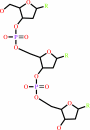 DNA(n)
|
+
|
2'-deoxyribonucleoside 5'-triphosphate
|
=
|
DNA(n+1)
|
+
|
 diphosphate
|
|
|
|
|
|
|
|
|
|
Enzyme class 2:
|
|
E.C.4.2.99.-
- ?????
|
|
|
|
|
|
|
Enzyme class 3:
|
|
E.C.4.2.99.18
- DNA-(apurinic or apyrimidinic site) lyase.
|
|
|
|
|
|
|
Reaction:
|
|
2'-deoxyribonucleotide-(2'-deoxyribose 5'-phosphate)- 2'-deoxyribonucleotide-DNA = a 3'-end 2'-deoxyribonucleotide-(2,3- dehydro-2,3-deoxyribose 5'-phosphate)-DNA + a 5'-end 5'-phospho- 2'-deoxyribonucleoside-DNA + H+
|
|
|
|
|
|
|
|
|
Note, where more than one E.C. class is given (as above), each may
correspond to a different protein domain or, in the case of polyprotein
precursors, to a different mature protein.
|
|
|
|
Molecule diagrams generated from .mol files obtained from the
KEGG ftp site
|
|
|
|
|
|
|
|
|
|
|
|
|
|
 |
|
|
|
|
|
|
| |
|
|
| |
|
DOI no:
|
Biochemistry
57:3934-3944
(2018)
|
|
PubMed id:
|
|
|
|
|
|
| |
|
Mapping Functional Substrate-Enzyme Interactions in the pol β Active Site through Chemical Biology: Structural Responses to Acidity Modification of Incoming dNTPs.
|
|
V.K.Batra,
K.Oertell,
W.A.Beard,
B.A.Kashemirov,
C.E.McKenna,
M.F.Goodman,
S.H.Wilson.
|
|
|
|
|
| |
ABSTRACT
|
|
|
|
| |
|
|
We report high-resolution crystal structures of DNA polymerase (pol) β in
ternary complex with a panel of incoming dNTPs carrying acidity-modified
5'-triphosphate groups. These novel dNTP analogues have a variety of
halomethylene substitutions replacing the bridging oxygen between Pβ and Pγ of
the incoming dNTP, whereas other analogues have alkaline substitutions at the
bridging oxygen. Use of these analogues allows the first systematic comparison
of effects of 5'-triphosphate acidity modification on active site structures and
the rate constant of DNA synthesis. These ternary complex structures with
incoming dATP, dTTP, and dCTP analogues reveal the enzyme's active site is not
grossly altered by the acidity modifications of the triphosphate group, yet with
analogues of all three incoming dNTP bases, subtle structural differences are
apparent in interactions around the nascent base pair and at the guanidinium
groups of active site arginine residues. These results are important for
understanding how acidity modification of the incoming dNTP's 5'-triphosphate
can influence DNA polymerase activity and the significance of interactions at
arginines 183 and 149 in the active site.
|
|
|
|
|
|
|
|
|
|
|
|
|
|
|
|
|
|
 |
 |
 |
|


 Links
Links


