|
PDBsum entry 5u8h

|
|
|
|
|
|

|

|

|

|
|

|
|

|
|

|
|

|
|

|
|

|
|
|
 |

|

|
|
|
|
|
|
|
|
|
|
|
|
|
|
|
|
|
|
|
|
|
|
|
|
|
|
|
|
|
|
|
|
|
|
|
Transferase,lyase/DNA
|
PDB id
|
|
|
|
5u8h
|
|
|
|
|
|
|
|
|
|
|
|
|
|
|

|

|

|
|
|
|
|
|
|
|
|
Enzyme class 1:
|
|
E.C.2.7.7.7
- DNA-directed Dna polymerase.
|
|
|
|
|
|
|
Reaction:
|
|
DNA(n) + a 2'-deoxyribonucleoside 5'-triphosphate = DNA(n+1) + diphosphate
|
|
|
|
|
|
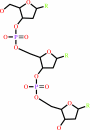 DNA(n)
|
+
|
2'-deoxyribonucleoside 5'-triphosphate
|
=
|
DNA(n+1)
|
+
|
 diphosphate
|
|
|
|
|
|
|
|
|
|
Enzyme class 2:
|
|
E.C.4.2.99.-
- ?????
|
|
|
|
|
|
|
Enzyme class 3:
|
|
E.C.4.2.99.18
- DNA-(apurinic or apyrimidinic site) lyase.
|
|
|
|
|
|
|
Reaction:
|
|
2'-deoxyribonucleotide-(2'-deoxyribose 5'-phosphate)- 2'-deoxyribonucleotide-DNA = a 3'-end 2'-deoxyribonucleotide-(2,3- dehydro-2,3-deoxyribose 5'-phosphate)-DNA + a 5'-end 5'-phospho- 2'-deoxyribonucleoside-DNA + H+
|
|
|
|
|
|
|
|
|
Note, where more than one E.C. class is given (as above), each may
correspond to a different protein domain or, in the case of polyprotein
precursors, to a different mature protein.
|
|
|
|
Molecule diagrams generated from .mol files obtained from the
KEGG ftp site
|
|
|
|
|
|
|
|
|
|
|
|
|
|
 |
|
|
|
|
|
|
| |
|
|
| |
|
|
Biochemistry
56:2363-2371
(2017)
|
|
PubMed id:
|
|
|
|
|
|
| |
|
Remote Mutations Induce Functional Changes in Active Site Residues of Human DNA Polymerase β.
|
|
B.E.Eckenroth,
J.B.Towle-Weicksel,
A.A.Nemec,
D.L.Murphy,
J.B.Sweasy,
S.Doublié.
|
|
|
|
|
| |
ABSTRACT
|
|
|
|
| |
|
|
With the formidable growth in the volume of genetic information, it has become
essential to identify and characterize mutations in macromolecules not only to
predict contributions to disease processes but also to guide the design of
therapeutic strategies. While mutations of certain residues have a predictable
phenotype based on their chemical nature and known structural position, many
types of mutations evade prediction based on current information. Described in
this work are the crystal structures of two cancer variants located in the palm
domain of DNA polymerase β (pol β), S229L and G231D, whose biological
phenotype was not readily linked to a predictable structural implication.
Structural results demonstrate that the mutations elicit their effect through
subtle influences on secondary interactions with a residue neighboring the
active site. Residues 229 and 231 are 7.5 and 12.5 Å, respectively, from the
nearest active site residue, with a β-strand between them. A residue on this
intervening strand, M236, appears to transmit fine structural perturbations to
the catalytic metal-coordinating residue D256, affecting its conformational
stability.
|
|
|
|
|
|
|
|
|
|
|
|
|
|
|
|
|
|
 |
 |
 |
|


 Links
Links