 |
PDBsum entry 5frm

|
|
|
|
|
|

|

|

|

|
|

|
|

|
|

|
|

|
|

|
|

|
|

|
|

|
|
|
 |

|

|
|
|
|
|
|
|
|
|
|
|
|
|
|
|
|
|
|
|
|
|
|
|
|
|
|
|
|
|
|
|
|
|
|
|
|
|
Recombination
|
PDB id
|
|
|
|
5frm
|
|
|
|
|
|
|
|
|
|
|
|
|
|
|

|

|

|
|
|
|
|
|
|
|
|
|
|
Enzyme class 2:
|
|
Chains A, B:
E.C.2.7.7.-
- ?????
|
|
|
|
|
|
|
Enzyme class 3:
|
|
Chains A, B:
E.C.2.7.7.49
- RNA-directed Dna polymerase.
|
|
|
|
|
|
|
Reaction:
|
|
DNA(n) + a 2'-deoxyribonucleoside 5'-triphosphate = DNA(n+1) + diphosphate
|
|
|
|
|
|
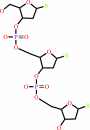 DNA(n)
|
+
|
2'-deoxyribonucleoside 5'-triphosphate
|
=
|
DNA(n+1)
|
+
|
 diphosphate
|
|
|
|
|
|
|
|
|
|
Enzyme class 4:
|
|
Chains A, B:
E.C.2.7.7.7
- DNA-directed Dna polymerase.
|
|
|
|
|
|
|
Reaction:
|
|
DNA(n) + a 2'-deoxyribonucleoside 5'-triphosphate = DNA(n+1) + diphosphate
|
|
|
|
|
|
DNA(n)
|
+
|
2'-deoxyribonucleoside 5'-triphosphate
|
=
|
DNA(n+1)
|
+
|
diphosphate
|
|
|
|
|
|
|
|
|
|
Enzyme class 5:
|
|
Chains A, B:
E.C.3.1.-.-
|
|
|
|
|
|
|
Enzyme class 6:
|
|
Chains A, B:
E.C.3.1.26.4
- ribonuclease H.
|
|
|
|
|
|
|
Reaction:
|
|
Endonucleolytic cleavage to 5'-phosphomonoester.
|
|
|
|
|
|
Enzyme class 7:
|
|
Chains A, B:
E.C.3.4.23.-
- ?????
|
|
|
|
|
|
|
|
|
|
Note, where more than one E.C. class is given (as above), each may
correspond to a different protein domain or, in the case of polyprotein
precursors, to a different mature protein.
|
|
|
|
Molecule diagrams generated from .mol files obtained from the
KEGG ftp site
|
|
|
|
|
|
|
|
|
|
|
|
|
|
 |
|
|
|
|
|
|
| |
|
|
| |
|
DOI no:
|
Acs Chem Biol
11:1074-1081
(2016)
|
|
PubMed id:
|
|
|
|
|
|
| |
|
HIV-1 Integrase Strand Transfer Inhibitors with Reduced Susceptibility to Drug Resistant Mutant Integrases.
|
|
X.Z.Zhao,
S.J.Smith,
D.P.Maskell,
M.Metifiot,
V.E.Pye,
K.Fesen,
C.Marchand,
Y.Pommier,
P.Cherepanov,
S.H.Hughes,
T.R.Burke.
|
|
|
|
|
| |
ABSTRACT
|
|
|
|
| |
|
|
HIV integrase (IN) strand transfer inhibitors (INSTIs) are among the newest
anti-AIDS drugs; however, mutant forms of IN can confer resistance. We developed
noncytotoxic naphthyridine-containing INSTIs that retain low nanomolar IC50
values against HIV-1 variants harboring all of the major INSTI-resistant
mutations. We found by analyzing crystal structures of inhibitors bound to the
IN from the prototype foamy virus (PFV) that the most successful inhibitors show
striking mimicry of the bound viral DNA prior to 3'-processing and the bound
host DNA prior to strand transfer. Using this concept of "bi-substrate
mimicry," we developed a new broadly effective inhibitor that not only
mimics aspects of both the bound target and viral DNA but also more completely
fills the space they would normally occupy. Maximizing shape complementarity and
recapitulating structural components encompassing both of the IN DNA substrates
could serve as a guiding principle for the development of new INSTIs.
|
|
|
|
|
|
|
|
|
|
|
|
|
|
|
|
|
|
 |
 |
 |
|
|


 Links
Links


