 |
PDBsum entry 4wtf

|
|
|
|
|
|

|

|

|

|
|

|
|

|
|

|
|

|
|

|
|

|
|
|
 |

|

|
|
|
|
|
|
|
|
|
|
|
|
|
|
|
|
|
|
|
|
|
|
|
|
|
|
|
|
|
|
|
|
|
|
|
Transferase/RNA
|
PDB id
|
|
|
|
4wtf
|
|
|
|
|
|
|
|
|
|
|
|
|
|
|

|

|

|
|
|
|
|
|
|
|
|
Enzyme class 2:
|
|
E.C.2.7.7.48
- RNA-directed Rna polymerase.
|
|
|
|
|
|
|
Reaction:
|
|
RNA(n) + a ribonucleoside 5'-triphosphate = RNA(n+1) + diphosphate
|
|
|
|
|
|
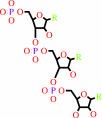 RNA(n)
|
+
|
ribonucleoside 5'-triphosphate
|
=
|
RNA(n+1)
|
+
|
 diphosphate
|
|
|
|
|
|
|
|
|
|
Enzyme class 3:
|
|
E.C.3.4.21.98
- hepacivirin.
|
|
|
|
|
|
|
Reaction:
|
|
Hydrolysis of four peptide bonds in the viral precursor polyprotein, commonly with Asp or Glu in the P6 position, Cys or Thr in P1 and Ser or Ala in P1'.
|
|
|
|
|
|
Enzyme class 4:
|
|
E.C.3.4.22.-
- ?????
|
|
|
|
|
|
|
Enzyme class 5:
|
|
E.C.3.6.1.15
- nucleoside-triphosphate phosphatase.
|
|
|
|
|
|
|
Reaction:
|
|
a ribonucleoside 5'-triphosphate + H2O = a ribonucleoside 5'-diphosphate + phosphate + H+
|
|
|
|
|
|
ribonucleoside 5'-triphosphate
|
+
|
H2O
|
=
|
ribonucleoside 5'-diphosphate
|
+
|
 phosphate
|
+
|
H(+)
|
|
|
|
|
|
|
|
|
|
Enzyme class 6:
|
|
E.C.3.6.4.13
- Rna helicase.
|
|
|
|
|
|
|
Reaction:
|
|
ATP + H2O = ADP + phosphate + H+
|
|
|
|
|
|
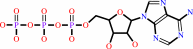 ATP
ATP
|
+
|
H2O
|
=
|
 ADP
ADP
|
+
|
phosphate
|
+
|
H(+)
|
|
|
|
|
|
|
|
|
|
|
|
|
Note, where more than one E.C. class is given (as above), each may
correspond to a different protein domain or, in the case of polyprotein
precursors, to a different mature protein.
|
|
|
|
Molecule diagrams generated from .mol files obtained from the
KEGG ftp site
|
|
|
|
|
|
|
|
|
|
|
|
|
|
 |
|
|
|
|
|
|
| |
|
|
| |
|
DOI no:
|
Science
347:771-775
(2015)
|
|
PubMed id:
|
|
|
|
|
|
| |
|
Viral replication. Structural basis for RNA replication by the hepatitis C virus polymerase.
|
|
T.C.Appleby,
J.K.Perry,
E.Murakami,
O.Barauskas,
J.Feng,
A.Cho,
D.Fox,
D.R.Wetmore,
M.E.McGrath,
A.S.Ray,
M.J.Sofia,
S.Swaminathan,
T.E.Edwards.
|
|
|
|
|
| |
ABSTRACT
|
|
|
|
| |
|
|
Nucleotide analog inhibitors have shown clinical success in the treatment of
hepatitis C virus (HCV) infection, despite an incomplete mechanistic
understanding of NS5B, the viral RNA-dependent RNA polymerase. Here we study the
details of HCV RNA replication by determining crystal structures of stalled
polymerase ternary complexes with enzymes, RNA templates, RNA primers, incoming
nucleotides, and catalytic metal ions during both primed initiation and
elongation of RNA synthesis. Our analysis revealed that highly conserved
active-site residues in NS5B position the primer for in-line attack on the
incoming nucleotide. A β loop and a C-terminal membrane-anchoring linker
occlude the active-site cavity in the apo state, retract in the primed
initiation assembly to enforce replication of the HCV genome from the 3'
terminus, and vacate the active-site cavity during elongation. We investigated
the incorporation of nucleotide analog inhibitors, including the clinically
active metabolite formed by sofosbuvir, to elucidate key molecular interactions
in the active site.
|
|
|
|
|
|
|
|
|
|
|
|
|
|
|
|
|
|
 |
 |
 |
|


 Links
Links


