 |
PDBsum entry 4rpy

|
|
|
|
|
|

|

|

|

|
|

|
|

|
|

|
|

|
|

|
|

|
|

|
|
|
 |

|

|
|
|
|
|
|
|
|
|
|
|
|
|
|
|
|
|
|
|
|
|
|
|
|
|
|
|
|
|
|
|
|
|
|
|
|
Transferase/DNA
|
PDB id
|
|
|
|
4rpy
|
|
|
|
|
|
|
|
|
|
|
|
|
|
|

|

|

|
|
|
|
|
|
|
|
|
Enzyme class 1:
|
|
E.C.2.7.7.7
- DNA-directed Dna polymerase.
|
|
|
|
|
|
|
Reaction:
|
|
DNA(n) + a 2'-deoxyribonucleoside 5'-triphosphate = DNA(n+1) + diphosphate
|
|
|
|
|
|
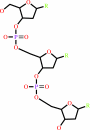 DNA(n)
|
+
|
2'-deoxyribonucleoside 5'-triphosphate
|
=
|
DNA(n+1)
Bound ligand (Het Group name = )
corresponds exactly
|
+
|
 diphosphate
|
|
|
|
|
|
|
|
|
|
Enzyme class 2:
|
|
E.C.4.2.99.-
- ?????
|
|
|
|
|
|
|
Enzyme class 3:
|
|
E.C.4.2.99.18
- DNA-(apurinic or apyrimidinic site) lyase.
|
|
|
|
|
|
|
Reaction:
|
|
2'-deoxyribonucleotide-(2'-deoxyribose 5'-phosphate)- 2'-deoxyribonucleotide-DNA = a 3'-end 2'-deoxyribonucleotide-(2,3- dehydro-2,3-deoxyribose 5'-phosphate)-DNA + a 5'-end 5'-phospho- 2'-deoxyribonucleoside-DNA + H+
|
|
|
|
|
|
|
|
|
Note, where more than one E.C. class is given (as above), each may
correspond to a different protein domain or, in the case of polyprotein
precursors, to a different mature protein.
|
|
|
|
Molecule diagrams generated from .mol files obtained from the
KEGG ftp site
|
|
|
|
|
|
|
|
|
|
|
|
|
|
 |
|
|
|
|
|
|
| |
|
|
| |
|
DOI no:
|
J Am Chem Soc
137:5225-5230
(2015)
|
|
PubMed id:
|
|
|
|
|
|
| |
|
Viewing Human DNA Polymerase β Faithfully and Unfaithfully Bypass an Oxidative Lesion by Time-Dependent Crystallography.
|
|
R.Vyas,
A.J.Reed,
E.J.Tokarsky,
Z.Suo.
|
|
|
|
|
| |
ABSTRACT
|
|
|
|
| |
|
|
One common oxidative DNA lesion, 8-oxo-7,8-dihydro-2'-deoxyguanine (8-oxoG), is
highly mutagenic in vivo due to its anti-conformation forming a Watson-Crick
base pair with correct deoxycytidine 5'-triphosphate (dCTP) and its
syn-conformation forming a Hoogsteen base pair with incorrect deoxyadenosine
5'-triphosphate (dATP). Here, we utilized time-resolved X-ray crystallography to
follow 8-oxoG bypass by human DNA polymerase β (hPolβ). In the 12 solved
structures, both Watson-Crick (anti-8-oxoG:anti-dCTP) and Hoogsteen
(syn-8-oxoG:anti-dATP) base pairing were clearly visible and were maintained
throughout the chemical reaction. Additionally, a third Mg(2+) appeared during
the process of phosphodiester bond formation and was located between the
reacting α- and β-phosphates of the dNTP, suggesting its role in stabilizing
reaction intermediates. After phosphodiester bond formation, hPolβ reopened its
conformation, pyrophosphate was released, and the newly incorporated primer
3'-terminal nucleotide stacked, rather than base paired, with 8-oxoG. These
structures provide the first real-time pictures, to our knowledge, of how a
polymerase correctly and incorrectly bypasses a DNA lesion.
|
|
|
|
|
|
|
|
|
|
|
|
|
|
|
|
|
|
 |
 |
 |
|


 Links
Links


