 |
PDBsum entry 3kd5

|
|
|
|
|
|

|

|

|

|
|

|
|

|
|

|
|

|
|

|
|

|
|

|
|
|
 |

|

|
|
|
|
|
|
|
|
|
|
|
|
|
|
|
|
|
|
|
|
|
|
|
|
|
|
|
|
|
|
|
|
|
|
|
|
Transferase/DNA
|
PDB id
|
|
|
|
3kd5
|
|
|
|
|
|
|
|
|
|
|
|
|
|
|

|

|

|
|
|
|
|
|
|
|
|
Enzyme class:
|
|
E.C.2.7.7.7
- DNA-directed Dna polymerase.
|
|
|
|
|
|
|
Reaction:
|
|
DNA(n) + a 2'-deoxyribonucleoside 5'-triphosphate = DNA(n+1) + diphosphate
|
|
|
|
|
|
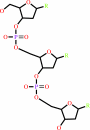 DNA(n)
|
+
|
2'-deoxyribonucleoside 5'-triphosphate
|
=
|
DNA(n+1)
|
+
|
 diphosphate
|
|
|
|
|
|
|
|
|
|
|
|
|
Molecule diagrams generated from .mol files obtained from the
KEGG ftp site
|
|
|
|
|
|
|
|
|
|
|
|
|
|
 |
|
|
|
|
|
|
| |
|
|
| |
|
|
J Biol Chem
286:25246-25255
(2011)
|
|
PubMed id:
|
|
|
|
|
|
| |
|
Phosphonoformic acid inhibits viral replication by trapping the closed form of the DNA polymerase.
|
|
K.E.Zahn,
E.P.Tchesnokov,
M.Götte,
S.Doublié.
|
|
|
|
|
| |
ABSTRACT
|
|
|
|
| |
|
|
Phosphonoformic acid (PFA, foscarnet) belongs to a class of antiviral drugs that
inhibit the human cytomegalovirus DNA polymerase (UL54) by mimicking the
pyrophosphate leaving group of the nucleotide transfer reaction. Difficulties
expressing UL54 have hampered investigation of the precise structural
requirements rendering inhibition by this drug. However, a previously engineered
chimeric DNA polymerase, constructed by mutating the homologous polymerase from
bacteriophage RB69 (gp43) to express several variable elements from UL54, can
bypass this obstacle because of its favorable expression and acquired
sensitivity to PFA (Tchesnokov, E. P., Obikhod, A., Schinazi, R. F., and Götte,
M. (2008) J. Biol. Chem. 283, 34218-34228). Here, we compare two crystal
structures that depict the chimeric DNA polymerase with and without PFA bound.
PFA is visualized for the first time in the active site of a DNA polymerase,
where interactions are resolved between the PP(i) mimic and two basic residues
absolutely conserved in the fingers domain of family B polymerases. PFA also
chelates metal ion B, the cation that contacts the triphosphate tail of the
incoming nucleotide. These DNA complexes utilize a primer-template pair
enzymatically chain-terminated by incorporation of acyclo-GMP, the
phosphorylated form of the anti-herpes drug acyclovir. We postulate that the
V478W mutation present in the chimera is critical in that it pushes the fingers
domain to more readily adopt the closed conformation whether or not the drug is
bound. The closed state of the fingers domain traps the variant polymerase in
the untranslocated state and increases affinity for PFA. This finding provides a
model for the mechanism of UL54 stalling by PFA.
|
|
|
|
|
|
|
|
|
|
|
|
|
|
|
|
|
|
 |
 |
 |
|


 Links
Links


