 |
PDBsum entry 3fql

|
|
|
|
|
 |
Contents |
 |
|
|
|
|
|
|
|
|
|
|
|
|
* Residue conservation analysis
|
|
|
|
|
|
|
|
|
|
|
Enzyme class 1:
|
|
E.C.2.7.7.48
- RNA-directed Rna polymerase.
|
|
|
|
|
|
|
Reaction:
|
|
RNA(n) + a ribonucleoside 5'-triphosphate = RNA(n+1) + diphosphate
|
|
|
|
|
|
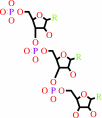 RNA(n)
|
+
|
ribonucleoside 5'-triphosphate
|
=
|
RNA(n+1)
|
+
|
 diphosphate
|
|
|
|
|
|
|
|
|
|
Enzyme class 2:
|
|
E.C.3.4.21.98
- hepacivirin.
|
|
|
|
|
|
|
Reaction:
|
|
Hydrolysis of four peptide bonds in the viral precursor polyprotein, commonly with Asp or Glu in the P6 position, Cys or Thr in P1 and Ser or Ala in P1'.
|
|
|
|
|
|
Enzyme class 3:
|
|
E.C.3.4.22.-
- ?????
|
|
|
|
|
|
|
Enzyme class 4:
|
|
E.C.3.6.1.15
- nucleoside-triphosphate phosphatase.
|
|
|
|
|
|
|
Reaction:
|
|
a ribonucleoside 5'-triphosphate + H2O = a ribonucleoside 5'-diphosphate + phosphate + H+
|
|
|
|
|
|
ribonucleoside 5'-triphosphate
|
+
|
H2O
|
=
|
ribonucleoside 5'-diphosphate
|
+
|
 phosphate
|
+
|
H(+)
|
|
|
|
|
|
|
|
|
|
Enzyme class 5:
|
|
E.C.3.6.4.13
- Rna helicase.
|
|
|
|
|
|
|
Reaction:
|
|
ATP + H2O = ADP + phosphate + H+
|
|
|
|
|
|
 ATP
ATP
|
+
|
H2O
|
=
|
 ADP
ADP
|
+
|
phosphate
|
+
|
H(+)
|
|
|
|
|
|
|
|
|
|
|
|
|
Note, where more than one E.C. class is given (as above), each may
correspond to a different protein domain or, in the case of polyprotein
precursors, to a different mature protein.
|
|
|
|
Molecule diagrams generated from .mol files obtained from the
KEGG ftp site
|
|
|
|
|
|
|
|
|
|
|
|
|
|
 |
|
|
|
|
|
|
| |
|
|
| |
|
DOI no:
|
J Biol Chem
284:15517-15529
(2009)
|
|
PubMed id:
|
|
|
|
|
|
| |
|
Slow binding inhibition and mechanism of resistance of non-nucleoside polymerase inhibitors of hepatitis C virus.
|
|
J.Q.Hang,
Y.Yang,
S.F.Harris,
V.Leveque,
H.J.Whittington,
S.Rajyaguru,
G.Ao-Ieong,
M.F.McCown,
A.Wong,
A.M.Giannetti,
S.Le Pogam,
F.Talamás,
N.Cammack,
I.Nájera,
K.Klumpp.
|
|
|
|
|
| |
ABSTRACT
|
|
|
|
| |
|
|
The binding affinity of four palm and thumb site representative non-nucleoside
inhibitors (NNIs) of HCV polymerase NS5B to wild-type and resistant NS5B
polymerase proteins was determined, and the influence of RNA binding on NNI
binding affinity was investigated. NNIs with high binding affinity potently
inhibited HCV RNA polymerase activity and replicon replication. Among the
compounds tested, HCV-796 showed slow binding kinetics to NS5B. The binding
affinity of HCV-796 to NS5B increased 27-fold over a 3-h incubation period with
an equilibrium Kd of 71 +/- 2 nm. Slow binding kinetics of HCV-796 was driven by
slow dissociation from NS5B with a k(off) of 4.9 +/- 0.5 x 10(-4) s(-1). NS5B
bound a long, 378-nucleotide HCV RNA oligonucleotide with high affinity (Kd =
6.9 +/- 0.3 nm), whereas the binding affinity was significantly lower for a
short, 21-nucleotide RNA (Kd = 155.1 +/- 16.2 nm). The formation of the NS5B-HCV
RNA complex did not affect the slow binding kinetics profile and only slightly
reduced NS5B binding affinity of HCV-796. The magnitude of reduction of NNI
binding affinity for the NS5B proteins with various resistance mutations in the
palm and thumb binding sites correlated well with resistance -fold shifts in
NS5B polymerase activity and replicon assays. Co-crystal structures of NS5B-Con1
and NS5B-BK with HCV-796 revealed a deep hydrophobic binding pocket at the palm
region of NS5B. HCV-796 interaction with the induced binding pocket on NS5B is
consistent with slow binding kinetics and loss of binding affinity with
mutations at amino acid position 316.
|
|
|
|
|
|
| |
Selected figure(s)
|
|
|
|
| |
|
|

|
|

|
|
Figure 1.
Chemical structure of non-nucleoside inhibitors of HCV NS5B
polymerase used in this study.
|
|
Figure 8.
The co-crystal structures of HCV-796 binding to the palm
domain of HCV NS5B polymerase. A, crystal structure details of
HCV-796 binding to NS5B570-Con1 (genotype 1b) with cysteine at
position 316 (pink highlight). B, crystal structure details of
HCV-796 binding to NS5B570-BK (1b) carrying asparagine at
position 316 (pink highlight). C, modeling of HCV-796 binding to
NS5B protein with tyrosine at position 316 (orange highlight).
|
|
|
|
|
|
| |
The above figures are
reprinted
by permission from the ASBMB:
J Biol Chem
(2009,
284,
15517-15529)
copyright 2009.
|
|
| |
Figures were
selected
by an automated process.
|
|
|
|
|
|
|
|
|
|
|
|
|
|
|
|
 |
 |
 |
|
Literature references that cite this PDB file's key reference
|
|
|
| |
PubMed id
|
|
Reference
|
|
|
|
|
|
N.D.Kim,
H.Chun,
S.J.Park,
J.W.Yang,
J.W.Kim,
and
S.K.Ahn
(2011).
Discovery of novel HCV polymerase inhibitors using pharmacophore-based virtual screening.
|
| |
Bioorg Med Chem Lett,
21,
3329-3334.
|
|
|
|
|
|
|
O.Nyanguile,
B.Devogelaere,
L.Vijgen,
W.Van den Broeck,
F.Pauwels,
M.D.Cummings,
H.L.De Bondt,
A.M.Vos,
J.M.Berke,
O.Lenz,
G.Vandercruyssen,
K.Vermeiren,
W.Mostmans,
P.Dehertogh,
F.Delouvroy,
S.Vendeville,
K.VanDyck,
K.Dockx,
E.Cleiren,
P.Raboisson,
K.A.Simmen,
and
G.C.Fanning
(2010).
1a/1b subtype profiling of nonnucleoside polymerase inhibitors of hepatitis C virus.
|
| |
J Virol,
84,
2923-2934.
|
|
|
PDB codes:
|
|
|
|
|
|
|
|
S.Margeridon-Thermet,
and
R.W.Shafer
(2010).
Comparison of the Mechanisms of Drug Resistance among HIV, Hepatitis B, and Hepatitis C.
|
| |
Viruses,
2,
2696-2739.
|
|
|
|
|
|
|
T.Shimakami,
R.E.Lanford,
and
S.M.Lemon
(2009).
Hepatitis C: recent successes and continuing challenges in the development of improved treatment modalities.
|
| |
Curr Opin Pharmacol,
9,
537-544.
|
|
|
|
|
|
The most recent references are shown first.
Citation data come partly from CiteXplore and partly
from an automated harvesting procedure. Note that this is likely to be
only a partial list as not all journals are covered by
either method. However, we are continually building up the citation data
so more and more references will be included with time.
Where a reference describes a PDB structure, the PDB
codes are
shown on the right.
|
|


 Links
Links


