|
PDBsum entry 3d6t

|
|
|
|
|
 |
Contents |
 |
|
|
|
|
|
|
|
|
|
|
|
|
|
|
* Residue conservation analysis
|
|
|
|
|
|
|
|
|
|
|
Enzyme class 2:
|
|
E.C.2.7.11.1
- non-specific serine/threonine protein kinase.
|
|
|
|
|
|
|
Reaction:
|
|
|
1.
|
L-seryl-[protein] + ATP = O-phospho-L-seryl-[protein] + ADP + H+
|
|
2.
|
L-threonyl-[protein] + ATP = O-phospho-L-threonyl-[protein] + ADP + H+
|
|
|
|
|
|
|
L-seryl-[protein]
|
+
|
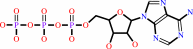 ATP
ATP
|
=
|
O-phospho-L-seryl-[protein]
Bound ligand (Het Group name = )
matches with 96.43% similarity
|
+
|
 ADP
ADP
|
+
|
H(+)
|
|
|
|
|
|
|
L-threonyl-[protein]
|
+
|
ATP
|
=
|
O-phospho-L-threonyl-[protein]
Bound ligand (Het Group name = )
matches with 96.43% similarity
|
+
|
ADP
|
+
|
H(+)
|
|
|
|
|
|
|
|
|
|
Enzyme class 3:
|
|
E.C.3.6.5.-
- ?????
|
|
|
|
|
|
|
|
|
|
Note, where more than one E.C. class is given (as above), each may
correspond to a different protein domain or, in the case of polyprotein
precursors, to a different mature protein.
|
|
|
|
Molecule diagrams generated from .mol files obtained from the
KEGG ftp site
|
|
|
|
|
|
|
|
|
|
|
|
|
|
 |
|
|
|
|
|
|
| |
|
|
| |
|
DOI no:
|
Proc Natl Acad Sci U S A
105:1499-1504
(2008)
|
|
PubMed id:
|
|
|
|
|
|
| |
|
Structure of the ROC domain from the Parkinson's disease-associated leucine-rich repeat kinase 2 reveals a dimeric GTPase.
|
|
J.Deng,
P.A.Lewis,
E.Greggio,
E.Sluch,
A.Beilina,
M.R.Cookson.
|
|
|
|
|
| |
ABSTRACT
|
|
|
|
| |
|
|
Mutations in leucine-rich repeat kinase 2 (LRRK2) are the most common cause of
Parkinson's disease (PD). LRRK2 contains a Ras of complex proteins (ROC) domain
that may act as a GTPase to regulate its protein kinase activity. The structure
of ROC and the mechanism(s) by which it regulates kinase activity are not known.
Here, we report the crystal structure of the LRRK2 ROC domain in complex with
GDP-Mg(2+) at 2.0-A resolution. The structure displays a dimeric fold generated
by extensive domain-swapping, resulting in a pair of active sites constructed
with essential functional groups contributed from both monomers. Two
PD-associated pathogenic residues, R1441 and I1371, are located at the interface
of two monomers and provide exquisite interactions to stabilize the ROC dimer.
The structure demonstrates that loss of stabilizing forces in the ROC dimer is
likely related to decreased GTPase activity resulting from mutations at these
sites. Our data suggest that the ROC domain may regulate LRRK2 kinase activity
as a dimer, possibly via the C-terminal of ROC (COR) domain as a molecular
hinge. The structure of the LRRK2 ROC domain also represents a signature from a
previously undescribed class of GTPases from complex proteins and results may
provide a unique molecular target for therapeutics in PD.
|
|
|
|
|
|
| |
Selected figure(s)
|
|
|
|
| |
|
|

|
|

|
|
Figure 1.
The unique dimeric ROC GTPase. (A) Stereoview of the
domain-swapped dimer. The two individual monomers are shown in
yellow and green. The GDP-Mg^2+ ligands are shown in
ball-and-stick format. (B) Ribbon representation of a single
monomer. The three head, neck, and body subdomains are
indicated, along with the labeled secondary structures. The
P-loop, G3/Switch II, and G4 and G5 loops are indicated in
orange, pink, red, and cyan, respectively. The disordered G2
loop is shown as a black dotted curve. (C) Surface
representation highlighting the GDP-Mg^2+ binding pocket on the
surface of the dimer that is contributed from both monomers. The
pair of functional units are shown as ROCs1 and ROCs2,
respectively.
|
|
Figure 2.
Structural basis of PD-associated mutations in ROC. (A) R1441
and W1434 from one monomer together with F1401 and P1406 from
the other stack on each other alternately, forming a hydrophobic
zipper at the dimer interface. The guanidinium group of R1441
also is hydrogen-bonded with the backbone carbonyl oxygen of
F1401 and the hydroxyl group of T1404 on helix α2 from the
other peptide chain. 2mF [o] − DF [c] electron density map is
shown in blue. (B) I1371 is inserted in a hydrophobic cavity,
which is constructed by residues from both monomers at the dimer
interface. I1371 is shown in stick format and colored in orange.
The surrounding residues are shown in stick format within the
semitransparent surface representation. The color scheme is the
same as that in Fig. 1. Note the side-chain methyl group of
T1404 is pointing directly to the tip of I1371, forming a
favorable van der Waals' interaction. (C) R1441C (lane 3), as a
prototypical mutation at the dimer interface, decreases
interaction with the full-length wild-type LRRK2 protein
compared with wild-type GST fusions (lane 2); no interaction was
seen with GST alone (lane 1). (D) Pull-down assays were
quantified and corrected for the amount of LRRK2 protein in the
inputs (middle blots). *, P < 0.0001; **, P < 0.01 compared with
GST alone (one-way ANOVA with Student–Newman–Kuell's post
hoc test; n = 3).
|
|
|
|
| |
Figures were
selected
by the author.
|
|
|
|
|
|
|
|
|
|
|
|
|
|
|
|
 |
 |
 |
|
Literature references that cite this PDB file's key reference
|
|
|
| |
PubMed id
|
|
Reference
|
|
|
|
|
|
Y.H.Huang,
X.Y.Liu,
X.X.Du,
Z.F.Jiang,
and
X.D.Su
(2012).
The structural basis for the sensing and binding of cyclic di-GMP by STING.
|
| |
Nat Struct Mol Biol,
19,
728-730.
|
|
|
PDB codes:
|
|
|
|
|
|
|
|
E.K.Tan,
and
A.H.Schapira
(2011).
LRRK2 as a therapeutic target in Parkinson's disease.
|
| |
Eur J Neurol,
18,
545-546.
|
|
|
|
|
|
|
H.M.Gao,
and
J.S.Hong
(2011).
Gene-environment interactions: Key to unraveling the mystery of Parkinson's disease.
|
| |
Prog Neurobiol,
94,
1.
|
|
|
|
|
|
|
V.Daniëls,
R.Vancraenenbroeck,
B.M.Law,
E.Greggio,
E.Lobbestael,
F.Gao,
M.De Maeyer,
M.R.Cookson,
K.Harvey,
V.Baekelandt,
and
J.M.Taymans
(2011).
Insight into the mode of action of the LRRK2 Y1699C pathogenic mutant.
|
| |
J Neurochem,
116,
304-315.
|
|
|
|
|
|
|
X.Li,
Q.J.Wang,
N.Pan,
S.Lee,
Y.Zhao,
B.T.Chait,
and
Z.Yue
(2011).
Phosphorylation-dependent 14-3-3 binding to LRRK2 is impaired by common mutations of familial Parkinson's disease.
|
| |
PLoS One,
6,
e17153.
|
|
|
|
|
|
|
C.B.Abdalla-Carvalho,
C.B.Santos-Rebouças,
B.C.Guimarães,
M.Campos,
J.S.Pereira,
A.L.de Rosso,
D.H.Nicaretta,
M.Marinho e Silva,
M.J.dos Santos,
and
M.M.Pimentel
(2010).
Genetic analysis of LRRK2 functional domains in Brazilian patients with Parkinson's disease.
|
| |
Eur J Neurol,
17,
1479-1481.
|
|
|
|
|
|
|
C.H.Hsu,
D.Chan,
and
B.Wolozin
(2010).
LRRK2 and the stress response: interaction with MKKs and JNK-interacting proteins.
|
| |
Neurodegener Dis,
7,
68-75.
|
|
|
|
|
|
|
D.Kerk,
and
G.B.Moorhead
(2010).
A phylogenetic survey of myotubularin genes of eukaryotes: distribution, protein structure, evolution, and gene expression.
|
| |
BMC Evol Biol,
10,
196.
|
|
|
|
|
|
|
J.M.Taymans,
and
M.R.Cookson
(2010).
Mechanisms in dominant parkinsonism: The toxic triangle of LRRK2, alpha-synuclein, and tau.
|
| |
Bioessays,
32,
227-235.
|
|
|
|
|
|
|
J.O.Aasly,
C.Vilariño-Güell,
J.C.Dachsel,
P.J.Webber,
A.B.West,
K.Haugarvoll,
K.K.Johansen,
M.Toft,
J.G.Nutt,
H.Payami,
J.M.Kachergus,
S.J.Lincoln,
A.Felic,
C.Wider,
A.I.Soto-Ortolaza,
S.A.Cobb,
L.R.White,
O.A.Ross,
and
M.J.Farrer
(2010).
Novel pathogenic LRRK2 p.Asn1437His substitution in familial Parkinson's disease.
|
| |
Mov Disord,
25,
2156-2163.
|
|
|
|
|
|
|
P.A.Robinson
(2010).
Understanding the molecular basis of Parkinson's disease, identification of biomarkers and routes to therapy.
|
| |
Expert Rev Proteomics,
7,
565-578.
|
|
|
|
|
|
|
P.P.Pungaliya,
Y.Bai,
K.Lipinski,
V.S.Anand,
S.Sen,
E.L.Brown,
B.Bates,
P.H.Reinhart,
A.B.West,
W.D.Hirst,
and
S.P.Braithwaite
(2010).
Identification and characterization of a leucine-rich repeat kinase 2 (LRRK2) consensus phosphorylation motif.
|
| |
PLoS One,
5,
e13672.
|
|
|
|
|
|
|
W.Dauer,
and
C.C.Ho
(2010).
The biology and pathology of the familial Parkinson's disease protein LRRK2.
|
| |
Mov Disord,
25,
S40-S43.
|
|
|
|
|
|
|
Y.Tong,
H.Yamaguchi,
E.Giaime,
S.Boyle,
R.Kopan,
R.J.Kelleher,
and
J.Shen
(2010).
Loss of leucine-rich repeat kinase 2 causes impairment of protein degradation pathways, accumulation of alpha-synuclein, and apoptotic cell death in aged mice.
|
| |
Proc Natl Acad Sci U S A,
107,
9879-9884.
|
|
|
|
|
|
|
Y.Xiong,
C.E.Coombes,
A.Kilaru,
X.Li,
A.D.Gitler,
W.J.Bowers,
V.L.Dawson,
T.M.Dawson,
and
D.J.Moore
(2010).
GTPase activity plays a key role in the pathobiology of LRRK2.
|
| |
PLoS Genet,
6,
e1000902.
|
|
|
|
|
|
|
A.Thaler,
E.Ash,
Z.Gan-Or,
A.Orr-Urtreger,
and
N.Giladi
(2009).
The LRRK2 G2019S mutation as the cause of Parkinson's disease in Ashkenazi Jews.
|
| |
J Neural Transm,
116,
1473-1482.
|
|
|
|
|
|
|
C.J.Gloeckner,
A.Schumacher,
K.Boldt,
and
M.Ueffing
(2009).
The Parkinson disease-associated protein kinase LRRK2 exhibits MAPKKK activity and phosphorylates MKK3/6 and MKK4/7, in vitro.
|
| |
J Neurochem,
109,
959-968.
|
|
|
|
|
|
|
C.L.Klein,
G.Rovelli,
W.Springer,
C.Schall,
T.Gasser,
and
P.J.Kahle
(2009).
Homo- and heterodimerization of ROCO kinases: LRRK2 kinase inhibition by the LRRK2 ROCO fragment.
|
| |
J Neurochem,
111,
703-715.
|
|
|
|
|
|
|
C.Paisán-Ruiz
(2009).
LRRK2 gene variation and its contribution to Parkinson disease.
|
| |
Hum Mutat,
30,
1153-1160.
|
|
|
|
|
|
|
E.Greggio,
J.M.Taymans,
E.Y.Zhen,
J.Ryder,
R.Vancraenenbroeck,
A.Beilina,
P.Sun,
J.Deng,
H.Jaffe,
V.Baekelandt,
K.Merchant,
and
M.R.Cookson
(2009).
The Parkinson's disease kinase LRRK2 autophosphorylates its GTPase domain at multiple sites.
|
| |
Biochem Biophys Res Commun,
389,
449-454.
|
|
|
|
|
|
|
E.Greggio,
and
M.R.Cookson
(2009).
Leucine-rich repeat kinase 2 mutations and Parkinson's disease: three questions.
|
| |
ASN Neuro,
1,
0.
|
|
|
|
|
|
|
G.Santpere,
and
I.Ferrer
(2009).
LRRK2 and neurodegeneration.
|
| |
Acta Neuropathol,
117,
227-246.
|
|
|
|
|
|
|
J.Alegre-Abarrategui,
H.Christian,
M.M.Lufino,
R.Mutihac,
L.L.Venda,
O.Ansorge,
and
R.Wade-Martins
(2009).
LRRK2 regulates autophagic activity and localizes to specific membrane microdomains in a novel human genomic reporter cellular model.
|
| |
Hum Mol Genet,
18,
4022-4034.
|
|
|
|
|
|
|
J.L.George,
S.Mok,
D.Moses,
S.Wilkins,
A.I.Bush,
R.A.Cherny,
and
D.I.Finkelstein
(2009).
Targeting the progression of Parkinson's disease.
|
| |
Curr Neuropharmacol,
7,
9.
|
|
|
|
|
|
|
N.D.Jorgensen,
Y.Peng,
C.C.Ho,
H.J.Rideout,
D.Petrey,
P.Liu,
and
W.T.Dauer
(2009).
The WD40 domain is required for LRRK2 neurotoxicity.
|
| |
PLoS One,
4,
e8463.
|
|
|
|
|
|
|
P.N.Gandhi,
S.G.Chen,
and
A.L.Wilson-Delfosse
(2009).
Leucine-rich repeat kinase 2 (LRRK2): a key player in the pathogenesis of Parkinson's disease.
|
| |
J Neurosci Res,
87,
1283-1295.
|
|
|
|
|
|
|
R.Gasper,
S.Meyer,
K.Gotthardt,
M.Sirajuddin,
and
A.Wittinghofer
(2009).
It takes two to tango: regulation of G proteins by dimerization.
|
| |
Nat Rev Mol Cell Biol,
10,
423-429.
|
|
|
|
|
|
|
S.Biskup,
and
A.B.West
(2009).
Zeroing in on LRRK2-linked pathogenic mechanisms in Parkinson's disease.
|
| |
Biochim Biophys Acta,
1792,
625-633.
|
|
|
|
|
|
|
S.Sen,
P.J.Webber,
and
A.B.West
(2009).
Dependence of leucine-rich repeat kinase 2 (LRRK2) kinase activity on dimerization.
|
| |
J Biol Chem,
284,
36346-36356.
|
|
|
|
|
|
|
X.Ding,
and
M.S.Goldberg
(2009).
Regulation of LRRK2 stability by the E3 ubiquitin ligase CHIP.
|
| |
PLoS One,
4,
e5949.
|
|
|
|
|
|
|
Y.Li,
L.Dunn,
E.Greggio,
B.Krumm,
G.S.Jackson,
M.R.Cookson,
P.A.Lewis,
and
J.Deng
(2009).
The R1441C mutation alters the folding properties of the ROC domain of LRRK2.
|
| |
Biochim Biophys Acta,
1792,
1194-1197.
|
|
|
|
|
|
|
B.Krumm,
X.Meng,
Y.Li,
Y.Xiang,
and
J.Deng
(2008).
Structural basis for antagonism of human interleukin 18 by poxvirus interleukin 18-binding protein.
|
| |
Proc Natl Acad Sci U S A,
105,
20711-20715.
|
|
|
PDB code:
|
|
|
|
|
|
|
|
E.Greggio,
I.Zambrano,
A.Kaganovich,
A.Beilina,
J.M.Taymans,
V.Daniëls,
P.Lewis,
S.Jain,
J.Ding,
A.Syed,
K.J.Thomas,
V.Baekelandt,
and
M.R.Cookson
(2008).
The Parkinson disease-associated leucine-rich repeat kinase 2 (LRRK2) is a dimer that undergoes intramolecular autophosphorylation.
|
| |
J Biol Chem,
283,
16906-16914.
|
|
|
|
|
|
|
K.Gotthardt,
M.Weyand,
A.Kortholt,
P.J.Van Haastert,
and
A.Wittinghofer
(2008).
Structure of the Roc-COR domain tandem of C. tepidum, a prokaryotic homologue of the human LRRK2 Parkinson kinase.
|
| |
EMBO J,
27,
2239-2249.
|
|
|
PDB codes:
|
|
|
|
|
|
|
|
M.J.Devine,
and
P.A.Lewis
(2008).
Emerging pathways in genetic Parkinson's disease: tangles, Lewy bodies and LRRK2.
|
| |
FEBS J,
275,
5748-5757.
|
|
|
|
|
|
|
W.N.van Egmond,
A.Kortholt,
K.Plak,
L.Bosgraaf,
S.Bosgraaf,
I.Keizer-Gunnink,
and
P.J.van Haastert
(2008).
Intramolecular activation mechanism of the Dictyostelium LRRK2 homolog Roco protein GbpC.
|
| |
J Biol Chem,
283,
30412-30420.
|
|
|
|
|
|
The most recent references are shown first.
Citation data come partly from CiteXplore and partly
from an automated harvesting procedure. Note that this is likely to be
only a partial list as not all journals are covered by
either method. However, we are continually building up the citation data
so more and more references will be included with time.
Where a reference describes a PDB structure, the PDB
codes are
shown on the right.
|
|


 Links
Links