
|
|
|
|
|
 |
Contents |
 |
|
|
|
|
|
|
|
|
|
|
|
|
* Residue conservation analysis
|
|
|
|
|
|
|
|
|
|
Enzyme class 2:
|
|
Chain A:
E.C.2.7.11.22
- cyclin-dependent kinase.
|
|
|
|
|
|
|
Reaction:
|
|
|
1.
|
L-seryl-[protein] + ATP = O-phospho-L-seryl-[protein] + ADP + H+
|
|
2.
|
L-threonyl-[protein] + ATP = O-phospho-L-threonyl-[protein] + ADP + H+
|
|
|
|
|
|
|
L-seryl-[protein]
|
+
|
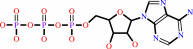 ATP
ATP
|
=
|
O-phospho-L-seryl-[protein]
|
+
|
 ADP
ADP
|
+
|
H(+)
|
|
|
|
|
|
|
L-threonyl-[protein]
|
+
|
ATP
|
=
|
O-phospho-L-threonyl-[protein]
|
+
|
ADP
|
+
|
H(+)
|
|
|
|
|
|
|
|
|
|
Enzyme class 3:
|
|
Chain A:
E.C.2.7.11.23
- [RNA-polymerase]-subunit kinase.
|
|
|
|
|
|
|
Reaction:
|
|
[DNA-directed RNA polymerase] + ATP = phospho-[DNA-directed RNA polymerase] + ADP + H+
|
|
|
|
|
|
[DNA-directed RNA polymerase]
|
+
|
ATP
|
=
|
phospho-[DNA-directed RNA polymerase]
|
+
|
ADP
|
+
|
H(+)
|
|
|
|
|
|
|
|
|
|
|
|
|
Note, where more than one E.C. class is given (as above), each may
correspond to a different protein domain or, in the case of polyprotein
precursors, to a different mature protein.
|
|
|
|
Molecule diagrams generated from .mol files obtained from the
KEGG ftp site
|
|
|
|
|
|
|
|
|
|
|
|
|
|
 |
|
|
|
|
|
|
| |
|
|
| |
|
DOI no:
|
Embo J
27:1907-1918
(2008)
|
|
PubMed id:
|
|
|
|
|
|
| |
|
The structure of P-TEFb (CDK9/cyclin T1), its complex with flavopiridol and regulation by phosphorylation.
|
|
S.Baumli,
G.Lolli,
E.D.Lowe,
S.Troiani,
L.Rusconi,
A.N.Bullock,
J.E.Debreczeni,
S.Knapp,
L.N.Johnson.
|
|
|
|
|
| |
ABSTRACT
|
|
|
|
| |
|
|
The positive transcription elongation factor b (P-TEFb) (CDK9/cyclin T (CycT))
promotes mRNA transcriptional elongation through phosphorylation of elongation
repressors and RNA polymerase II. To understand the regulation of a
transcriptional CDK by its cognate cyclin, we have determined the structures of
the CDK9/CycT1 and free cyclin T2. There are distinct differences between
CDK9/CycT1 and the cell cycle CDK CDK2/CycA manifested by a relative rotation of
26 degrees of CycT1 with respect to the CDK, showing for the first time
plasticity in CDK cyclin interactions. The CDK9/CycT1 interface is relatively
sparse but retains some core CDK-cyclin interactions. The CycT1 C-terminal helix
shows flexibility that may be important for the interaction of this region with
HIV TAT and HEXIM. Flavopiridol, an anticancer drug in phase II clinical trials,
binds to the ATP site of CDK9 inducing unanticipated structural changes that
bury the inhibitor. CDK9 activity and recognition of regulatory proteins are
governed by autophosphorylation. We show that CDK9/CycT1 autophosphorylates on
Thr186 in the activation segment and three C-terminal phosphorylation sites.
Autophosphorylation on all sites occurs in cis.
|
|
|
|
|
|
|
|
|
|
|
|
|
|
|
|
|
|
 |
 |
 |
|
Literature references that cite this PDB file's key reference
|
|
|
| |
PubMed id
|
|
Reference
|
|
|
|
|
|
S.Larochelle,
R.Amat,
K.Glover-Cutter,
M.Sansó,
C.Zhang,
J.J.Allen,
K.M.Shokat,
D.L.Bentley,
and
R.P.Fisher
(2012).
Cyclin-dependent kinase control of the initiation-to-elongation switch of RNA polymerase II.
|
| |
Nat Struct Mol Biol,
19,
1108-1115.
|
|
|
|
|
|
|
C.Fang,
Z.Xiao,
and
Z.Guo
(2011).
Generation and validation of the first predictive pharmacophore model for cyclin-dependent kinase 9 inhibitors.
|
| |
J Mol Graph Model,
29,
800-808.
|
|
|
|
|
|
|
H.M.Shallal,
and
W.A.Russu
(2011).
Discovery, synthesis, and investigation of the antitumor activity of novel piperazinylpyrimidine derivatives.
|
| |
Eur J Med Chem,
46,
2043-2057.
|
|
|
|
|
|
|
D.Myatt,
L.Johnson,
S.Baumli,
and
G.Siligardi
(2010).
The binding of flavopiridol to blood serum albumin.
|
| |
Chirality,
22,
E40-E43.
|
|
|
|
|
|
|
E.C.Dow,
H.Liu,
and
A.P.Rice
(2010).
T-loop phosphorylated Cdk9 localizes to nuclear speckle domains which may serve as sites of active P-TEFb function and exchange between the Brd4 and 7SK/HEXIM1 regulatory complexes.
|
| |
J Cell Physiol,
224,
84-93.
|
|
|
|
|
|
|
G.Napolitano,
S.Amente,
V.Castiglia,
B.Gargano,
V.Ruda,
X.Darzacq,
O.Bensaude,
B.Majello,
and
L.Lania
(2010).
Caffeine prevents transcription inhibition and P-TEFb/7SK dissociation following UV-induced DNA damage.
|
| |
PLoS One,
5,
e11245.
|
|
|
|
|
|
|
I.Lebars,
D.Martinez-Zapien,
A.Durand,
J.Coutant,
B.Kieffer,
and
A.C.Dock-Bregeon
(2010).
HEXIM1 targets a repeated GAUC motif in the riboregulator of transcription 7SK and promotes base pair rearrangements.
|
| |
Nucleic Acids Res,
38,
7749-7763.
|
|
|
|
|
|
|
J.A.Frey,
and
V.Gandhi
(2010).
8-Amino-adenosine inhibits multiple mechanisms of transcription.
|
| |
Mol Cancer Ther,
9,
236-245.
|
|
|
|
|
|
|
M.R.López-Huertas,
S.Callejas,
D.Abia,
E.Mateos,
A.Dopazo,
J.Alcamí,
and
M.Coiras
(2010).
Modifications in host cell cytoskeleton structure and function mediated by intracellular HIV-1 Tat protein are greatly dependent on the second coding exon.
|
| |
Nucleic Acids Res,
38,
3287-3307.
|
|
|
|
|
|
|
M.W.Nowicki,
and
M.D.Walkinshaw
(2010).
CDK9 inhibitors push cancer cells over the edge.
|
| |
Chem Biol,
17,
1047-1048.
|
|
|
|
|
|
|
S.Baumli,
J.A.Endicott,
and
L.N.Johnson
(2010).
Halogen bonds form the basis for selective P-TEFb inhibition by DRB.
|
| |
Chem Biol,
17,
931-936.
|
|
|
PDB codes:
|
|
|
|
|
|
|
|
S.Wang,
G.Griffiths,
C.A.Midgley,
A.L.Barnett,
M.Cooper,
J.Grabarek,
L.Ingram,
W.Jackson,
G.Kontopidis,
S.J.McClue,
C.McInnes,
J.McLachlan,
C.Meades,
M.Mezna,
I.Stuart,
M.P.Thomas,
D.I.Zheleva,
D.P.Lane,
R.C.Jackson,
D.M.Glover,
D.G.Blake,
and
P.M.Fischer
(2010).
Discovery and characterization of 2-anilino-4- (thiazol-5-yl)pyrimidine transcriptional CDK inhibitors as anticancer agents.
|
| |
Chem Biol,
17,
1111-1121.
|
|
|
PDB codes:
|
|
|
|
|
|
|
|
T.H.Tahirov,
N.D.Babayeva,
K.Varzavand,
J.J.Cooper,
S.C.Sedore,
and
D.H.Price
(2010).
Crystal structure of HIV-1 Tat complexed with human P-TEFb.
|
| |
Nature,
465,
747-751.
|
|
|
PDB codes:
|
|
|
|
|
|
|
|
A.Ali,
A.Ghosh,
R.S.Nathans,
N.Sharova,
S.O'Brien,
H.Cao,
M.Stevenson,
and
T.M.Rana
(2009).
Identification of flavopiridol analogues that selectively inhibit positive transcription elongation factor (P-TEFb) and block HIV-1 replication.
|
| |
Chembiochem,
10,
2072-2080.
|
|
|
|
|
|
|
A.J.Kapasi,
C.L.Clark,
K.Tran,
and
D.H.Spector
(2009).
Recruitment of cdk9 to the immediate-early viral transcriptosomes during human cytomegalovirus infection requires efficient binding to cyclin T1, a threshold level of IE2 86, and active transcription.
|
| |
J Virol,
83,
5904-5917.
|
|
|
|
|
|
|
A.P.Rice
(2009).
Dysregulation of positive transcription elongation factor B and myocardial hypertrophy.
|
| |
Circ Res,
104,
1327-1329.
|
|
|
|
|
|
|
F.Vollmuth,
W.Blankenfeldt,
and
M.Geyer
(2009).
Structures of the dual bromodomains of the P-TEFb-activating protein Brd4 at atomic resolution.
|
| |
J Biol Chem,
284,
36547-36556.
|
|
|
PDB codes:
|
|
|
|
|
|
|
|
G.Lolli
(2009).
Binding to DNA of the RNA-polymerase II C-terminal domain allows discrimination between Cdk7 and Cdk9 phosphorylation.
|
| |
Nucleic Acids Res,
37,
1260-1268.
|
|
|
|
|
|
|
I.D'Orso,
and
A.D.Frankel
(2009).
Tat acetylation modulates assembly of a viral-host RNA-protein transcription complex.
|
| |
Proc Natl Acad Sci U S A,
106,
3101-3106.
|
|
|
|
|
|
|
J.Kohoutek
(2009).
P-TEFb- the final frontier.
|
| |
Cell Div,
4,
19.
|
|
|
|
|
|
|
J.Weigelt
(2009).
The case for open-access chemical biology. A strategy for pre-competitive medicinal chemistry to promote drug discovery.
|
| |
EMBO Rep,
10,
941-945.
|
|
|
|
|
|
|
L.N.Johnson
(2009).
Protein kinase inhibitors: contributions from structure to clinical compounds.
|
| |
Q Rev Biophys,
42,
1.
|
|
|
|
|
|
|
P.J.Day,
A.Cleasby,
I.J.Tickle,
M.O'Reilly,
J.E.Coyle,
F.P.Holding,
R.L.McMenamin,
J.Yon,
R.Chopra,
C.Lengauer,
and
H.Jhoti
(2009).
Crystal structure of human CDK4 in complex with a D-type cyclin.
|
| |
Proc Natl Acad Sci U S A,
106,
4166-4170.
|
|
|
PDB codes:
|
|
|
|
|
|
|
|
R.Ramakrishnan,
E.C.Dow,
and
A.P.Rice
(2009).
Characterization of Cdk9 T-loop phosphorylation in resting and activated CD4(+) T lymphocytes.
|
| |
J Leukoc Biol,
86,
1345-1350.
|
|
|
|
|
|
|
T.Takaki,
A.Echalier,
N.R.Brown,
T.Hunt,
J.A.Endicott,
and
M.E.Noble
(2009).
The structure of CDK4/cyclin D3 has implications for models of CDK activation.
|
| |
Proc Natl Acad Sci U S A,
106,
4171-4176.
|
|
|
PDB code:
|
|
|
|
|
|
|
|
W.Coley,
K.Kehn-Hall,
R.Van Duyne,
and
F.Kashanchi
(2009).
Novel HIV-1 therapeutics through targeting altered host cell pathways.
|
| |
Expert Opin Biol Ther,
9,
1369-1382.
|
|
|
|
|
|
The most recent references are shown first.
Citation data come partly from CiteXplore and partly
from an automated harvesting procedure. Note that this is likely to be
only a partial list as not all journals are covered by
either method. However, we are continually building up the citation data
so more and more references will be included with time.
Where a reference describes a PDB structure, the PDB
codes are
shown on the right.
|
 |


 Links
Links


