 |
PDBsum entry 3lp0

|
|
|
|
|
|

|

|

|

|
|

|
|

|
|

|
|

|
|

|
|

|
|

|
|
|
 |

|

|
|
|
|
|
|
|
|
|
|
|
|
|
|
|
|
|
|
|
|
|
|
|
|
|
|
|
|
|
|
|
|
|
|
|
|
Transferase/hydrolase
|
PDB id
|
|
|
|
3lp0
|
|
|
|
|
|
|
|
|
|
|
|
|
|
|

|

|

|
|
|
|
|
|
|
|
 |
Contents |
 |
|
|
|
|
|
|
|
|
|
|
|
|
|
|
* Residue conservation analysis
|
|
|
|
|
|
|
|
|
|
Enzyme class 1:
|
|
Chains A, B:
E.C.2.7.7.-
- ?????
|
|
|
|
|
|
|
Enzyme class 2:
|
|
Chains A, B:
E.C.2.7.7.49
- RNA-directed Dna polymerase.
|
|
|
|
|
|
|
Reaction:
|
|
DNA(n) + a 2'-deoxyribonucleoside 5'-triphosphate = DNA(n+1) + diphosphate
|
|
|
|
|
|
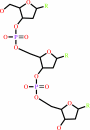 DNA(n)
|
+
|
2'-deoxyribonucleoside 5'-triphosphate
|
=
|
DNA(n+1)
|
+
|
 diphosphate
|
|
|
|
|
|
|
|
|
|
Enzyme class 3:
|
|
Chains A, B:
E.C.2.7.7.7
- DNA-directed Dna polymerase.
|
|
|
|
|
|
|
Reaction:
|
|
DNA(n) + a 2'-deoxyribonucleoside 5'-triphosphate = DNA(n+1) + diphosphate
|
|
|
|
|
|
DNA(n)
|
+
|
2'-deoxyribonucleoside 5'-triphosphate
|
=
|
DNA(n+1)
|
+
|
diphosphate
|
|
|
|
|
|
|
|
|
|
Enzyme class 4:
|
|
Chains A, B:
E.C.3.1.-.-
|
|
|
|
|
|
|
Enzyme class 5:
|
|
Chains A, B:
E.C.3.1.13.2
- exoribonuclease H.
|
|
|
|
|
|
|
Reaction:
|
|
Exonucleolytic cleavage to 5'-phosphomonoester oligonucleotides in both 5'- to 3'- and 3'- to 5'-directions.
|
|
|
|
|
|
Enzyme class 6:
|
|
Chains A, B:
E.C.3.1.26.13
- retroviral ribonuclease H.
|
|
|
|
|
|
|
Enzyme class 7:
|
|
Chains A, B:
E.C.3.4.23.16
- HIV-1 retropepsin.
|
|
|
|
|
|
|
Reaction:
|
|
Specific for a P1 residue that is hydrophobic, and P1' variable, but often Pro.
|
|
|
|
|
|
|
|
|
Note, where more than one E.C. class is given (as above), each may
correspond to a different protein domain or, in the case of polyprotein
precursors, to a different mature protein.
|
|
|
|
Molecule diagrams generated from .mol files obtained from the
KEGG ftp site
|
|
|
|
|
|
|
|
|
|
|
|
|
|
 |
|
|
|
|
|
|
| |
|
|
| |
|
|
J Virol
84:7625-7633
(2010)
|
|
PubMed id:
|
|
|
|
|
|
| |
|
Structural basis for the inhibition of RNase H activity of HIV-1 reverse transcriptase by RNase H active site-directed inhibitors.
|
|
H.P.Su,
Y.Yan,
G.S.Prasad,
R.F.Smith,
C.L.Daniels,
P.D.Abeywickrema,
J.C.Reid,
H.M.Loughran,
M.Kornienko,
S.Sharma,
J.A.Grobler,
B.Xu,
V.Sardana,
T.J.Allison,
P.D.Williams,
P.L.Darke,
D.J.Hazuda,
S.Munshi.
|
|
|
|
|
| |
ABSTRACT
|
|
|
|
| |
|
|
HIV/AIDS continues to be a menace to public health. Several drugs currently on
the market have successfully improved the ability to manage the viral burden in
infected patients. However, new drugs are needed to combat the rapid emergence
of mutated forms of the virus that are resistant to existing therapies.
Currently, approved drugs target three of the four major enzyme activities
encoded by the virus that are critical to the HIV life cycle. Although a number
of inhibitors of HIV RNase H activity have been reported, few inhibit by
directly engaging the RNase H active site. Here, we describe structures of
naphthyridinone-containing inhibitors bound to the RNase H active site. This
class of compounds binds to the active site via two metal ions that are
coordinated by catalytic site residues, D443, E478, D498, and D549. The
directionality of the naphthyridinone pharmacophore is restricted by the
ordering of D549 and H539 in the RNase H domain. In addition, one of the
naphthyridinone-based compounds was found to bind at a second site close to the
polymerase active site and non-nucleoside/nucleotide inhibitor sites in a
metal-independent manner. Further characterization, using fluorescence-based
thermal denaturation and a crystal structure of the isolated RNase H domain
reveals that this compound can also bind the RNase H site and retains the
metal-dependent binding mode of this class of molecules. These structures
provide a means for structurally guided design of novel RNase H inhibitors.
|
|
|
|
|
|
|
|
|
|
|
|
|
|
|
|
|
|
 |
 |
 |
|
|


 Links
Links


