 |
PDBsum entry 3bq1

|
|
|
|
|
|

|

|

|

|
|

|
|

|
|

|
|

|
|

|
|

|
|

|
|
|
 |

|

|
|
|
|
|
|
|
|
|
|
|
|
|
|
|
|
|
|
|
|
|
|
|
|
|
|
|
|
|
|
|
|
|
|
|
|
Transferase/DNA
|
PDB id
|
|
|
|
3bq1
|
|
|
|
|
|
|
|
|
|
|
|
|
|
|

|

|

|
|
|
|
|
|
|
|
 |
Contents |
 |
|
|
|
|
|
|
|
|
|
|
|
|
|
|
|
|
* Residue conservation analysis
|
|
|
|
|
|
|
|
|
|
|
Enzyme class:
|
|
E.C.2.7.7.7
- DNA-directed Dna polymerase.
|
|
|
|
|
|
|
Reaction:
|
|
DNA(n) + a 2'-deoxyribonucleoside 5'-triphosphate = DNA(n+1) + diphosphate
|
|
|
|
|
|
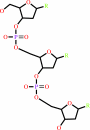 DNA(n)
|
+
|
2'-deoxyribonucleoside 5'-triphosphate
|
=
|
DNA(n+1)
|
+
|
 diphosphate
|
|
|
|
|
|
|
|
|
|
|
|
|
Molecule diagrams generated from .mol files obtained from the
KEGG ftp site
|
|
|
|
|
|
|
|
|
|
|
|
|
|
 |
|
|
|
|
|
|
| |
|
|
| |
|
DOI no:
|
Mol Cell
29:767-779
(2008)
|
|
PubMed id:
|
|
|
|
|
|
| |
|
Structural insights into the generation of single-base deletions by the Y family DNA polymerase dbh.
|
|
R.C.Wilson,
J.D.Pata.
|
|
|
|
|
| |
ABSTRACT
|
|
|
|
| |
|
|
Dbh is a Y family translesion DNA polymerase that accurately bypasses some
damaged forms of deoxyguanosine, but also generates single-base deletion errors
at frequencies of up to 50%, in specific hot spot sequences. We describe
preinsertion binary, insertion ternary, and postinsertion binary crystal
structures of Dbh synthesizing DNA after making a single-base deletion. The
skipped template base adopts an extrahelical conformation stabilized by
interactions with the C-terminal domain of the enzyme. DNA translocation and
positioning of the next templating base at the active site, with space opposite
to accommodate incoming nucleotide, occur independently of nucleotide binding,
incorporation, and pyrophosphate release. We also show that Dbh creates
single-base deletions more rapidly when the skipped base is located two or three
bases upstream of the nascent base pair than when it is directly adjacent to the
templating base, indicating that Dbh predominantly creates single-base deletions
by template slippage rather than by dNTP-stabilized misalignment.
|
|
|
|
|
|
| |
Selected figure(s)
|
|
|
|
| |
|
|

|
|

|
|
Figure 1.
Figure 1. Crystal Structure of Dbh Extending DNA Synthesis
beyond a Single-Base Deletion in a Repetitive Sequence
(A)
Ternary complex structure. The polymerase and primer-template
DNA are shown in ribbons representation, the incoming dNTP is
shown as a ball-and-stick model, and the Ca^2+ ion (bound in the
metal B position) is shown as a sphere (green). Residues Arg333
and Tyr249 that interact with the bulged template cytosine at
position −3 are shown in ball-and-stick representation.
Coloring is as follows: palm (magenta), thumb (green), fingers
(blue), C-terminal domain (orange), linker between polymerase
and C-terminal domains (pale yellow); and DNA (white). The
template strand single-base deletion hot spot sequence
(5′-GCCC-3′) is labeled and highlighted in red.
(B)
Protein-DNA interactions. Hydrogen bonds and van der Waals
contacts are indicated by dotted lines; residues that contact
the DNA with side-chain atoms are labeled in boldface; other
residues that contact main-chain atoms are labeled in plain
type. Residues are colored according to domain, as in (A).
Nucleotides are numbered relative to the templating base
(position 0). The complete sequence of the DNA oligonucleotides
used is shown; the template-strand hot spot sequence is
highlighted in red. Unpaired nucleotides at the 5′ and 3′
ends of the template strand (positions +2 and −12) were not
clearly visible in the electron density maps and were thus not
modeled. Residues in the flexible loop that are close enough to
contact the backbone of the template in positions −1, −2,
and −3 are boxed and labeled in italic font; precise contacts
are not identified, because of the weak electron density in this
part of the protein. The Ca^2+ ion bound at the active site in
the metal B position is shown as a circle labeled B.
(C–E) The active sites and primer-template DNA sequences are
shown for (C) preinsertion binary complex, (D) insertion ternary
complex, and (E) postinsertion binary complex. For each
structure, a final refined 2F[o] − F[c] electron density map,
calculated using the same resolution limits (Table 1) as used
for refining each structure and contoured at 1.2 σ (gray mesh),
is shown for the DNA substrates, calcium, and Dbh residues Asp7,
Asp105, Glu106, Tyr10, Tyr48, and Arg51 and is superimposed on
the final refined model. The incoming nucleotide (ddGTP), DNA,
and selected residues in the active site pocket are shown in
stick representation; other portions of the protein are shown in
ribbons representation. The 3′ primer terminus (dG) of each
structure is labeled. Atoms are colored by element: oxygen
(red), nitrogen (blue), phosphate (yellow), carbon (white), and
calcium (green). Coordination of the Ca^2+ ion in the ternary
complex is shown with dotted lines (dark gray).
|
|
Figure 3.
Figure 3. Orientation of the C-Terminal Domains of Dbh and
Dpo4 and Their Interactions with DNA
(A) Comparison of the
structures of apo-Dbh (left; PDB code 1K1Q, chain A [Silvian et
al., 2001]), Dbh ternary complex (middle), and Dpo4 ternary
complex (right; Ab-2A, PDB code 1S0O, chain B [Ling et al.,
2004]). Arrows indicate direction and magnitude of movement
needed to move the C-terminal domain of one structure to the
orientation found in the Dbh ternary complex structure. Rotation
axes are shown as black lines. Structures were aligned based on
the polymerase domains; Dbh (apo) and Dbh (ternary), rmsd 1.2
Å, 232 Cα atoms; Dbh(ternary) and Dpo4 (Ab-2A ternary),
rmsd 1.7 Å, 240 Cα atoms.
(B) Residues of the
C-terminal domain of Dbh that contact the DNA. Atoms in the
C-terminal domain of Dbh that are located within 3.8 Å of
the DNA are highlighted in white.
(C) Comparison of DNA
binding by the C-terminal domains in the ternary complexes of
the Dbh (top) and Dpo4 Ab-2a (bottom). The bulged base in Dbh
(C-3) and the bulged ribose in Dpo4 (Ab-2A) are highlighted in
red. The structures are oriented identically, by superimposition
of the polymerase domains as in (A), and are viewed from the
same direction. For clarity, only the DNA and C-terminal domains
are shown. Structures are colored as in Figure 1.
|
|
|
|
|
|
| |
The above figures are
reprinted
by permission from Cell Press:
Mol Cell
(2008,
29,
767-779)
copyright 2008.
|
|
| |
Figures were
selected
by the author.
|
|
|
|
|
|
|
|
|
|
|
|
|
|
|
|
 |
 |
 |
|
Literature references that cite this PDB file's key reference
|
|
|
| |
PubMed id
|
|
Reference
|
|
|
|
|
|
C.Biertümpfel,
Y.Zhao,
Y.Kondo,
S.Ramón-Maiques,
M.Gregory,
J.Y.Lee,
C.Masutani,
A.R.Lehmann,
F.Hanaoka,
and
W.Yang
(2010).
Structure and mechanism of human DNA polymerase eta.
|
| |
Nature,
465,
1044-1048.
|
|
|
PDB codes:
|
|
|
|
|
|
|
|
J.D.Pata
(2010).
Structural diversity of the Y-family DNA polymerases.
|
| |
Biochim Biophys Acta,
1804,
1124-1135.
|
|
|
|
|
|
|
O.Rechkoblit,
A.Kolbanovskiy,
L.Malinina,
N.E.Geacintov,
S.Broyde,
and
D.J.Patel
(2010).
Mechanism of error-free and semitargeted mutagenic bypass of an aromatic amine lesion by Y-family polymerase Dpo4.
|
| |
Nat Struct Mol Biol,
17,
379-388.
|
|
|
PDB codes:
|
|
|
|
|
|
|
|
S.Broyde,
and
D.J.Patel
(2010).
DNA repair: How to accurately bypass damage.
|
| |
Nature,
465,
1023-1024.
|
|
|
|
|
|
|
D.F.Jarosz,
S.E.Cohen,
J.C.Delaney,
J.M.Essigmann,
and
G.C.Walker
(2009).
A DinB variant reveals diverse physiological consequences of incomplete TLS extension by a Y-family DNA polymerase.
|
| |
Proc Natl Acad Sci U S A,
106,
21137-21142.
|
|
|
|
|
|
|
F.Wang,
and
W.Yang
(2009).
Structural insight into translesion synthesis by DNA Pol II.
|
| |
Cell,
139,
1279-1289.
|
|
|
PDB codes:
|
|
|
|
|
|
|
|
H.Zhang,
J.W.Beckman,
and
F.P.Guengerich
(2009).
Frameshift deletion by Sulfolobus solfataricus P2 DNA polymerase Dpo4 T239W is selective for purines and involves normal conformational change followed by slow phosphodiester bond formation.
|
| |
J Biol Chem,
284,
35144-35153.
|
|
|
|
|
|
|
J.D.Fowler,
J.A.Brown,
M.Kvaratskhelia,
and
Z.Suo
(2009).
Probing conformational changes of human DNA polymerase lambda using mass spectrometry-based protein footprinting.
|
| |
J Mol Biol,
390,
368-379.
|
|
|
|
|
|
The most recent references are shown first.
Citation data come partly from CiteXplore and partly
from an automated harvesting procedure. Note that this is likely to be
only a partial list as not all journals are covered by
either method. However, we are continually building up the citation data
so more and more references will be included with time.
Where a reference describes a PDB structure, the PDB
codes are
shown on the right.
|
|


 Links
Links


