|
|
|
|
|
 |
Contents |
 |
|
|
|
|
|
|
|
|
|
|
|
|
* Residue conservation analysis
|
|
|
|
|
|
|
|
|
|
Enzyme class 1:
|
|
Chain A:
E.C.3.6.4.10
- non-chaperonin molecular chaperone ATPase.
|
|
|
|
|
|
|
Reaction:
|
|
ATP + H2O = ADP + phosphate + H+
|
|
|
|
|
|
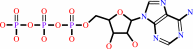 ATP
ATP
|
+
|
H2O
|
=
|
 ADP
ADP
|
+
|
phosphate
Bound ligand (Het Group name = )
corresponds exactly
|
+
|
H(+)
|
|
|
|
|
|
|
|
|
|
Enzyme class 2:
|
|
Chain B:
E.C.3.1.3.-
- ?????
|
|
|
|
|
|
|
|
|
|
Note, where more than one E.C. class is given (as above), each may
correspond to a different protein domain or, in the case of polyprotein
precursors, to a different mature protein.
|
|
|
|
Molecule diagrams generated from .mol files obtained from the
KEGG ftp site
|
|
|
|
|
|
|
|
|
|
|
|
|
|
 |
|
|
|
|
|
|
| |
|
|
| |
|
DOI no:
|
Mol Cell
28:422-433
(2007)
|
|
PubMed id:
|
|
|
|
|
|
| |
|
Structural basis of J cochaperone binding and regulation of Hsp70.
|
|
J.Jiang,
E.G.Maes,
A.B.Taylor,
L.Wang,
A.P.Hinck,
E.M.Lafer,
R.Sousa.
|
|
|
|
|
| |
ABSTRACT
|
|
|
|
| |
|
|
The many protein processing reactions of the ATP-hydrolyzing Hsp70s are
regulated by J cochaperones, which contain J domains that stimulate Hsp70 ATPase
activity and accessory domains that present protein substrates to Hsp70s. We
report the structure of a J domain complexed with a J responsive portion of a
mammalian Hsp70. The J domain activates ATPase activity by directing the linker
that connects the Hsp70 nucleotide binding domain (NBD) and substrate binding
domain (SBD) toward a hydrophobic patch on the NBD surface. Binding of the J
domain to Hsp70 displaces the SBD from the NBD, which may allow the SBD
flexibility to capture diverse substrates. Unlike prokaryotic Hsp70, the SBD and
NBD of the mammalian chaperone interact in the ADP state. Thus, although both
nucleotides and J cochaperones modulate Hsp70 NBD:linker and NBD:SBD
interactions, the intrinsic persistence of those interactions differs in
different Hsp70s and this may optimize their activities for different cellular
roles.
|
|
|
|
|
|
| |
Selected figure(s)
|
|
|
|
| |
|
|

|
|

|
|
Figure 2.
Figure 2. The NBD_Linker:Auxilin J Domain Complex
(A)
NBD_Linker:auxilin J Domain complex with J domain (cyan) in
ribbon representation and NBD_Linker rendered as a transparent
surface (green; with aa 383–390 in magenta) with the path of
the polypeptide chain shown as a coil and the bound nucleotide
in stick representation.
(B) Model from (A) rotated as
indicated. In yellow on the J domain are regions corresponding
to those mapped by NMR (in the polyoma virus T antigen) to be
involved in interaction with Hsc70 (Garimella et al., 2006).
(C) The region indicated by the box in (B) expanded to
identify residues important for the J domain:Hsc70 interaction.
These are labeled with white lettering on the surface of the
Hsc70, which is colored green, red, and blue for carbon, oxygen,
and nitrogen atoms, respectively, and with black lettering on
the J domain with stick representations of the side chains of
relevant J domain residues colored cyan, red, and blue for
carbon, oxygen, and nitrogen atoms, respectively.
|
|
Figure 4.
Figure 4. J Domain-Induced Changes in Linker Conformation May
Activate ATPase through Interactions with Y371 and I181
(A)
Structures of the J domain (cyan) and Hsc70 residues 371–389,
181, and 187 with the linker in the “Out” conformation.
Hsc70 linker residues 383–389 and 371–382+181+187 are in
magenta and green, respectively. The ED around the illustrated
Hsc70 residues is contoured at 0.5 σ.
(B) As in (A), but
with the linker in the “In” conformation and extending to
residue 390; average B factors for linker residues 383–389
(“Out”) or 383–390 (“In”) are 55 and 56, respectively,
whereas the average B factor for residues 3–382 of the NBD is
28.
(C) Effects of J domain on the ATPase rates of WT and
mutant Hsc70ΔC enzymes. Experimental conditions as in Figure 1,
but with Hsc70ΔC and J domain (+J) at 10 and 25 μM,
respectively. Error bars are ± SEM for n = 3.
|
|
|
|
|
|
| |
The above figures are
reprinted
from an Open Access publication published by Cell Press:
Mol Cell
(2007,
28,
422-433)
copyright 2007.
|
|
| |
Figures were
selected
by an automated process.
|
|
|
|
|
|
|
|
|
|
|
|
|
|
|
|
 |
 |
 |
|
Literature references that cite this PDB file's key reference
|
|
|
| |
PubMed id
|
|
Reference
|
|
|
|
|
|
A.Zhuravleva,
and
L.M.Gierasch
(2011).
Allosteric signal transmission in the nucleotide-binding domain of 70-kDa heat shock protein (Hsp70) molecular chaperones.
|
| |
Proc Natl Acad Sci U S A,
108,
6987-6992.
|
|
|
|
|
|
|
L.Chang,
Y.Miyata,
P.M.Ung,
E.B.Bertelsen,
T.J.McQuade,
H.A.Carlson,
E.R.Zuiderweg,
and
J.E.Gestwicki
(2011).
Chemical screens against a reconstituted multiprotein complex: myricetin blocks DnaJ regulation of DnaK through an allosteric mechanism.
|
| |
Chem Biol,
18,
210-221.
|
|
|
|
|
|
|
M.Hagiwara,
K.Maegawa,
M.Suzuki,
R.Ushioda,
K.Araki,
Y.Matsumoto,
J.Hoseki,
K.Nagata,
and
K.Inaba
(2011).
Structural basis of an ERAD pathway mediated by the ER-resident protein disulfide reductase ERdj5.
|
| |
Mol Cell,
41,
432-444.
|
|
|
PDB codes:
|
|
|
|
|
|
|
|
A.Takano,
N.Suetsugu,
M.Wada,
and
D.Kohda
(2010).
Crystallographic and functional analyses of J-domain of JAC1 essential for chloroplast photorelocation movement in Arabidopsis thaliana.
|
| |
Plant Cell Physiol,
51,
1372-1376.
|
|
|
PDB code:
|
|
|
|
|
|
|
|
C.Sahi,
T.Lee,
M.Inada,
J.A.Pleiss,
and
E.A.Craig
(2010).
Cwc23, an essential J protein critical for pre-mRNA splicing with a dispensable J domain.
|
| |
Mol Cell Biol,
30,
33-42.
|
|
|
|
|
|
|
H.H.Kampinga,
and
E.A.Craig
(2010).
The HSP70 chaperone machinery: J proteins as drivers of functional specificity.
|
| |
Nat Rev Mol Cell Biol,
11,
579-592.
|
|
|
|
|
|
|
J.C.Young
(2010).
Mechanisms of the Hsp70 chaperone system.
|
| |
Biochem Cell Biol,
88,
291-300.
|
|
|
|
|
|
|
J.Hoseki,
R.Ushioda,
and
K.Nagata
(2010).
Mechanism and components of endoplasmic reticulum-associated degradation.
|
| |
J Biochem,
147,
19-25.
|
|
|
|
|
|
|
K.Mapa,
M.Sikor,
V.Kudryavtsev,
K.Waegemann,
S.Kalinin,
C.A.Seidel,
W.Neupert,
D.C.Lamb,
and
D.Mokranjac
(2010).
The conformational dynamics of the mitochondrial Hsp70 chaperone.
|
| |
Mol Cell,
38,
89.
|
|
|
|
|
|
|
M.Blamowska,
M.Sichting,
K.Mapa,
D.Mokranjac,
W.Neupert,
and
K.Hell
(2010).
ATPase domain and interdomain linker play a key role in aggregation of mitochondrial Hsp70 chaperone Ssc1.
|
| |
J Biol Chem,
285,
4423-4431.
|
|
|
|
|
|
|
M.Shida,
A.Arakawa,
R.Ishii,
S.Kishishita,
T.Takagi,
M.Kukimoto-Niino,
S.Sugano,
A.Tanaka,
M.Shirouzu,
and
S.Yokoyama
(2010).
Direct inter-subdomain interactions switch between the closed and open forms of the Hsp70 nucleotide-binding domain in the nucleotide-free state.
|
| |
Acta Crystallogr D Biol Crystallogr,
66,
223-232.
|
|
|
PDB codes:
|
|
|
|
|
|
|
|
R.G.Smock,
O.Rivoire,
W.P.Russ,
J.F.Swain,
S.Leibler,
R.Ranganathan,
and
L.M.Gierasch
(2010).
An interdomain sector mediating allostery in Hsp70 molecular chaperones.
|
| |
Mol Syst Biol,
6,
414.
|
|
|
|
|
|
|
Y.Liu,
L.M.Gierasch,
and
I.Bahar
(2010).
Role of Hsp70 ATPase domain intrinsic dynamics and sequence evolution in enabling its functional interactions with NEFs.
|
| |
PLoS Comput Biol,
6,
0.
|
|
|
|
|
|
|
Y.Xing,
T.Böcking,
M.Wolf,
N.Grigorieff,
T.Kirchhausen,
and
S.C.Harrison
(2010).
Structure of clathrin coat with bound Hsc70 and auxilin: mechanism of Hsc70-facilitated disassembly.
|
| |
EMBO J,
29,
655-665.
|
|
|
|
|
|
|
D.Becker,
M.Krayl,
A.Strub,
Y.Li,
M.P.Mayer,
and
W.Voos
(2009).
Impaired Interdomain Communication in Mitochondrial Hsp70 Results in the Loss of Inward-directed Translocation Force.
|
| |
J Biol Chem,
284,
2934-2946.
|
|
|
|
|
|
|
D.Sharma,
and
D.C.Masison
(2009).
Hsp70 structure, function, regulation and influence on yeast prions.
|
| |
Protein Pept Lett,
16,
571-581.
|
|
|
|
|
|
|
H.J.Woo,
J.Jiang,
E.M.Lafer,
and
R.Sousa
(2009).
ATP-induced conformational changes in Hsp70: molecular dynamics and experimental validation of an in silico predicted conformation.
|
| |
Biochemistry,
48,
11470-11477.
|
|
|
|
|
|
|
P.Kota,
D.W.Summers,
H.Y.Ren,
D.M.Cyr,
and
N.V.Dokholyan
(2009).
Identification of a consensus motif in substrates bound by a Type I Hsp40.
|
| |
Proc Natl Acad Sci U S A,
106,
11073-11078.
|
|
|
|
|
|
|
J.P.Schuermann,
J.Jiang,
J.Cuellar,
O.Llorca,
L.Wang,
L.E.Gimenez,
S.Jin,
A.B.Taylor,
B.Demeler,
K.A.Morano,
P.J.Hart,
J.M.Valpuesta,
E.M.Lafer,
and
R.Sousa
(2008).
Structure of the Hsp110:Hsc70 nucleotide exchange machine.
|
| |
Mol Cell,
31,
232-243.
|
|
|
PDB code:
|
|
|
|
|
|
|
|
K.Petrova,
S.Oyadomari,
L.M.Hendershot,
and
D.Ron
(2008).
Regulated association of misfolded endoplasmic reticulum lumenal proteins with P58/DNAJc3.
|
| |
EMBO J,
27,
2862-2872.
|
|
|
|
|
|
|
P.G.Needham,
and
D.C.Masison
(2008).
Prion-impairing mutations in Hsp70 chaperone Ssa1: effects on ATPase and chaperone activities.
|
| |
Arch Biochem Biophys,
478,
167-174.
|
|
|
|
|
|
|
S.Tzankov,
M.J.Wong,
K.Shi,
C.Nassif,
and
J.C.Young
(2008).
Functional Divergence between Co-chaperones of Hsc70.
|
| |
J Biol Chem,
283,
27100-27109.
|
|
|
|
|
|
The most recent references are shown first.
Citation data come partly from CiteXplore and partly
from an automated harvesting procedure. Note that this is likely to be
only a partial list as not all journals are covered by
either method. However, we are continually building up the citation data
so more and more references will be included with time.
Where a reference describes a PDB structure, the PDB
codes are
shown on the right.
|
 |


 Links
Links