 |
PDBsum entry 2qnq

|
|
|
|
|
 |
Contents |
 |
|
|
|
|
|
|
|
|
|
|
|
|
|
|
* Residue conservation analysis
|
|
|
|
|
|
|
|
|
|
|
Enzyme class 1:
|
|
E.C.2.7.7.-
- ?????
|
|
|
|
|
|
|
Enzyme class 2:
|
|
E.C.2.7.7.49
- RNA-directed Dna polymerase.
|
|
|
|
|
|
|
Reaction:
|
|
DNA(n) + a 2'-deoxyribonucleoside 5'-triphosphate = DNA(n+1) + diphosphate
|
|
|
|
|
|
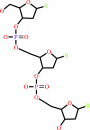 DNA(n)
|
+
|
2'-deoxyribonucleoside 5'-triphosphate
|
=
|
DNA(n+1)
|
+
|
 diphosphate
|
|
|
|
|
|
|
|
|
|
Enzyme class 3:
|
|
E.C.2.7.7.7
- DNA-directed Dna polymerase.
|
|
|
|
|
|
|
Reaction:
|
|
DNA(n) + a 2'-deoxyribonucleoside 5'-triphosphate = DNA(n+1) + diphosphate
|
|
|
|
|
|
DNA(n)
|
+
|
2'-deoxyribonucleoside 5'-triphosphate
|
=
|
DNA(n+1)
|
+
|
diphosphate
|
|
|
|
|
|
|
|
|
|
Enzyme class 4:
|
|
E.C.3.1.-.-
|
|
|
|
|
|
|
Enzyme class 5:
|
|
E.C.3.1.13.2
- exoribonuclease H.
|
|
|
|
|
|
|
Reaction:
|
|
Exonucleolytic cleavage to 5'-phosphomonoester oligonucleotides in both 5'- to 3'- and 3'- to 5'-directions.
|
|
|
|
|
|
Enzyme class 6:
|
|
E.C.3.1.26.13
- retroviral ribonuclease H.
|
|
|
|
|
|
|
Enzyme class 7:
|
|
E.C.3.4.23.16
- HIV-1 retropepsin.
|
|
|
|
|
|
|
Reaction:
|
|
Specific for a P1 residue that is hydrophobic, and P1' variable, but often Pro.
|
|
|
|
|
|
|
|
|
Note, where more than one E.C. class is given (as above), each may
correspond to a different protein domain or, in the case of polyprotein
precursors, to a different mature protein.
|
|
|
|
Molecule diagrams generated from .mol files obtained from the
KEGG ftp site
|
|
|
|
|
|
|
|
|
|
|
|
|
|
 |
|
|
|
|
|
|
| |
|
|
| |
|
|
J Med Chem
51:2078-2087
(2008)
|
|
PubMed id:
|
|
|
|
|
|
| |
|
Structure-guided design of C2-symmetric HIV-1 protease inhibitors based on a pyrrolidine scaffold.
|
|
A.Blum,
J.Böttcher,
A.Heine,
G.Klebe,
W.E.Diederich.
|
|
|
|
|
| |
ABSTRACT
|
|
|
|
| |
|
|
Infections with the human immunodeficiency virus, which inevitably lead to the
development of AIDS, are still among the most serious global health problems
causing more than 2.5 million deaths per year. In the pathophysiological
processes of this pandemic, HIV protease has proven to be an invaluable drug
target because of its essential role in the virus' replication process. By use
of pyrrolidine as core structure, symmetric 3,4-bis-N-alkylsulfonamides were
designed and synthesized enantioselectively from D-(-)-tartaric acid as a new
class of HIV protease inhibitors. Structure-guided design using the cocrystal
structure of an initial lead as starting point resulted in a second series of
inhibitors with improved affinity. The binding modes of four representatives
were determined by X-ray crystallography to elucidate the underlying factors
accounting for the SAR. With this information for further rational design, the
combination of suitable side chains resulted in a final inhibitor showing a
significantly improved affinity of K(i) = 74 nM.
|
|
|
|
|
|
|
|
|
|
|
|
|
|
|
|
|
|
 |
 |
 |
|
Literature references that cite this PDB file's key reference
|
|
|
| |
PubMed id
|
|
Reference
|
|
|
|
|
|
T.Luksch,
A.Blum,
N.Klee,
W.E.Diederich,
C.A.Sotriffer,
and
G.Klebe
(2010).
Pyrrolidine derivatives as plasmepsin inhibitors: binding mode analysis assisted by molecular dynamics simulations of a highly flexible protein.
|
| |
ChemMedChem,
5,
443-454.
|
|
|
|
|
|
The most recent references are shown first.
Citation data come partly from CiteXplore and partly
from an automated harvesting procedure. Note that this is likely to be
only a partial list as not all journals are covered by
either method. However, we are continually building up the citation data
so more and more references will be included with time.
|
|


 Links
Links


