 |
PDBsum entry 2w7o

|
|
|
|
|
|

|

|

|

|
|

|
|

|
|

|
|

|
|

|
|

|
|

|
|

|
|
|
 |

|

|
|
|
|
|
|
|
|
|
|
|
|
|
|
|
|
|
|
|
|
|
|
|
|
|
|
|
|
|
|
|
|
|
|
|
|
|
DNA binding protein
|
PDB id
|
|
|
|
2w7o
|
|
|
|
|
|
|
|
|
|
|
|
|
|
|

|

|

|
|
|
|
|
|
|
|
 |
Contents |
 |
|
|
|
|
|
|
|
|
|
|
|
|
|
|
|
|
* Residue conservation analysis
|
|
|
|
|
|
PDB id:
|
|
|
|
| Name: |
|
DNA binding protein
|
|
|
Title:
|
|
Structure and activity of bypass synthesis by human DNA polymerase kappa opposite the 7,8-dihydro-8-oxodeoxyguanosine adduct
|
|
Structure:
|
|
DNA polymerase kappa. Chain: a, b. Fragment: residues 19-526. Synonym: dinb, dinp. Engineered: yes. Other_details: human DNA polymerase kappa catalytic core, residues 19-526. 5'-d( Gp Gp Gp Gp Gp Ap Ap Gp Gp Ap Tp Tp C)-3'. Chain: e, p.
|
|
Source:
|
|
Homo sapiens. Human. Organism_taxid: 9606. Gene: polk, dinb1. Expressed in: escherichia coli. Expression_system_taxid: 469008. Synthetic: yes. Synthetic: yes
|
|
Resolution:
|
|
|
3.16Å
|
R-factor:
|
0.241
|
R-free:
|
0.278
|
|
|
Authors:
|
|
A.Irimia,M.Egli
|
|
Key ref:
|
|
A.Irimia
et al.
(2009).
Structural and functional elucidation of the mechanism promoting error-prone synthesis by human DNA polymerase kappa opposite the 7,8-dihydro-8-oxo-2'-deoxyguanosine adduct.
J Biol Chem,
284,
22467-22480.
PubMed id:
|
|
|
Date:
|
|
|
23-Dec-08
|
Release date:
|
16-Jun-09
|
|
|
|
|
|
|
PROCHECK
|

|
|
|
|
|
Headers
|
|
|
|
References
|
|
|
|
|
|

|
|
Q9UBT6
(POLK_HUMAN) -
DNA polymerase kappa from Homo sapiens
|
|
|
|
Seq:
Struc:
|
|
|
|
870 a.a.
432 a.a.
|
|

|

|

|
|
|
|
|
|
|
|
|
|
|
Key: |
 |
PfamA domain |
|
|
 |
Secondary structure |
|
 |
CATH domain |
|
|
|
|
|
|
|
|

|
|
|
|
G-G-G-A-A-G-G-A-T-T-C
11 bases
|
|
|
|
C-A-C-8OG-G-A-A-T-C-C-T-T-C-C-C
15 bases
|
|
|
|
G-G-G-G-G-A-A-G-G-A-T-T-C
13 bases
|
|
|
|
C-A-C-8OG-G-A-A-T-C-C-T-T-C-C-C-C-C
17 bases
|
|
|
|
|
|
|
|
|
|
|
|
|
|
Enzyme class:
|
|
E.C.2.7.7.7
- DNA-directed Dna polymerase.
|
|
|
|
|
|
|
Reaction:
|
|
DNA(n) + a 2'-deoxyribonucleoside 5'-triphosphate = DNA(n+1) + diphosphate
|
|
|
|
|
|
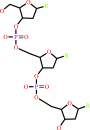 DNA(n)
|
+
|
2'-deoxyribonucleoside 5'-triphosphate
|
=
|
DNA(n+1)
|
+
|
 diphosphate
|
|
|
|
|
|
|
|
|
|
|
|
|
Molecule diagrams generated from .mol files obtained from the
KEGG ftp site
|
|
|
|
|
|
|
|
|
|
|
|
|
|
 |
|
|
|
|
|
|
| |
|
|
| |
|
|
J Biol Chem
284:22467-22480
(2009)
|
|
PubMed id:
|
|
|
|
|
|
| |
|
Structural and functional elucidation of the mechanism promoting error-prone synthesis by human DNA polymerase kappa opposite the 7,8-dihydro-8-oxo-2'-deoxyguanosine adduct.
|
|
A.Irimia,
R.L.Eoff,
F.P.Guengerich,
M.Egli.
|
|
|
|
|
| |
ABSTRACT
|
|
|
|
| |
|
|
Human polymerase kappa (hPol kappa) is one of four eukaryotic Y-class DNA
polymerases and may be an important element in the cellular response to
polycyclic aromatic hydrocarbons such as benzo[a]pyrene, which can lead to
reactive oxygenated metabolite-mediated oxidative stress. Here, we present a
detailed analysis of the activity and specificity of hPol kappa bypass opposite
the major oxidative adduct 7,8-dihydro-8-oxo-2'-deoxyguanosine (8-oxoG). Unlike
its archaeal homolog Dpo4, hPol kappa bypasses this lesion in an error-prone
fashion by inserting mainly dATP. Analysis of transient-state kinetics shows
diminished "bursts" for dATP:8-oxoG and dCTP:8-oxoG incorporation,
indicative of non-productive complex formation, but dATP:8-oxoG insertion events
that do occur are 2-fold more efficient than dCTP:G insertion events. Crystal
structures of ternary hPol kappa complexes with adducted template-primer DNA
reveal non-productive (dGTP and dATP) alignments of incoming nucleotide and
8-oxoG. Structural limitations placed upon the hPol kappa by interactions
between the N-clasp and finger domains combined with stabilization of the
syn-oriented template 8-oxoG through the side chain of Met-135 both appear to
contribute to error-prone bypass. Mutating Leu-508 in the little finger domain
of hPol kappa to lysine modulates the insertion opposite 8-oxoG toward more
accurate bypass, similar to previous findings with Dpo4. Our structural and
activity data provide insight into important mechanistic aspects of error-prone
bypass of 8-oxoG by hPol kappa compared with accurate and efficient bypass of
the lesion by Dpo4 and polymerase eta.
|
|
|
|
|
|
|
|
|
|
|
|
|
|
|
|
|
|
 |
 |
 |
|
Literature references that cite this PDB file's key reference
|
|
|
| |
PubMed id
|
|
Reference
|
|
|
|
|
|
L.Maddukuri,
R.L.Eoff,
J.Y.Choi,
C.J.Rizzo,
F.P.Guengerich,
and
L.J.Marnett
(2010).
In vitro bypass of the major malondialdehyde- and base propenal-derived DNA adduct by human Y-family DNA polymerases κ, ι, and Rev1.
|
| |
Biochemistry,
49,
8415-8424.
|
|
|
|
|
|
|
R.L.Eoff,
J.Y.Choi,
and
F.P.Guengerich
(2010).
Mechanistic Studies with DNA Polymerases Reveal Complex Outcomes following Bypass of DNA Damage.
|
| |
J Nucleic Acids,
2010,
0.
|
|
|
|
|
|
The most recent references are shown first.
Citation data come partly from CiteXplore and partly
from an automated harvesting procedure. Note that this is likely to be
only a partial list as not all journals are covered by
either method. However, we are continually building up the citation data
so more and more references will be included with time.
|
|


 Links
Links


