 |
PDBsum entry 2fjw

|
|
|
|
|
|

|

|

|

|
|

|
|

|
|

|
|

|
|
|
 |

|

|
|
|
|
|
|
|
|
|
|
|
|
|
|
|
|
|
|
|
|
|
|
|
|
|
|
|
|
|
|
|
|
|
Transferase/DNA
|
PDB id
|
|
|
|
2fjw
|
|
|
|
|
|
|
|
|
|
|
|
|
|
|

|

|

|
|
|
|
|
|
|
|
 |
Contents |
 |
|
|
|
|
|
|
|
|
|
|
|
|
* Residue conservation analysis
|
|
|
|
|
|
|
|
|
|
|
Enzyme class 2:
|
|
E.C.2.7.7.-
- ?????
|
|
|
|
|
|
|
Enzyme class 3:
|
|
E.C.2.7.7.49
- RNA-directed Dna polymerase.
|
|
|
|
|
|
|
Reaction:
|
|
DNA(n) + a 2'-deoxyribonucleoside 5'-triphosphate = DNA(n+1) + diphosphate
|
|
|
|
|
|
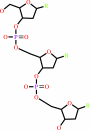 DNA(n)
|
+
|
2'-deoxyribonucleoside 5'-triphosphate
|
=
|
DNA(n+1)
|
+
|
 diphosphate
|
|
|
|
|
|
|
|
|
|
Enzyme class 4:
|
|
E.C.2.7.7.7
- DNA-directed Dna polymerase.
|
|
|
|
|
|
|
Reaction:
|
|
DNA(n) + a 2'-deoxyribonucleoside 5'-triphosphate = DNA(n+1) + diphosphate
|
|
|
|
|
|
DNA(n)
|
+
|
2'-deoxyribonucleoside 5'-triphosphate
|
=
|
DNA(n+1)
|
+
|
diphosphate
|
|
|
|
|
|
|
|
|
|
Enzyme class 5:
|
|
E.C.3.1.-.-
|
|
|
|
|
|
|
Enzyme class 6:
|
|
E.C.3.1.26.4
- ribonuclease H.
|
|
|
|
|
|
|
Reaction:
|
|
Endonucleolytic cleavage to 5'-phosphomonoester.
|
|
|
|
|
|
Enzyme class 7:
|
|
E.C.3.4.23.-
- ?????
|
|
|
|
|
|
|
|
|
|
Note, where more than one E.C. class is given (as above), each may
correspond to a different protein domain or, in the case of polyprotein
precursors, to a different mature protein.
|
|
|
|
Molecule diagrams generated from .mol files obtained from the
KEGG ftp site
|
|
|
|
|
|
|
|
|
|
|
|
|
|
 |
|
|
|
|
|
|
| |
|
|
| |
|
DOI no:
|
J Am Chem Soc
128:7846-7854
(2006)
|
|
PubMed id:
|
|
|
|
|
|
| |
|
A high-throughput, high-resolution strategy for the study of site-selective DNA binding agents: analysis of a "highly twisted" benzimidazole-diamidine.
|
|
K.D.Goodwin,
M.A.Lewis,
F.A.Tanious,
R.R.Tidwell,
W.D.Wilson,
M.M.Georgiadis,
E.C.Long.
|
|
|
|
|
| |
ABSTRACT
|
|
|
|
| |
|
|
A general strategy for the rapid structural analysis of DNA binding ligands is
described as it was applied to the study of RT29, a benzimidazole-diamidine
compound containing a highly twisted diphenyl ether linkage. By combining the
existing high-throughput fluorescent intercalator displacement (HT-FID) assay
developed by Boger et al. and a high-resolution (HR) host-guest crystallographic
technique, a system was produced that was capable of determining detailed
structural information pertaining to RT29-DNA interactions within approximately
3 days. Our application of the HT/HR strategy immediately revealed that RT29 has
a preference for 4-base pair (bp), A.T-rich sites (AATT) and a similar tolerance
and affinity for three A-T-bp sites (such as ATTC) containing a G.C bp. On the
basis of these selectivities, oligonucleotides were designed and the host-guest
crystallographic method was used to generate diffraction quality crystals.
Analysis of the resulting crystal structures revealed that the diphenyl ether
moiety of RT29 undergoes conformational changes that allow it to adopt a
crescent shape that now complements the minor groove structure. The presence of
a G.C bp in the RT29 binding site of ATTC did not overly perturb its interaction
with DNA-the compound adjusted to the nucleobases that were available through
water-mediated interactions. Our analyses suggest that the HT/HR strategy may be
used to expedite the screening of novel minor groove binding compounds leading
to a direct, HR structural determination.
|
|
|
|
|
|
|
|
|
|
|
|
|
|
|
|
|
|
 |
 |
 |
|
Literature references that cite this PDB file's key reference
|
|
|
| |
PubMed id
|
|
Reference
|
|
|
|
|
|
L.S.Glass,
B.Nguyen,
K.D.Goodwin,
C.Dardonville,
W.D.Wilson,
E.C.Long,
and
M.M.Georgiadis
(2009).
Crystal structure of a trypanocidal 4,4'-bis(imidazolinylamino)diphenylamine bound to DNA.
|
| |
Biochemistry,
48,
5943-5952.
|
|
|
PDB code:
|
|
|
|
|
|
|
|
K.D.Goodwin,
M.A.Lewis,
E.C.Long,
and
M.M.Georgiadis
(2008).
Crystal structure of DNA-bound Co(III) bleomycin B2: Insights on intercalation and minor groove binding.
|
| |
Proc Natl Acad Sci U S A,
105,
5052-5056.
|
|
|
PDB codes:
|
|
|
|
|
|
|
|
S.Lee,
B.R.Bowman,
Y.Ueno,
S.Wang,
and
G.L.Verdine
(2008).
Synthesis and structure of duplex DNA containing the genotoxic nucleobase lesion N7-methylguanine.
|
| |
J Am Chem Soc,
130,
11570-11571.
|
|
|
PDB code:
|
|
|
|
|
|
|
|
C.B.Spillane,
J.A.Smith,
J.L.Morgan,
and
F.R.Keene
(2007).
DNA affinity binding studies using a fluorescent dye displacement technique: the dichotomy of the binding site.
|
| |
J Biol Inorg Chem,
12,
819-824.
|
|
|
|
|
|
|
F.A.Tanious,
W.Laine,
P.Peixoto,
C.Bailly,
K.D.Goodwin,
M.A.Lewis,
E.C.Long,
M.M.Georgiadis,
R.R.Tidwell,
and
W.D.Wilson
(2007).
Unusually strong binding to the DNA minor groove by a highly twisted benzimidazole diphenylether: induced fit and bound water.
|
| |
Biochemistry,
46,
6944-6956.
|
|
|
|
|
|
|
S.P.Montaño,
M.L.Coté,
M.J.Roth,
and
M.M.Georgiadis
(2006).
Crystal structures of oligonucleotides including the integrase processing site of the Moloney murine leukemia virus.
|
| |
Nucleic Acids Res,
34,
5353-5360.
|
|
|
PDB codes:
|
|
|
|
|
|
|
The most recent references are shown first.
Citation data come partly from CiteXplore and partly
from an automated harvesting procedure. Note that this is likely to be
only a partial list as not all journals are covered by
either method. However, we are continually building up the citation data
so more and more references will be included with time.
Where a reference describes a PDB structure, the PDB
code is
shown on the right.
|
|


 Links
Links


