 |
PDBsum entry 1xc9

|
|
|
|
|
|

|

|

|

|
|

|
|

|
|

|
|

|
|

|
|

|
|
|
 |

|

|
|
|
|
|
|
|
|
|
|
|
|
|
|
|
|
|
|
|
|
|
|
|
|
|
|
|
|
|
|
|
|
|
|
|
Transferase/DNA
|
PDB id
|
|
|
|
1xc9
|
|
|
|
|
|
|
|
|
|
|
|
|
|
|

|

|

|
|
|
|
|
|
|
|
 |
Contents |
 |
|
|
|
|
|
|
|
|
|
|
|
|
|
|
|
|
* Residue conservation analysis
|
|
|
|
|
|
|
|
|
|
|
Enzyme class:
|
|
E.C.2.7.7.7
- DNA-directed Dna polymerase.
|
|
|
|
|
|
|
Reaction:
|
|
DNA(n) + a 2'-deoxyribonucleoside 5'-triphosphate = DNA(n+1) + diphosphate
|
|
|
|
|
|
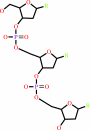 DNA(n)
|
+
|
2'-deoxyribonucleoside 5'-triphosphate
|
=
|
DNA(n+1)
|
+
|
 diphosphate
|
|
|
|
|
|
|
|
|
|
|
|
|
Molecule diagrams generated from .mol files obtained from the
KEGG ftp site
|
|
|
|
|
|
|
|
|
|
|
|
|
|
 |
|
|
|
|
|
|
| |
|
|
| |
|
DOI no:
|
J Biol Chem
280:3764-3770
(2005)
|
|
PubMed id:
|
|
|
|
|
|
| |
|
Structure of a high fidelity DNA polymerase bound to a benzo[a]pyrene adduct that blocks replication.
|
|
G.W.Hsu,
X.Huang,
N.P.Luneva,
N.E.Geacintov,
L.S.Beese.
|
|
|
|
|
| |
ABSTRACT
|
|
|
|
| |
|
|
Of the carcinogens to which humans are most frequently exposed, the polycyclic
aromatic hydrocarbon benzo[a]pyrene (BP) is one of the most ubiquitous. BP is a
byproduct of grilled foods and tobacco and fuel combustion and has long been
linked to various human cancers, particularly lung and skin. BP is metabolized
to diol epoxides that covalently modify DNA bases to form bulky adducts that
block DNA synthesis by replicative or high fidelity DNA polymerases. Here we
present the structure of a high fidelity polymerase from a thermostable strain
of Bacillus stearothermophilus (Bacillus fragment) bound to the most common
BP-derived N2-guanine adduct base-paired with cytosine. The BP adduct adopts a
conformation that places the polycyclic BP moiety in the nascent DNA minor
groove and is the first structure of a minor groove adduct bound to a
polymerase. Orientation of the BP moiety into the nascent DNA minor groove
results in extensive disruption to the interactions between the adducted DNA
duplex and the polymerase. The disruptions revealed by the structure of Bacillus
fragment bound to a BP adduct provide a molecular basis for rationalizing the
potent blocking effect on replication exerted by BP adducts.
|
|
|
|
|
|
| |
Selected figure(s)
|
|
|
|
| |
|
|

|
|

|
|
Figure 2.
FIG. 2. [BP]dG at the post-insertion site of the BF active
site. Stereoview of the structure of BF bound to BP-modified DNA
duplex (red) superimposed on the structure of BF bound to
unmodified DNA duplex (gray). A schematic representing the BF
active site is shown below.
|
|
Figure 3.
FIG. 3. [BP]dG-induced distortions to the BF polymerase
active site. A, the C:[BP]dG base pair surrounded by omit
electron density contoured at 3  with hydrogen bonds
represented in black (dashed lines) accompanied by lengths. B,
superposition of the BP-modified DNA duplex (red) and an
unmodified DNA duplex (gray). The BP moiety of the [BP]dG
protrudes into the DNA minor groove. C, comparison of BF protein
side chain conformations when BF is bound to C:[BP]dG (red) and
C:G (gray) at the post-insertion site (n-1 position). Hydrogen
bonds are represented as dashed lines. D, model of BF in a
ternary complex with [BP]dG (yellow) obstructing the insertion
site to an incoming dCTP. A cognate base pair is shown in gray,
and hydrogen bonds are represented by dashed lines. with hydrogen bonds
represented in black (dashed lines) accompanied by lengths. B,
superposition of the BP-modified DNA duplex (red) and an
unmodified DNA duplex (gray). The BP moiety of the [BP]dG
protrudes into the DNA minor groove. C, comparison of BF protein
side chain conformations when BF is bound to C:[BP]dG (red) and
C:G (gray) at the post-insertion site (n-1 position). Hydrogen
bonds are represented as dashed lines. D, model of BF in a
ternary complex with [BP]dG (yellow) obstructing the insertion
site to an incoming dCTP. A cognate base pair is shown in gray,
and hydrogen bonds are represented by dashed lines.
|
|
|
|
|
|
| |
The above figures are
reprinted
by permission from the ASBMB:
J Biol Chem
(2005,
280,
3764-3770)
copyright 2005.
|
|
| |
Figures were
selected
by an automated process.
|
|
|
|
|
|
|
|
|
|
|
|
|
|
|
|
 |
 |
 |
|
Literature references that cite this PDB file's key reference
|
|
|
| |
PubMed id
|
|
Reference
|
|
|
|
|
|
S.Tommasi,
S.I.Kim,
X.Zhong,
X.Wu,
G.P.Pfeifer,
and
A.Besaratinia
(2010).
Investigating the epigenetic effects of a prototype smoke-derived carcinogen in human cells.
|
| |
PLoS One,
5,
e10594.
|
|
|
|
|
|
|
P.Xu,
L.Oum,
Y.C.Lee,
N.E.Geacintov,
and
S.Broyde
(2009).
Visualizing sequence-governed nucleotide selectivities and mutagenic consequences through a replicative cycle: processing of a bulky carcinogen N2-dG lesion in a Y-family DNA polymerase.
|
| |
Biochemistry,
48,
4677-4690.
|
|
|
|
|
|
|
S.Schneider,
S.Schorr,
and
T.Carell
(2009).
Crystal structure analysis of DNA lesion repair and tolerance mechanisms.
|
| |
Curr Opin Struct Biol,
19,
87-95.
|
|
|
|
|
|
|
T.D.Christian,
and
L.J.Romano
(2009).
Monitoring the conformation of benzo[a]pyrene adducts in the polymerase active site using fluorescence resonance energy transfer.
|
| |
Biochemistry,
48,
5382-5388.
|
|
|
|
|
|
|
J.C.Delaney,
and
J.M.Essigmann
(2008).
Biological properties of single chemical-DNA adducts: a twenty year perspective.
|
| |
Chem Res Toxicol,
21,
232-252.
|
|
|
|
|
|
|
L.Jia,
N.E.Geacintov,
and
S.Broyde
(2008).
The N-clasp of human DNA polymerase kappa promotes blockage or error-free bypass of adenine- or guanine-benzo[a]pyrenyl lesions.
|
| |
Nucleic Acids Res,
36,
6571-6584.
|
|
|
|
|
|
|
R.Venkatramani,
and
R.Radhakrishnan
(2008).
Effect of oxidatively damaged DNA on the active site preorganization during nucleotide incorporation in a high fidelity polymerase from Bacillus stearothermophilus.
|
| |
Proteins,
71,
1360-1372.
|
|
|
|
|
|
|
S.Broyde,
L.Wang,
O.Rechkoblit,
N.E.Geacintov,
and
D.J.Patel
(2008).
Lesion processing: high-fidelity versus lesion-bypass DNA polymerases.
|
| |
Trends Biochem Sci,
33,
209-219.
|
|
|
|
|
|
|
Y.Wang,
N.C.Schnetz-Boutaud,
H.Kroth,
H.Yagi,
J.M.Sayer,
S.Kumar,
D.M.Jerina,
and
M.P.Stone
(2008).
3'-Intercalation of a N2-dG 1R-trans-anti-benzo[c]phenanthrene DNA adduct in an iterated (CG)3 repeat.
|
| |
Chem Res Toxicol,
21,
1348-1358.
|
|
|
PDB code:
|
|
|
|
|
|
|
|
F.A.Rodríguez,
Y.Cai,
C.Lin,
Y.Tang,
A.Kolbanovskiy,
S.Amin,
D.J.Patel,
S.Broyde,
and
N.E.Geacintov
(2007).
Exocyclic amino groups of flanking guanines govern sequence-dependent adduct conformations and local structural distortions for minor groove-aligned benzo[a]pyrenyl-guanine lesions in a GG mutation hotspot context.
|
| |
Nucleic Acids Res,
35,
1555-1568.
|
|
|
|
|
|
|
J.Bauer,
G.Xing,
H.Yagi,
J.M.Sayer,
D.M.Jerina,
and
H.Ling
(2007).
A structural gap in Dpo4 supports mutagenic bypass of a major benzo[a]pyrene dG adduct in DNA through template misalignment.
|
| |
Proc Natl Acad Sci U S A,
104,
14905-14910.
|
|
|
PDB codes:
|
|
|
|
|
|
|
|
M.Garcia-Diaz,
and
K.Bebenek
(2007).
Multiple functions of DNA polymerases.
|
| |
CRC Crit Rev Plant Sci,
26,
105-122.
|
|
|
|
|
|
|
P.Xu,
L.Oum,
L.S.Beese,
N.E.Geacintov,
and
S.Broyde
(2007).
Following an environmental carcinogen N2-dG adduct through replication: elucidating blockage and bypass in a high-fidelity DNA polymerase.
|
| |
Nucleic Acids Res,
35,
4275-4288.
|
|
|
|
|
|
|
S.Meneni,
F.Liang,
and
B.P.Cho
(2007).
Examination of the long-range effects of aminofluorene-induced conformational heterogeneity and its relevance to the mechanism of translesional DNA synthesis.
|
| |
J Mol Biol,
366,
1387-1400.
|
|
|
|
|
|
|
J.J.Warren,
L.J.Forsberg,
and
L.S.Beese
(2006).
The structural basis for the mutagenicity of O(6)-methyl-guanine lesions.
|
| |
Proc Natl Acad Sci U S A,
103,
19701-19706.
|
|
|
PDB codes:
|
|
|
|
|
|
|
|
V.K.Batra,
D.D.Shock,
R.Prasad,
W.A.Beard,
E.W.Hou,
L.C.Pedersen,
J.M.Sayer,
H.Yagi,
S.Kumar,
D.M.Jerina,
and
S.H.Wilson
(2006).
Structure of DNA polymerase beta with a benzo[c]phenanthrene diol epoxide-adducted template exhibits mutagenic features.
|
| |
Proc Natl Acad Sci U S A,
103,
17231-17236.
|
|
|
PDB code:
|
|
|
|
|
|
|
The most recent references are shown first.
Citation data come partly from CiteXplore and partly
from an automated harvesting procedure. Note that this is likely to be
only a partial list as not all journals are covered by
either method. However, we are continually building up the citation data
so more and more references will be included with time.
Where a reference describes a PDB structure, the PDB
code is
shown on the right.
|
|


 Links
Links


