 |
PDBsum entry 2hhs

|
|
|
|
|
|

|

|

|

|
|

|
|

|
|

|
|

|
|

|
|

|
|
|
 |

|

|
|
|
|
|
|
|
|
|
|
|
|
|
|
|
|
|
|
|
|
|
|
|
|
|
|
|
|
|
|
|
|
|
|
|
Transferase/DNA
|
PDB id
|
|
|
|
2hhs
|
|
|
|
|
|
|
|
|
|
|
|
|
|
|

|

|

|
|
|
|
|
|
|
|
 |
Contents |
 |
|
|
|
|
|
|
|
|
|
|
|
|
|
|
|
|
* Residue conservation analysis
|
|
|
|
|
|
|
|
|
|
|
Enzyme class:
|
|
E.C.2.7.7.7
- DNA-directed Dna polymerase.
|
|
|
|
|
|
|
Reaction:
|
|
DNA(n) + a 2'-deoxyribonucleoside 5'-triphosphate = DNA(n+1) + diphosphate
|
|
|
|
|
|
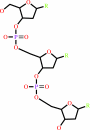 DNA(n)
|
+
|
2'-deoxyribonucleoside 5'-triphosphate
|
=
|
DNA(n+1)
|
+
|
 diphosphate
|
|
|
|
|
|
|
|
|
|
|
|
|
Molecule diagrams generated from .mol files obtained from the
KEGG ftp site
|
|
|
|
|
|
|
|
|
|
|
|
|
|
 |
|
|
|
|
|
|
| |
|
|
| |
|
DOI no:
|
Proc Natl Acad Sci U S A
103:19701-19706
(2006)
|
|
PubMed id:
|
|
|
|
|
|
| |
|
The structural basis for the mutagenicity of O(6)-methyl-guanine lesions.
|
|
J.J.Warren,
L.J.Forsberg,
L.S.Beese.
|
|
|
|
|
| |
ABSTRACT
|
|
|
|
| |
|
|
Methylating agents are widespread environmental carcinogens that generate a
broad spectrum of DNA damage. Methylation at the guanine O(6) position confers
the greatest mutagenic and carcinogenic potential. DNA polymerases insert
cytosine and thymine with similar efficiency opposite O(6)-methyl-guanine
(O6MeG). We combined pre-steady-state kinetic analysis and a series of nine
x-ray crystal structures to contrast the reaction pathways of accurate and
mutagenic replication of O6MeG in a high-fidelity DNA polymerase from Bacillus
stearothermophilus. Polymerases achieve substrate specificity by selecting for
nucleotides with shape and hydrogen-bonding patterns that complement a canonical
DNA template. Our structures reveal that both thymine and cytosine O6MeG base
pairs evade proofreading by mimicking the essential molecular features of
canonical substrates. The steric mimicry depends on stabilization of a rare
cytosine tautomer in C.O6MeG-polymerase complexes. An unusual electrostatic
interaction between O-methyl protons and a thymine carbonyl oxygen helps
stabilize T.O6MeG pairs bound to DNA polymerase. Because DNA methylators
constitute an important class of chemotherapeutic agents, the molecular
mechanisms of replication of these DNA lesions are important for our
understanding of both the genesis and treatment of cancer.
|
|
|
|
|
|
| |
Selected figure(s)
|
|
|
|
| |
|
|

|
|

|
|
Figure 1.
Fig. 1. Structures of O6MeG·C (a) and O6MeG·T
(b) pairs in DNA duplexes, unbound by protein. Hydrogen bonds
are shown as dashed lines. (a Left) O6MeG·C wobble pair
from ref. 27. (a Right) Model of Watson–Crick
O6MeG·protonated C pair from ref. 52. (b) O6MeG·T
pairs from refs. 29 and 30. The presence or absence of the H
bond indicated by the "?" has been the subject of some
controversy (29, 30).
|
|
Figure 3.
Fig. 3. T·O6MeG (a) and C·O6MeG (b)
conformations in the –2 base pair position. Mesh shows 1  2 F[o]
– F[c] electron density for the base pairs. 2 F[o]
– F[c] electron density for the base pairs.
|
|
|
|
| |
Figures were
selected
by an automated process.
|
|
|
|
|
|
|
|
|
|
|
|
|
|
|
|
 |
 |
 |
|
Literature references that cite this PDB file's key reference
|
|
|
| |
PubMed id
|
|
Reference
|
|
|
|
|
|
A.A.Golosov,
J.J.Warren,
L.S.Beese,
and
M.Karplus
(2010).
The mechanism of the translocation step in DNA replication by DNA polymerase I: a computer simulation analysis.
|
| |
Structure,
18,
83-93.
|
|
|
PDB codes:
|
|
|
|
|
|
|
|
V.B.Chen,
W.B.Arendall,
J.J.Headd,
D.A.Keedy,
R.M.Immormino,
G.J.Kapral,
L.W.Murray,
J.S.Richardson,
and
D.C.Richardson
(2010).
MolProbity: all-atom structure validation for macromolecular crystallography.
|
| |
Acta Crystallogr D Biol Crystallogr,
66,
12-21.
|
|
|
|
|
|
|
P.Khuu,
and
P.S.Ho
(2009).
A rare nucleotide base tautomer in the structure of an asymmetric DNA junction.
|
| |
Biochemistry,
48,
7824-7832.
|
|
|
PDB code:
|
|
|
|
|
|
|
|
R.Guza,
L.Ma,
Q.Fang,
A.E.Pegg,
and
N.Tretyakova
(2009).
Cytosine methylation effects on the repair of O6-methylguanines within CG dinucleotides.
|
| |
J Biol Chem,
284,
22601-22610.
|
|
|
|
|
|
|
S.D.Gilbert,
F.E.Reyes,
A.L.Edwards,
and
R.T.Batey
(2009).
Adaptive ligand binding by the purine riboswitch in the recognition of guanine and adenine analogs.
|
| |
Structure,
17,
857-868.
|
|
|
PDB codes:
|
|
|
|
|
|
|
|
X.Meng,
Y.Zhou,
S.Zhang,
E.Y.Lee,
D.N.Frick,
and
M.Y.Lee
(2009).
DNA damage alters DNA polymerase delta to a form that exhibits increased discrimination against modified template bases and mismatched primers.
|
| |
Nucleic Acids Res,
37,
647-657.
|
|
|
|
|
|
|
A.Dimitri,
J.A.Burns,
S.Broyde,
and
D.A.Scicchitano
(2008).
Transcription elongation past O6-methylguanine by human RNA polymerase II and bacteriophage T7 RNA polymerase.
|
| |
Nucleic Acids Res,
36,
6459-6471.
|
|
|
|
|
|
|
H.Feitsma,
A.Akay,
and
E.Cuppen
(2008).
Alkylation damage causes MMR-dependent chromosomal instability in vertebrate embryos.
|
| |
Nucleic Acids Res,
36,
4047-4056.
|
|
|
|
|
|
|
J.C.Delaney,
and
J.M.Essigmann
(2008).
Biological properties of single chemical-DNA adducts: a twenty year perspective.
|
| |
Chem Res Toxicol,
21,
232-252.
|
|
|
|
|
|
|
P.Hsieh,
and
K.Yamane
(2008).
DNA mismatch repair: molecular mechanism, cancer, and ageing.
|
| |
Mech Ageing Dev,
129,
391-407.
|
|
|
|
|
|
|
R.van Boxtel,
P.W.Toonen,
H.S.van Roekel,
M.Verheul,
B.M.Smits,
J.Korving,
A.de Bruin,
and
E.Cuppen
(2008).
Lack of DNA mismatch repair protein MSH6 in the rat results in hereditary non-polyposis colorectal cancer-like tumorigenesis.
|
| |
Carcinogenesis,
29,
1290-1297.
|
|
|
|
|
|
|
S.Broyde,
L.Wang,
O.Rechkoblit,
N.E.Geacintov,
and
D.J.Patel
(2008).
Lesion processing: high-fidelity versus lesion-bypass DNA polymerases.
|
| |
Trends Biochem Sci,
33,
209-219.
|
|
|
|
|
|
|
J.J.Warren,
T.J.Pohlhaus,
A.Changela,
R.R.Iyer,
P.L.Modrich,
and
L.S.Beese
(2007).
Structure of the human MutSalpha DNA lesion recognition complex.
|
| |
Mol Cell,
26,
579-592.
|
|
|
PDB codes:
|
|
|
|
|
|
|
The most recent references are shown first.
Citation data come partly from CiteXplore and partly
from an automated harvesting procedure. Note that this is likely to be
only a partial list as not all journals are covered by
either method. However, we are continually building up the citation data
so more and more references will be included with time.
Where a reference describes a PDB structure, the PDB
codes are
shown on the right.
|
|


 Links
Links


