 |
PDBsum entry 1vij

|
|
|
|
|
|

|

|

|

|
|

|
|

|
|

|
|

|
|
|
 |

|

|
|
|
|
|
|
|
|
|
|
|
|
|
|
|
|
|
|
|
|
|
|
|
|
|
|
|
|
|
|
|
|
|
Aspartyl protease
|
PDB id
|
|
|
|
1vij
|
|
|
|
|
|
|
|
|
|
|
|
|
|
|

|

|

|
|
|
|
|
|
|
|
 |
Contents |
 |
|
|
|
|
|
|
|
|
|
|
|
|
* Residue conservation analysis
|
|
|
|
|
|
|
|
|
|
|
Enzyme class 1:
|
|
E.C.2.7.7.-
- ?????
|
|
|
|
|
|
|
Enzyme class 2:
|
|
E.C.2.7.7.49
- RNA-directed Dna polymerase.
|
|
|
|
|
|
|
Reaction:
|
|
DNA(n) + a 2'-deoxyribonucleoside 5'-triphosphate = DNA(n+1) + diphosphate
|
|
|
|
|
|
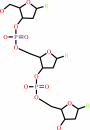 DNA(n)
|
+
|
2'-deoxyribonucleoside 5'-triphosphate
|
=
|
DNA(n+1)
|
+
|
 diphosphate
|
|
|
|
|
|
|
|
|
|
Enzyme class 3:
|
|
E.C.2.7.7.7
- DNA-directed Dna polymerase.
|
|
|
|
|
|
|
Reaction:
|
|
DNA(n) + a 2'-deoxyribonucleoside 5'-triphosphate = DNA(n+1) + diphosphate
|
|
|
|
|
|
DNA(n)
|
+
|
2'-deoxyribonucleoside 5'-triphosphate
|
=
|
DNA(n+1)
|
+
|
diphosphate
|
|
|
|
|
|
|
|
|
|
Enzyme class 4:
|
|
E.C.3.1.-.-
|
|
|
|
|
|
|
Enzyme class 5:
|
|
E.C.3.1.13.2
- exoribonuclease H.
|
|
|
|
|
|
|
Reaction:
|
|
Exonucleolytic cleavage to 5'-phosphomonoester oligonucleotides in both 5'- to 3'- and 3'- to 5'-directions.
|
|
|
|
|
|
Enzyme class 6:
|
|
E.C.3.1.26.13
- retroviral ribonuclease H.
|
|
|
|
|
|
|
Enzyme class 7:
|
|
E.C.3.4.23.16
- HIV-1 retropepsin.
|
|
|
|
|
|
|
Reaction:
|
|
Specific for a P1 residue that is hydrophobic, and P1' variable, but often Pro.
|
|
|
|
|
|
|
|
|
Note, where more than one E.C. class is given (as above), each may
correspond to a different protein domain or, in the case of polyprotein
precursors, to a different mature protein.
|
|
|
|
Molecule diagrams generated from .mol files obtained from the
KEGG ftp site
|
|
|
|
|
|
|
|
|
|
|
|
|
|
 |
|
|
|
|
|
|
| |
|
|
| |
|
|
Eur J Biochem
248:313-322
(1997)
|
|
PubMed id:
|
|
|
|
|
|
| |
|
Structure of HOE/BAY 793 complexed to human immunodeficiency virus (HIV-1) protease in two different crystal forms--structure/function relationship and influence of crystal packing.
|
|
G.Lange-Savage,
H.Berchtold,
A.Liesum,
K.H.Budt,
A.Peyman,
J.Knolle,
J.Sedlacek,
M.Fabry,
R.Hilgenfeld.
|
|
|
|
|
| |
ABSTRACT
|
|
|
|
| |
|
|
Human immunodeficiency virus 1 (HIV-1) protease is a prime target in the search
for drugs to combat the AIDS virus. The enzyme functions as a C2-symmetric
dimer, cleaving the gag and gag-pol viral polyproteins at distinct sites. The
possession of a twofold axis passing through the active site, has led to the
design of C2-symmetrical inhibitors in the form of substrate-based
transition-state analogs. One of the most active compounds of this class of
inhibitors is HOE/BAY 793, which contains a vicinal diol central unit [Budt,
K.-H., Hansen, J., Knolle, J., Meichsner, C., Paessens, A., Ruppert, D. &
Stowasser, B. & Winkler, I. (1990) European Patent application EP0428,849;
Budt, K.-H., Hansen, J., Knolle, J., Meichsner, C., Ruppert, D., Paessens, A.
& Stowasser B. (1993) IXth International Conference on AIDS; Budt, K.-H.,
Peyman, A., Hansen, J., Knolle, J., Meichsner, C., Paessens, A., Ruppert, D.
& Stowasser, B. (1995) Bioorg. Med. Chem. 3, 559-571.] The structure of this
inhibitor bound to HIV-1 protease, in two different crystal forms, has been
solved at 0.24-nm resolution using X-ray crystallography. In both forms, the
details of the inhibitor-protease interactions revealed an overall asymmetric
binding mode, especially between the central diol unit and the active-site
aspartates. The main binding interactions comprise several specific H-bonds and
hydrophobic contacts, which rationalize many of the characteristics of the
structure/activity relationship in the class of vicinal diol inhibitors. In a
general analysis of the mobility of the flap regions, which cover the active
site and participate directly in binding, using our structures and the HIV
protease models present in the Brookhaven databank, we found that in most
structures the flexibility of the flaps is limited by local crystal contacts.
However, in one of the structures presented here, no significant crystal
contacts to the flap regions were present, and as a result the flexibility of
the inhibitor bound flaps increased significantly. This suggests that the
mobility and conformational flexibility of the flap residues are important in
the functioning of HIV-1 protease, and must be considered in the future design
of drugs against HIV protease and in structure-based drug design in general.
|
|
|
|
|
|
|
|
|
|
|
|
|
|
|
|
|
|
 |
 |
 |
|
Literature references that cite this PDB file's key reference
|
|
|
| |
PubMed id
|
|
Reference
|
|
|
|
|
|
V.Hornak,
and
C.Simmerling
(2007).
Targeting structural flexibility in HIV-1 protease inhibitor binding.
|
| |
Drug Discov Today,
12,
132-138.
|
|
|
|
|
|
|
C.S.Rapp,
and
R.M.Pollack
(2005).
Crystal packing effects on protein loops.
|
| |
Proteins,
60,
103-109.
|
|
|
|
|
|
|
D.Kovalskyy,
V.Dubyna,
A.E.Mark,
and
A.Kornelyuk
(2005).
A molecular dynamics study of the structural stability of HIV-1 protease under physiological conditions: the role of Na+ ions in stabilizing the active site.
|
| |
Proteins,
58,
450-458.
|
|
|
|
|
|
|
A.Tossi,
I.Bonin,
N.Antcheva,
S.Norbedo,
F.Benedetti,
S.Miertus,
A.C.Nair,
T.Maliar,
F.Dal Bello,
G.Palù,
and
D.Romeo
(2000).
Aspartic protease inhibitors. An integrated approach for the design andsynthesis of diaminodiol-based peptidomimetics.
|
| |
Eur J Biochem,
267,
1715-1722.
|
|
|
|
|
|
|
W.R.Scott,
and
C.A.Schiffer
(2000).
Curling of flap tips in HIV-1 protease as a mechanism for substrate entry and tolerance of drug resistance.
|
| |
Structure,
8,
1259-1265.
|
|
|
|
|
|
|
J.L.Martin,
J.Begun,
A.Schindeler,
W.A.Wickramasinghe,
D.Alewood,
P.F.Alewood,
D.A.Bergman,
R.I.Brinkworth,
G.Abbenante,
D.R.March,
R.C.Reid,
and
D.P.Fairlie
(1999).
Molecular recognition of macrocyclic peptidomimetic inhibitors by HIV-1 protease.
|
| |
Biochemistry,
38,
7978-7988.
|
|
|
PDB codes:
|
|
|
|
|
|
|
|
J.Kervinen,
J.Lubkowski,
A.Zdanov,
D.Bhatt,
B.M.Dunn,
K.Y.Hui,
D.J.Powell,
J.Kay,
A.Wlodawer,
and
A.Gustchina
(1998).
Toward a universal inhibitor of retroviral proteases: comparative analysis of the interactions of LP-130 complexed with proteases from HIV-1, FIV, and EIAV.
|
| |
Protein Sci,
7,
2314-2323.
|
|
|
PDB codes:
|
|
|
|
|
|
|
The most recent references are shown first.
Citation data come partly from CiteXplore and partly
from an automated harvesting procedure. Note that this is likely to be
only a partial list as not all journals are covered by
either method. However, we are continually building up the citation data
so more and more references will be included with time.
Where a reference describes a PDB structure, the PDB
codes are
shown on the right.
|
|


 Links
Links


