 |
PDBsum entry 1tp7

|
|
|
|
|
 |
Contents |
 |
|
|
|
|
|
|
|
|
|
|
|
|
* Residue conservation analysis
|
|
|
|
|
|
PDB id:
|
|
|
|
| Name: |
|
Transferase
|
|
|
Title:
|
|
Crystal structure of the RNA-dependent RNA polymerase from human rhinovirus 16
|
|
Structure:
|
|
Genome polyprotein. Chain: a, b, c, d. Fragment: RNA-directed RNA polymerase (residues 1694-2153). Synonym: p3d. Engineered: yes
|
|
Source:
|
|
Human rhinovirus 16. Organism_taxid: 31708. Gene: 3d. Expressed in: escherichia coli bl21(de3). Expression_system_taxid: 469008.
|
|
Resolution:
|
|
|
2.40Å
|
R-factor:
|
0.243
|
R-free:
|
0.292
|
|
|
Authors:
|
|
T.C.Appleby,H.Luecke,J.H.Shim,J.Z.Wu,I.W.Cheney,W.Zhong,L.Vogeley, Z.Hong,N.Yao
|
|
Key ref:
|
|
T.C.Appleby
et al.
(2005).
Crystal structure of complete rhinovirus RNA polymerase suggests front loading of protein primer.
J Virol,
79,
277-288.
PubMed id:
|
|
|
Date:
|
|
|
15-Jun-04
|
Release date:
|
21-Jun-05
|
|
|
|
|
|
|
PROCHECK
|

|
|
|
|
|
Headers
|
|
|
|
References
|
|
|
|
|
|

|
|
Q82122
(POLG_HRV16) -
Genome polyprotein from Human rhinovirus 16
|
|
|
|
Seq:
Struc:
|
|
|
|
2153 a.a.
460 a.a.
|
|

|

|
|
|
|
|
|
|
|
|
|
|
|
Key: |
 |
PfamA domain |
|
|
 |
Secondary structure |
|
 |
CATH domain |
|
|
|
|
|
|
|
|
|
|
|
|
|
Enzyme class 2:
|
|
E.C.2.7.7.48
- RNA-directed Rna polymerase.
|
|
|
|
|
|
|
Reaction:
|
|
RNA(n) + a ribonucleoside 5'-triphosphate = RNA(n+1) + diphosphate
|
|
|
|
|
|
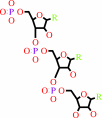 RNA(n)
|
+
|
ribonucleoside 5'-triphosphate
|
=
|
RNA(n+1)
|
+
|
 diphosphate
|
|
|
|
|
|
|
|
|
|
Enzyme class 3:
|
|
E.C.3.4.22.28
- picornain 3C.
|
|
|
|
|
|
|
Reaction:
|
|
Selective cleavage of Gln-|-Gly bond in the poliovirus polyprotein. In other picornavirus reactions Glu may be substituted for Gln, and Ser or Thr for Gly.
|
|
|
|
|
|
Enzyme class 4:
|
|
E.C.3.4.22.29
- picornain 2A.
|
|
|
|
|
|
|
Reaction:
|
|
Selective cleavage of Tyr-|-Gly bond in the picornavirus polyprotein. In other picornavirus reactions Glu may be substituted for Gln, and Ser or Thr for Gly.
|
|
|
|
|
|
Enzyme class 5:
|
|
E.C.3.6.1.15
- nucleoside-triphosphate phosphatase.
|
|
|
|
|
|
|
Reaction:
|
|
a ribonucleoside 5'-triphosphate + H2O = a ribonucleoside 5'-diphosphate + phosphate + H+
|
|
|
|
|
|
ribonucleoside 5'-triphosphate
|
+
|
H2O
|
=
|
ribonucleoside 5'-diphosphate
|
+
|
 phosphate
|
+
|
H(+)
|
|
|
|
|
|
|
|
|
|
|
|
|
Note, where more than one E.C. class is given (as above), each may
correspond to a different protein domain or, in the case of polyprotein
precursors, to a different mature protein.
|
|
|
|
Molecule diagrams generated from .mol files obtained from the
KEGG ftp site
|
|
|
|
|
|
|
|
|
|
|
|
|
|
 |
|
|
|
|
|
|
| |
|
|
| |
|
|
J Virol
79:277-288
(2005)
|
|
PubMed id:
|
|
|
|
|
|
| |
|
Crystal structure of complete rhinovirus RNA polymerase suggests front loading of protein primer.
|
|
T.C.Appleby,
H.Luecke,
J.H.Shim,
J.Z.Wu,
I.W.Cheney,
W.Zhong,
L.Vogeley,
Z.Hong,
N.Yao.
|
|
|
|
|
| |
ABSTRACT
|
|
|
|
| |
|
|
Picornaviruses utilize virally encoded RNA polymerase and a uridylylated protein
primer to ensure replication of the entire viral genome. The molecular details
of this mechanism are not well understood due to the lack of structural
information. We report the crystal structure of human rhinovirus 16 3D
RNA-dependent RNA polymerase (HRV16 3Dpol) at a 2.4-A resolution, representing
the first complete polymerase structure from the Picornaviridae family. HRV16
3Dpol shares the canonical features of other known polymerase structures and
contains an N-terminal region that tethers the fingers and thumb subdomains,
forming a completely encircled active site cavity which is accessible through a
small tunnel on the backside of the molecule. The small thumb subdomain
contributes to the formation of a large cleft on the front face of the
polymerase which also leads to the active site. The cleft appears large enough
to accommodate a template:primer duplex during RNA elongation or a protein
primer during the uridylylation stage of replication initiation. Based on the
structural features of HRV16 3Dpo1 and the catalytic mechanism known for all
polymerases, a front-loading model for uridylylation is proposed.
|
|
|
|
|
|
|
|
|
|
|
|
|
|
|
|
|
|
 |
 |
 |
|
Literature references that cite this PDB file's key reference
|
|
|
| |
PubMed id
|
|
Reference
|
|
|
|
|
|
C.E.Cameron,
H.Suk Oh,
and
I.M.Moustafa
(2010).
Expanding knowledge of P3 proteins in the poliovirus lifecycle.
|
| |
Future Microbiol,
5,
867-881.
|
|
|
|
|
|
|
J.Kerkvliet,
R.Edukulla,
and
M.Rodriguez
(2010).
Novel roles of the picornaviral 3D polymerase in viral pathogenesis.
|
| |
Adv Virol,
2010,
368068.
|
|
|
|
|
|
|
B.P.Steil,
and
D.J.Barton
(2009).
Cis-active RNA elements (CREs) and picornavirus RNA replication.
|
| |
Virus Res,
139,
240-252.
|
|
|
|
|
|
|
N.Lewis-Rogers,
M.L.Bendall,
and
K.A.Crandall
(2009).
Phylogenetic relationships and molecular adaptation dynamics of human rhinoviruses.
|
| |
Mol Biol Evol,
26,
969-981.
|
|
|
|
|
|
|
A.Gruez,
B.Selisko,
M.Roberts,
G.Bricogne,
C.Bussetta,
I.Jabafi,
B.Coutard,
A.M.De Palma,
J.Neyts,
and
B.Canard
(2008).
The crystal structure of coxsackievirus B3 RNA-dependent RNA polymerase in complex with its protein primer VPg confirms the existence of a second VPg binding site on Picornaviridae polymerases.
|
| |
J Virol,
82,
9577-9590.
|
|
|
PDB codes:
|
|
|
|
|
|
|
|
D.N.Harrison,
E.V.Gazina,
D.F.Purcell,
D.A.Anderson,
and
S.Petrou
(2008).
Amiloride derivatives inhibit coxsackievirus B3 RNA replication.
|
| |
J Virol,
82,
1465-1473.
|
|
|
|
|
|
|
K.K.Ng,
J.J.Arnold,
and
C.E.Cameron
(2008).
Structure-function relationships among RNA-dependent RNA polymerases.
|
| |
Curr Top Microbiol Immunol,
320,
137-156.
|
|
|
|
|
|
|
M.Hass,
M.Lelke,
C.Busch,
B.Becker-Ziaja,
and
S.Günther
(2008).
Mutational evidence for a structural model of the Lassa virus RNA polymerase domain and identification of two residues, Gly1394 and Asp1395, that are critical for transcription but not replication of the genome.
|
| |
J Virol,
82,
10207-10217.
|
|
|
|
|
|
|
P.Roy
(2008).
Bluetongue virus: dissection of the polymerase complex.
|
| |
J Gen Virol,
89,
1789-1804.
|
|
|
|
|
|
|
J.M.Wehrfritz,
M.Boyce,
S.Mirza,
and
P.Roy
(2007).
Reconstitution of bluetongue virus polymerase activity from isolated domains based on a three-dimensional structural model.
|
| |
Biopolymers,
86,
83-94.
|
|
|
|
|
|
|
J.Pan,
V.N.Vakharia,
and
Y.J.Tao
(2007).
The structure of a birnavirus polymerase reveals a distinct active site topology.
|
| |
Proc Natl Acad Sci U S A,
104,
7385-7390.
|
|
|
PDB code:
|
|
|
|
|
|
|
|
L.L.Marcotte,
A.B.Wass,
D.W.Gohara,
H.B.Pathak,
J.J.Arnold,
D.J.Filman,
C.E.Cameron,
and
J.M.Hogle
(2007).
Crystal structure of poliovirus 3CD protein: virally encoded protease and precursor to the RNA-dependent RNA polymerase.
|
| |
J Virol,
81,
3583-3596.
|
|
|
PDB codes:
|
|
|
|
|
|
|
|
T.L.Yap,
T.Xu,
Y.L.Chen,
H.Malet,
M.P.Egloff,
B.Canard,
S.G.Vasudevan,
and
J.Lescar
(2007).
Crystal structure of the dengue virus RNA-dependent RNA polymerase catalytic domain at 1.85-angstrom resolution.
|
| |
J Virol,
81,
4753-4765.
|
|
|
PDB codes:
|
|
|
|
|
|
|
|
A.Nayak,
I.G.Goodfellow,
K.E.Woolaway,
J.Birtley,
S.Curry,
and
G.J.Belsham
(2006).
Role of RNA structure and RNA binding activity of foot-and-mouth disease virus 3C protein in VPg uridylylation and virus replication.
|
| |
J Virol,
80,
9865-9875.
|
|
|
|
|
|
|
C.Ferrer-Orta,
A.Arias,
R.Agudo,
R.Pérez-Luque,
C.Escarmís,
E.Domingo,
and
N.Verdaguer
(2006).
The structure of a protein primer-polymerase complex in the initiation of genome replication.
|
| |
EMBO J,
25,
880-888.
|
|
|
PDB codes:
|
|
|
|
|
|
|
|
C.H.Schein,
D.E.Volk,
N.Oezguen,
and
A.Paul
(2006).
Novel, structure-based mechanism for uridylylation of the genome-linked peptide (VPg) of picornaviruses.
|
| |
Proteins,
63,
719-726.
|
|
|
|
|
|
|
J.Ortín,
and
F.Parra
(2006).
Structure and function of RNA replication.
|
| |
Annu Rev Microbiol,
60,
305-326.
|
|
|
|
|
|
|
J.R.Mesters,
J.Tan,
and
R.Hilgenfeld
(2006).
Viral enzymes.
|
| |
Curr Opin Struct Biol,
16,
776-786.
|
|
|
|
|
|
The most recent references are shown first.
Citation data come partly from CiteXplore and partly
from an automated harvesting procedure. Note that this is likely to be
only a partial list as not all journals are covered by
either method. However, we are continually building up the citation data
so more and more references will be included with time.
Where a reference describes a PDB structure, the PDB
codes are
shown on the right.
|
|


 Links
Links


