
|
|
|
|
|
 |
Contents |
 |
|
|
|
|
|
|
|
|
|
|
* Residue conservation analysis
|
|
|
|
|
|
PDB id:
|
|
|
|
| Name: |
|
Kinase/kinase activator
|
|
|
Title:
|
|
Structure and regulation of the cdk5-p25(nck5a) complex
|
|
Structure:
|
|
Cell division protein kinase 5. Chain: a, b. Synonym: tau protein kinase ii catalytic subunit, cdk5. Engineered: yes. Cyclin-dependent kinase 5 activator. Chain: d, e. Fragment: residues 147-293. Synonym: cdk5 activator 1, cyclin-dependent kinase 5 regulatory subunit 1, tau protein kinase ii 23 kda subunit, tpkii regulatory
|
|
Source:
|
|
Homo sapiens. Human. Organism_taxid: 9606. Expressed in: spodoptera frugiperda. Expression_system_taxid: 7108. Expression_system_cell_line: sf9.
|
|
Biol. unit:
|
|
Dimer (from PDB file)
|
|
Resolution:
|
|
|
2.65Å
|
R-factor:
|
0.236
|
R-free:
|
0.287
|
|
|
Authors:
|
|
C.Tarricone,R.Dhavan,J.Peng,L.B.Areces,L.-H.Tsai,A.Musacchio
|
Key ref:

|
|
C.Tarricone
et al.
(2001).
Structure and regulation of the CDK5-p25(nck5a) complex.
Mol Cell,
8,
657-669.
PubMed id:
DOI:

|
|
|
Date:
|
|
|
11-May-01
|
Release date:
|
14-Aug-02
|
|
|
|
|
|
|
PROCHECK
|

|
|
|
|
|
Headers
|
|
|
|
References
|
|
|
|
|
|
|
|
|
|
|
|
Enzyme class:
|
|
Chains A, B:
E.C.2.7.11.1
- non-specific serine/threonine protein kinase.
|
|
|
|
|
|
|
Reaction:
|
|
|
1.
|
L-seryl-[protein] + ATP = O-phospho-L-seryl-[protein] + ADP + H+
|
|
2.
|
L-threonyl-[protein] + ATP = O-phospho-L-threonyl-[protein] + ADP + H+
|
|
|
|
|
|
|
L-seryl-[protein]
|
+
|
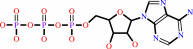 ATP
ATP
|
=
|
O-phospho-L-seryl-[protein]
|
+
|
 ADP
ADP
|
+
|
H(+)
|
|
|
|
|
|
|
L-threonyl-[protein]
|
+
|
ATP
|
=
|
O-phospho-L-threonyl-[protein]
|
+
|
ADP
|
+
|
H(+)
|
|
|
|
|
|
|
|
|
|
|
|
|
Molecule diagrams generated from .mol files obtained from the
KEGG ftp site
|
|
|
|
|
|
|
|
|
|
|
|
|
|
 |
|
|
|
|
|
|
| |
|
|
| |
|
DOI no:
|
Mol Cell
8:657-669
(2001)
|
|
PubMed id:
|
|
|
|
|
|
| |
|
Structure and regulation of the CDK5-p25(nck5a) complex.
|
|
C.Tarricone,
R.Dhavan,
J.Peng,
L.B.Areces,
L.H.Tsai,
A.Musacchio.
|
|
|
|
|
| |
ABSTRACT
|
|
|
|
| |
|
|
CDK5 plays an indispensable role in the central nervous system, and its
deregulation is involved in neurodegeneration. We report the crystal structure
of a complex between CDK5 and p25, a fragment of the p35 activator. Despite its
partial structural similarity with the cyclins, p25 displays an unprecedented
mechanism for the regulation of a cyclin-dependent kinase. p25 tethers the
unphosphorylated T loop of CDK5 in the active conformation. Residue Ser159,
equivalent to Thr160 on CDK2, contributes to the specificity of the CDK5-p35
interaction. Its substitution with threonine prevents p35 binding, while the
presence of alanine affects neither binding nor kinase activity. Finally, we
provide evidence that the CDK5-p25 complex employs a distinct mechanism from the
phospho-CDK2-cyclin A complex to establish substrate specificity.
|
|
|
|
|
|
| |
Selected figure(s)
|
|
|
|
| |
|
|

|
|

|
|
Figure 2.
Figure 2. Comparison of p25 and Cyclin A
|
|
Figure 6.
Figure 6. Role of Glu240
p25
in Substrate Recognition
|
|
|
|
|
|
| |
The above figures are
reprinted
by permission from Cell Press:
Mol Cell
(2001,
8,
657-669)
copyright 2001.
|
|
| |
Figures were
selected
by an automated process.
|
|
|
|
|
|
|
|
|
|
|
|
|
|
|
|
 |
 |
 |
|
Literature references that cite this PDB file's key reference
|
|
|
| |
PubMed id
|
|
Reference
|
|
|
|
|
|
N.Zhang,
R.Zhong,
H.Yan,
and
Y.Jiang
(2011).
Structural features underlying selective inhibition of GSK3β by dibromocantharelline: implications for rational drug design.
|
| |
Chem Biol Drug Des,
77,
199-205.
|
|
|
|
|
|
|
B.Zhang,
Z.C.Su,
T.E.Tay,
and
V.B.Tan
(2010).
Mechanism of CDK5 activation revealed by steered molecular dynamics simulations and energy calculations.
|
| |
J Mol Model,
16,
1159-1168.
|
|
|
|
|
|
|
J.C.Lozano,
P.Schatt,
V.Vergé,
J.Gobinet,
V.Villey,
and
G.Peaucellier
(2010).
CDK5 is present in sea urchin and starfish eggs and embryos and can interact with p35, cyclin E and cyclin B3.
|
| |
Mol Reprod Dev,
77,
449-461.
|
|
|
|
|
|
|
J.Zhang,
H.Li,
O.Yabut,
H.Fitzpatrick,
G.D'Arcangelo,
and
K.Herrup
(2010).
Cdk5 suppresses the neuronal cell cycle by disrupting the E2F1-DP1 complex.
|
| |
J Neurosci,
30,
5219-5228.
|
|
|
|
|
|
|
M.Rabiller,
M.Getlik,
S.Klüter,
A.Richters,
S.Tückmantel,
J.R.Simard,
and
D.Rauh
(2010).
Proteus in the world of proteins: conformational changes in protein kinases.
|
| |
Arch Pharm (Weinheim),
343,
193-206.
|
|
|
|
|
|
|
S.Hisanaga,
and
R.Endo
(2010).
Regulation and role of cyclin-dependent kinase activity in neuronal survival and death.
|
| |
J Neurochem,
115,
1309-1321.
|
|
|
|
|
|
|
A.E.Kissler,
N.Pettersson,
A.Frölich,
S.J.Sigrist,
and
B.Suter
(2009).
Drosophila cdk5 is needed for locomotive behavior and NMJ elaboration, but seems dispensable for synaptic transmission.
|
| |
Dev Neurobiol,
69,
365-377.
|
|
|
|
|
|
|
L.R.Orlando,
R.Ayala,
L.R.Kett,
A.A.Curley,
J.Duffner,
D.C.Bragg,
L.H.Tsai,
A.W.Dunah,
and
A.B.Young
(2009).
Phosphorylation of the homer-binding domain of group I metabotropic glutamate receptors by cyclin-dependent kinase 5.
|
| |
J Neurochem,
110,
557-569.
|
|
|
|
|
|
|
T.Takaki,
A.Echalier,
N.R.Brown,
T.Hunt,
J.A.Endicott,
and
M.E.Noble
(2009).
The structure of CDK4/cyclin D3 has implications for models of CDK activation.
|
| |
Proc Natl Acad Sci U S A,
106,
4171-4176.
|
|
|
PDB code:
|
|
|
|
|
|
|
|
S.Aviram,
E.Simon,
T.Gildor,
F.Glaser,
and
D.Kornitzer
(2008).
Autophosphorylation-induced degradation of the Pho85 cyclin Pcl5 is essential for response to amino acid limitation.
|
| |
Mol Cell Biol,
28,
6858-6869.
|
|
|
|
|
|
|
S.Baumli,
G.Lolli,
E.D.Lowe,
S.Troiani,
L.Rusconi,
A.N.Bullock,
J.E.Debreczeni,
S.Knapp,
and
L.N.Johnson
(2008).
The structure of P-TEFb (CDK9/cyclin T1), its complex with flavopiridol and regulation by phosphorylation.
|
| |
EMBO J,
27,
1907-1918.
|
|
|
PDB codes:
|
|
|
|
|
|
|
|
D.R.Ledee,
B.K.Tripathi,
and
P.S.Zelenka
(2007).
The CDK5 activator, p39, binds specifically to myosin essential light chain.
|
| |
Biochem Biophys Res Commun,
354,
1034-1039.
|
|
|
|
|
|
|
G.Lolli,
and
L.N.Johnson
(2007).
Recognition of Cdk2 by Cdk7.
|
| |
Proteins,
67,
1048-1059.
|
|
|
PDB code:
|
|
|
|
|
|
|
|
H.Kamei,
T.Saito,
M.Ozawa,
Y.Fujita,
A.Asada,
J.A.Bibb,
T.C.Saido,
H.Sorimachi,
and
S.Hisanaga
(2007).
Suppression of calpain-dependent cleavage of the CDK5 activator p35 to p25 by site-specific phosphorylation.
|
| |
J Biol Chem,
282,
1687-1694.
|
|
|
|
|
|
|
H.Lin,
M.C.Chen,
C.Y.Chiu,
Y.M.Song,
and
S.Y.Lin
(2007).
Cdk5 regulates STAT3 activation and cell proliferation in medullary thyroid carcinoma cells.
|
| |
J Biol Chem,
282,
2776-2784.
|
|
|
|
|
|
|
H.Lin,
T.Y.Lin,
and
J.L.Juang
(2007).
Abl deregulates Cdk5 kinase activity and subcellular localization in Drosophila neurodegeneration.
|
| |
Cell Death Differ,
14,
607-615.
|
|
|
|
|
|
|
K.Huang,
I.Ferrin-O'Connell,
W.Zhang,
G.A.Leonard,
E.K.O'Shea,
and
F.A.Quiocho
(2007).
Structure of the Pho85-Pho80 CDK-cyclin complex of the phosphate-responsive signal transduction pathway.
|
| |
Mol Cell,
28,
614-623.
|
|
|
PDB codes:
|
|
|
|
|
|
|
|
L.Connell-Crowley,
D.Vo,
L.Luke,
and
E.Giniger
(2007).
Drosophila lacking the Cdk5 activator, p35, display defective axon guidance, age-dependent behavioral deficits and reduced lifespan.
|
| |
Mech Dev,
124,
341-349.
|
|
|
|
|
|
|
L.W.Tam,
N.F.Wilson,
and
P.A.Lefebvre
(2007).
A CDK-related kinase regulates the length and assembly of flagella in Chlamydomonas.
|
| |
J Cell Biol,
176,
819-829.
|
|
|
|
|
|
|
M.P.Mazanetz,
and
P.M.Fischer
(2007).
Untangling tau hyperphosphorylation in drug design for neurodegenerative diseases.
|
| |
Nat Rev Drug Discov,
6,
464-479.
|
|
|
|
|
|
|
Z.Hou,
Q.Li,
L.He,
H.Y.Lim,
X.Fu,
N.S.Cheung,
D.X.Qi,
and
R.Z.Qi
(2007).
Microtubule association of the neuronal p35 activator of Cdk5.
|
| |
J Biol Chem,
282,
18666-18670.
|
|
|
|
|
|
|
A.P.Kornev,
N.M.Haste,
S.S.Taylor,
and
L.F.Eyck
(2006).
Surface comparison of active and inactive protein kinases identifies a conserved activation mechanism.
|
| |
Proc Natl Acad Sci U S A,
103,
17783-17788.
|
|
|
|
|
|
|
A.R.Nebreda
(2006).
CDK activation by non-cyclin proteins.
|
| |
Curr Opin Cell Biol,
18,
192-198.
|
|
|
|
|
|
|
B.Zhang,
V.B.Tan,
K.M.Lim,
and
T.E.Tay
(2006).
Molecular dynamics simulations on the inhibition of cyclin-dependent kinases 2 and 5 in the presence of activators.
|
| |
J Comput Aided Mol Des,
20,
395-404.
|
|
|
|
|
|
|
J.Sridhar,
N.Akula,
and
N.Pattabiraman
(2006).
Selectivity and potency of cyclin-dependent kinase inhibitors.
|
| |
AAPS J,
8,
E204-E221.
|
|
|
|
|
|
|
M.Otyepka,
I.Bártová,
Z.Kríz,
and
J.Koca
(2006).
Different mechanisms of CDK5 and CDK2 activation as revealed by CDK5/p25 and CDK2/cyclin A dynamics.
|
| |
J Biol Chem,
281,
7271-7281.
|
|
|
|
|
|
|
X.Fu,
Y.K.Choi,
D.Qu,
Y.Yu,
N.S.Cheung,
and
R.Z.Qi
(2006).
Identification of nuclear import mechanisms for the neuronal Cdk5 activator.
|
| |
J Biol Chem,
281,
39014-39021.
|
|
|
|
|
|
|
A.Cheng,
S.Gerry,
P.Kaldis,
and
M.J.Solomon
(2005).
Biochemical characterization of Cdk2-Speedy/Ringo A2.
|
| |
BMC Biochem,
6,
19.
|
|
|
|
|
|
|
C.P.Barrett,
and
M.E.Noble
(2005).
Molecular motions of human cyclin-dependent kinase 2.
|
| |
J Biol Chem,
280,
13993-14005.
|
|
|
|
|
|
|
Y.S.Zhu,
T.Saito,
A.Asada,
S.Maekawa,
and
S.Hisanaga
(2005).
Activation of latent cyclin-dependent kinase 5 (Cdk5)-p35 complexes by membrane dissociation.
|
| |
J Neurochem,
94,
1535-1545.
|
|
|
|
|
|
|
E.R.Lacy,
I.Filippov,
W.S.Lewis,
S.Otieno,
L.Xiao,
S.Weiss,
L.Hengst,
and
R.W.Kriwacki
(2004).
p27 binds cyclin-CDK complexes through a sequential mechanism involving binding-induced protein folding.
|
| |
Nat Struct Mol Biol,
11,
358-364.
|
|
|
|
|
|
|
J.C.Cruz,
and
L.H.Tsai
(2004).
Cdk5 deregulation in the pathogenesis of Alzheimer's disease.
|
| |
Trends Mol Med,
10,
452-458.
|
|
|
|
|
|
|
P.D.Smith,
M.J.O'Hare,
and
D.S.Park
(2004).
CDKs: taking on a role as mediators of dopaminergic loss in Parkinson's disease.
|
| |
Trends Mol Med,
10,
445-451.
|
|
|
|
|
|
|
Y.Wan,
W.Hur,
C.Y.Cho,
Y.Liu,
F.J.Adrian,
O.Lozach,
S.Bach,
T.Mayer,
D.Fabbro,
L.Meijer,
and
N.S.Gray
(2004).
Synthesis and target identification of hymenialdisine analogs.
|
| |
Chem Biol,
11,
247-259.
|
|
|
|
|
|
|
D.Kamei,
M.Murakami,
Y.Nakatani,
Y.Ishikawa,
T.Ishii,
and
I.Kudo
(2003).
Potential role of microsomal prostaglandin E synthase-1 in tumorigenesis.
|
| |
J Biol Chem,
278,
19396-19405.
|
|
|
|
|
|
|
G.P.Studzinski,
and
J.S.Harrison
(2003).
The neuronal cyclin-dependent kinase 5 activator p35Nck5a and Cdk5 activity in monocytic cells.
|
| |
Leuk Lymphoma,
44,
235-240.
|
|
|
|
|
|
|
H.S.Yang,
and
P.W.Hinds
(2003).
Increased ezrin expression and activation by CDK5 coincident with acquisition of the senescent phenotype.
|
| |
Mol Cell,
11,
1163-1176.
|
|
|
|
|
|
|
L.Meijer,
A.L.Skaltsounis,
P.Magiatis,
P.Polychronopoulos,
M.Knockaert,
M.Leost,
X.P.Ryan,
C.A.Vonica,
A.Brivanlou,
R.Dajani,
C.Crovace,
C.Tarricone,
A.Musacchio,
S.M.Roe,
L.Pearl,
and
P.Greengard
(2003).
GSK-3-selective inhibitors derived from Tyrian purple indirubins.
|
| |
Chem Biol,
10,
1255-1266.
|
|
|
PDB code:
|
|
|
|
|
|
|
|
P.M.Fischer
(2003).
CDK versus GSK-3 inhibition: a purple haze no longer?
|
| |
Chem Biol,
10,
1144-1146.
|
|
|
|
|
|
|
H.Patzke,
and
L.H.Tsai
(2002).
Calpain-mediated cleavage of the cyclin-dependent kinase-5 activator p39 to p29.
|
| |
J Biol Chem,
277,
8054-8060.
|
|
|
|
|
|
|
J.Zhang,
C.H.Luan,
K.C.Chou,
and
G.V.Johnson
(2002).
Identification of the N-terminal functional domains of Cdk5 by molecular truncation and computer modeling.
|
| |
Proteins,
48,
447-453.
|
|
|
|
|
|
|
Y.L.Zheng,
B.S.Li,
N.D.Amin,
W.Albers,
and
H.C.Pant
(2002).
A peptide derived from cyclin-dependent kinase activator (p35) specifically inhibits Cdk5 activity and phosphorylation of tau protein in transfected cells.
|
| |
Eur J Biochem,
269,
4427-4434.
|
|
|
|
|
|
The most recent references are shown first.
Citation data come partly from CiteXplore and partly
from an automated harvesting procedure. Note that this is likely to be
only a partial list as not all journals are covered by
either method. However, we are continually building up the citation data
so more and more references will be included with time.
Where a reference describes a PDB structure, the PDB
code is
shown on the right.
|
 |


 Links
Links


