|
PDBsum entry 1zd7

|
|
|
|
|
 |
Contents |
 |
|
|
|
|
|
|
|
|
|
|
|
|
* Residue conservation analysis
|
|
|
|
|
|
|
|
|
|
|
Enzyme class:
|
|
E.C.2.7.7.7
- DNA-directed Dna polymerase.
|
|
|
|
|
|
|
Reaction:
|
|
DNA(n) + a 2'-deoxyribonucleoside 5'-triphosphate = DNA(n+1) + diphosphate
|
|
|
|
|
|
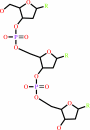 DNA(n)
|
+
|
2'-deoxyribonucleoside 5'-triphosphate
|
=
|
DNA(n+1)
|
+
|
 diphosphate
|
|
|
|
|
|
|
|
|
|
|
|
|
Molecule diagrams generated from .mol files obtained from the
KEGG ftp site
|
|
|
|
|
|
|
|
|
|
|
|
|
|
 |
|
|
|
|
|
|
| |
|
|
| |
|
DOI no:
|
J Mol Biol
353:1093-1105
(2005)
|
|
PubMed id:
|
|
|
|
|
|
| |
|
Crystal structures of an intein from the split dnaE gene of Synechocystis sp. PCC6803 reveal the catalytic model without the penultimate histidine and the mechanism of zinc ion inhibition of protein splicing.
|
|
P.Sun,
S.Ye,
S.Ferrandon,
T.C.Evans,
M.Q.Xu,
Z.Rao.
|
|
|
|
|
| |
ABSTRACT
|
|
|
|
| |
|
|
The first naturally occurring split intein was found in the dnaE gene of
Synechocystis sp. PCC6803 and belongs to a subclass of inteins without a
penultimate histidine residue. We describe two high-resolution crystal
structures, one derived from an excised Ssp DnaE intein and the second from a
splicing-deficient precursor protein. The X-ray structures indicate that His147
in the conserved block F activates the side-chain N(delta) atom of the intein
C-terminal Asn159, leading to a nucleophilic attack on the peptide bond carbonyl
carbon atom at the C-terminal splice site. In this process, Arg73 appears to
stabilize the transition state by interacting with the carbonyl oxygen atom of
the scissile bond. Arg73 also seems to substitute for the conserved penultimate
histidine residue in the formation of an oxyanion hole, as previously identified
in other inteins. The finding that the precursor structure contains a zinc ion
chelating the highly conserved Cys160 and Asp140 reveals the structural basis of
Zn2+-mediated inhibition of protein splicing. Furthermore, it is of interest to
observe that the carbonyl carbon atom of Asn159 and N(eta) of Arg73 are 2.6
angstroms apart in the free intein structure and 10.6 angstroms apart in the
precursor structure. The orientation change of the aromatic ring of Tyr-1
following the initial acyl shift may be a key switching event contributing to
the alignment of Arg73 and the C-terminal scissile bond, and may explain the
sequential reaction property of the Ssp DnaE intein.
|
|
|
|
|
|
| |
Selected figure(s)
|
|
|
|
| |
|
|

|
|

|
|
Figure 1.
Figure 1. (a) Diagram of conserved intein motifs of
bifunctional inteins, mini inteins and the Ssp DnaE split
intein. Blocks A and B (black) in the N-terminal subdomain
(magenta) and blocks F and G (black) in the C-terminal subdomain
(yellow) are shared by the splicing domains and the endonuclease
domain is shown in grey. Residues involved in nucleophilic
attack (letters in a box), as well as other highly conserved
amino acids are indicated below the block diagram. (b) A
representation of the Ssp DnaE intein fusions. The exDnaE fusion
protein consists of maltose-binding protein (MBP), the
full-length wild-type Ssp DnaE intein (residues 1-159, which
include 123 amino acid residues from the N terminus and 36 amino
acid residues from the C terminus) with five native extein
residues at its N terminus and three native residues at its C
terminus, and the CBD. The resulting protein exDnaE is splicing
functional. Black arrows indicate the splicing sites of Ssp DnaE
intein. preDnaE consists of CBD, Ssp DnaB intein and the
full-length Ssp DnaE intein with C1A and N159A mutations
(residue 1-159) along with five native extein residues at its N
terminus and three native residues at its C terminus. The black
arrow shows the cleavage site of the modified Ssp DnaB intein.41
The intein proteins after purification are indicated in red.
|
|
Figure 3.
Figure 3. (a) Close-up stereo view of the superposition of
the N-terminal subdomain of preDnaE (cyan) and exDnaE (purple).
(b) Stereo view of the modeled N-terminal catalytic module of
Ssp DnaE intein. (e) Close-up stereo view of the superposition
of the C-terminal subdomain of preDnaE (cyan) and exDnaE
(purple). (f) Stereo view of the modeled C-terminal catalytic
module of Ssp DnaE intein. Residues are shown in ball-and-stick
representations. The broken lines indicate hydrogen bonds, and
bond distances are labeled. (c), (d), (g), (h) and (i) A
chemical mechanism proposed for splicing the Ssp DnaE intein.
The red arrows indicate the routes of nucleophilic attacks in
the splicing pathway. Broken lines indicate hydrogen bonds. The
tetrahedral intermediate formed by an N-S acyl rearrangement at
Cys1 is not shown.
|
|
|
|
|
|
| |
The above figures are
reprinted
by permission from Elsevier:
J Mol Biol
(2005,
353,
1093-1105)
copyright 2005.
|
|
| |
Figures were
selected
by an automated process.
|
|
|
|
|
|
|
|
|
|
|
|
|
|
|
|
 |
 |
 |
|
Literature references that cite this PDB file's key reference
|
|
|
| |
PubMed id
|
|
Reference
|
|
|
|
|
|
G.Volkmann,
and
H.Iwaï
(2010).
Protein trans-splicing and its use in structural biology: opportunities and limitations.
|
| |
Mol Biosyst,
6,
2110-2121.
|
|
|
|
|
|
|
L.Berrade,
Y.Kwon,
and
J.A.Camarero
(2010).
Photomodulation of protein trans-splicing through backbone photocaging of the DnaE split intein.
|
| |
Chembiochem,
11,
1368-1372.
|
|
|
|
|
|
|
L.Zhang,
N.Xiao,
Y.Pan,
Y.Zheng,
Z.Pan,
Z.Luo,
X.Xu,
and
Y.Liu
(2010).
Binding and inhibition of copper ions to RecA inteins from Mycobacterium tuberculosis.
|
| |
Chemistry,
16,
4297-4306.
|
|
|
|
|
|
|
S.Elleuche,
and
S.Pöggeler
(2010).
Inteins, valuable genetic elements in molecular biology and biotechnology.
|
| |
Appl Microbiol Biotechnol,
87,
479-489.
|
|
|
|
|
|
|
S.Frutos,
M.Goger,
B.Giovani,
D.Cowburn,
and
T.W.Muir
(2010).
Branched intermediate formation stimulates peptide bond cleavage in protein splicing.
|
| |
Nat Chem Biol,
6,
527-533.
|
|
|
|
|
|
|
A.S.Aranko,
S.Züger,
E.Buchinger,
and
H.Iwaï
(2009).
In vivo and in vitro protein ligation by naturally occurring and engineered split DnaE inteins.
|
| |
PLoS ONE,
4,
e5185.
|
|
|
|
|
|
|
G.Amitai,
B.P.Callahan,
M.J.Stanger,
G.Belfort,
and
M.Belfort
(2009).
Modulation of intein activity by its neighboring extein substrates.
|
| |
Proc Natl Acad Sci U S A,
106,
11005-11010.
|
|
|
|
|
|
|
J.A.Kritzer,
S.Hamamichi,
J.M.McCaffery,
S.Santagata,
T.A.Naumann,
K.A.Caldwell,
G.A.Caldwell,
and
S.Lindquist
(2009).
Rapid selection of cyclic peptides that reduce alpha-synuclein toxicity in yeast and animal models.
|
| |
Nat Chem Biol,
5,
655-663.
|
|
|
|
|
|
|
L.Zhang,
Y.Zheng,
Z.Xi,
Z.Luo,
X.Xu,
C.Wang,
and
Y.Liu
(2009).
Metal ions binding to recA inteins from Mycobacterium tuberculosis.
|
| |
Mol Biosyst,
5,
644-650.
|
|
|
|
|
|
|
S.W.Lockless,
and
T.W.Muir
(2009).
Traceless protein splicing utilizing evolved split inteins.
|
| |
Proc Natl Acad Sci U S A,
106,
10999-11004.
|
|
|
|
|
|
|
T.Kamioka,
M.Tawa,
S.Sohya,
T.Yamazaki,
and
Y.Kuroda
(2009).
Improved protein splicing reaction for low solubility protein fragments without insertion of native extein residues.
|
| |
Biopolymers,
92,
465-470.
|
|
|
|
|
|
|
Z.Du,
P.T.Shemella,
Y.Liu,
S.A.McCallum,
B.Pereira,
S.K.Nayak,
G.Belfort,
M.Belfort,
and
C.Wang
(2009).
Highly conserved histidine plays a dual catalytic role in protein splicing: a pKa shift mechanism.
|
| |
J Am Chem Soc,
131,
11581-11589.
|
|
|
|
|
|
|
M.Vila-Perelló,
Y.Hori,
M.Ribó,
and
T.W.Muir
(2008).
Activation of protein splicing by protease- or light-triggered O to N acyl migration.
|
| |
Angew Chem Int Ed Engl,
47,
7764-7767.
|
|
|
|
|
|
|
M.A.Johnson,
M.W.Southworth,
T.Herrmann,
L.Brace,
F.B.Perler,
and
K.Wüthrich
(2007).
NMR structure of a KlbA intein precursor from Methanococcus jannaschii.
|
| |
Protein Sci,
16,
1316-1328.
|
|
|
PDB codes:
|
|
|
|
|
|
|
|
P.Van Roey,
B.Pereira,
Z.Li,
K.Hiraga,
M.Belfort,
and
V.Derbyshire
(2007).
Crystallographic and mutational studies of Mycobacterium tuberculosis recA mini-inteins suggest a pivotal role for a highly conserved aspartate residue.
|
| |
J Mol Biol,
367,
162-173.
|
|
|
PDB codes:
|
|
|
|
|
|
|
|
J.Yang,
T.V.Henry-Smith,
and
M.Qi
(2006).
Functional analysis of the split Synechocystis DnaE intein in plant tissues by biolistic particle bombardment.
|
| |
Transgenic Res,
15,
583-593.
|
|
|
|
|
|
The most recent references are shown first.
Citation data come partly from CiteXplore and partly
from an automated harvesting procedure. Note that this is likely to be
only a partial list as not all journals are covered by
either method. However, we are continually building up the citation data
so more and more references will be included with time.
Where a reference describes a PDB structure, the PDB
codes are
shown on the right.
|
|


 Links
Links