 |
PDBsum entry 1qtm

|
|
|
|
|
|

|

|

|

|
|

|
|

|
|

|
|

|
|

|
|

|
|

|
|
|
 |

|

|
|
|
|
|
|
|
|
|
|
|
|
|
|
|
|
|
|
|
|
|
|
|
|
|
|
|
|
|
|
|
|
|
|
|
|
Transferase/DNA
|
PDB id
|
|
|
|
1qtm
|
|
|
|
|
|
|
|
|
|
|
|
|
|
|

|

|

|
|
|
|
|
|
|
|
 |
Contents |
 |
|
|
|
|
|
|
|
|
|
|
|
|
|
|
|
|
* Residue conservation analysis
|
|
|
|
|
|
|
|
|
|
|
Enzyme class:
|
|
E.C.2.7.7.7
- DNA-directed Dna polymerase.
|
|
|
|
|
|
|
Reaction:
|
|
DNA(n) + a 2'-deoxyribonucleoside 5'-triphosphate = DNA(n+1) + diphosphate
|
|
|
|
|
|
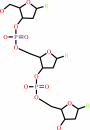 DNA(n)
|
+
|
2'-deoxyribonucleoside 5'-triphosphate
|
=
|
DNA(n+1)
|
+
|
 diphosphate
|
|
|
|
|
|
|
|
|
|
|
|
|
Molecule diagrams generated from .mol files obtained from the
KEGG ftp site
|
|
|
|
|
|
|
|
|
|
|
|
|
|
 |
|
|
|
|
|
|
| |
|
|
| |
|
DOI no:
|
Proc Natl Acad Sci U S A
96:9491-9496
(1999)
|
|
PubMed id:
|
|
|
|
|
|
| |
|
Structure-based design of Taq DNA polymerases with improved properties of dideoxynucleotide incorporation.
|
|
Y.Li,
V.Mitaxov,
G.Waksman.
|
|
|
|
|
| |
ABSTRACT
|
|
|
|
| |
|
|
The Taq DNA polymerase is the most commonly used enzyme in DNA sequencing.
However, all versions of Taq polymerase are deficient in two respects: (i) these
enzymes incorporate each of the four dideoxynucleoside 5' triphosphates (ddNTPs)
at widely different rates during sequencing (ddGTP, for example, is incorporated
10 times faster than the other three ddNTPs), and (ii) these enzymes show uneven
band-intensity or peak-height patterns in radio-labeled or dye-labeled DNA
sequence profiles, respectively. We have determined the crystal structures of
all four ddNTP-trapped closed ternary complexes of the large fragment of the Taq
DNA polymerase (Klentaq1). The ddGTP-trapped complex structure differs from the
other three ternary complex structures by a large shift in the position of the
side chain of residue 660 in the O helix, resulting in additional hydrogen bonds
being formed between the guanidinium group of this residue and the base of
ddGTP. When Arg-660 is mutated to Asp, Ser, Phe, Tyr, or Leu, the enzyme has a
marked and selective reduction in ddGTP incorporation rate. As a result, the G
track generated during DNA sequencing by these Taq polymerase variants does not
terminate prematurely, and higher molecular-mass G bands are detected. Another
property of these Taq polymerase variants is that the sequencing patterns
produced by these enzymes are remarkably even in band-intensity and peak-height
distribution, thus resulting in a significant improvement in the accuracy of DNA
sequencing.
|
|
|
|
|
|
| |
Selected figure(s)
|
|
|
|
| |
|
|

|
|

|
|
Figure 1.
Fig. 1. Stereo diagram of the interactions between the
side chain of Arg-660 and the incoming base. In the protein,
only the O helix is represented and is colored in red, gold,
dark blue, and dark green for the ddCTP-, ddATP-, ddTTP-, and
ddGTP-trapped complexes, respectively. In the DNA, only the
dCMP/ddGTP pair is represented and is colored in green. H-bond
interactions between Arg-660 and the O6 and N7 atoms in the base
of the ddGTP are indicated by lines. Distances between atoms
involved in H-bonds are indicated.
|
|
Figure 2.
Fig. 2. Comparison of DNA sequencing by Taq-WT, Taq-RD,
Taq-RL, Taq-RY, Taq-RS, and Taq-RF. The enzymes used for
sequencing are indicated above the corresponding sequences.
|
|
|
|
| |
Figures were
selected
by an automated process.
|
|
|
|
|
|
|
|
|
|
|
|
|
|
|
|
 |
 |
 |
|
Literature references that cite this PDB file's key reference
|
|
|
| |
PubMed id
|
|
Reference
|
|
|
|
|
|
G.Zhao,
and
Y.Guan
(2010).
Polymerization behavior of Klenow fragment and Taq DNA polymerase in short primer extension reactions.
|
| |
Acta Biochim Biophys Sin (Shanghai),
42,
722-728.
|
|
|
|
|
|
|
N.Ramsay,
A.S.Jemth,
A.Brown,
N.Crampton,
P.Dear,
and
P.Holliger
(2010).
CyDNA: synthesis and replication of highly Cy-dye substituted DNA by an evolved polymerase.
|
| |
J Am Chem Soc,
132,
5096-5104.
|
|
|
|
|
|
|
S.Obeid,
A.Baccaro,
W.Welte,
K.Diederichs,
and
A.Marx
(2010).
Structural basis for the synthesis of nucleobase modified DNA by Thermus aquaticus DNA polymerase.
|
| |
Proc Natl Acad Sci U S A,
107,
21327-21331.
|
|
|
PDB codes:
|
|
|
|
|
|
|
|
C.Sandalli,
K.Singh,
M.J.Modak,
A.Ketkar,
S.Canakci,
I.Demir,
and
A.O.Belduz
(2009).
A new DNA polymerase I from Geobacillus caldoxylosilyticus TK4: cloning, characterization, and mutational analysis of two aromatic residues.
|
| |
Appl Microbiol Biotechnol,
84,
105-117.
|
|
|
|
|
|
|
D.Loakes,
J.Gallego,
V.B.Pinheiro,
E.T.Kool,
and
P.Holliger
(2009).
Evolving a polymerase for hydrophobic base analogues.
|
| |
J Am Chem Soc,
131,
14827-14837.
|
|
|
|
|
|
|
I.M.Carr,
J.I.Robinson,
R.Dimitriou,
A.F.Markham,
A.W.Morgan,
and
D.T.Bonthron
(2009).
Inferring relative proportions of DNA variants from sequencing electropherograms.
|
| |
Bioinformatics,
25,
3244-3250.
|
|
|
|
|
|
|
K.D.Eilert,
and
D.R.Foran
(2009).
Polymerase resistance to polymerase chain reaction inhibitors in bone*.
|
| |
J Forensic Sci,
54,
1001-1007.
|
|
|
|
|
|
|
M.D.Gibbs,
R.A.Reeves,
D.Mandelman,
Q.Mi,
J.Lee,
and
P.L.Bergquist
(2009).
Molecular diversity and catalytic activity of Thermus DNA polymerases.
|
| |
Extremophiles,
13,
817-826.
|
|
|
|
|
|
|
J.H.Wu,
and
W.T.Liu
(2007).
Quantitative multiplexing analysis of PCR-amplified ribosomal RNA genes by hierarchical oligonucleotide primer extension reaction.
|
| |
Nucleic Acids Res,
35,
e82.
|
|
|
|
|
|
|
S.Melissis,
N.E.Labrou,
and
Y.D.Clonis
(2007).
One-step purification of Taq DNA polymerase using nucleotide-mimetic affinity chromatography.
|
| |
Biotechnol J,
2,
121-132.
|
|
|
|
|
|
|
K.B.Sauter,
and
A.Marx
(2006).
Evolving thermostable reverse transcriptase activity in a DNA polymerase scaffold.
|
| |
Angew Chem Int Ed Engl,
45,
7633-7635.
|
|
|
|
|
|
|
S.Vichier-Guerre,
S.Ferris,
N.Auberger,
K.Mahiddine,
and
J.L.Jestin
(2006).
A population of thermostable reverse transcriptases evolved from Thermus aquaticus DNA polymerase I by phage display.
|
| |
Angew Chem Int Ed Engl,
45,
6133-6137.
|
|
|
|
|
|
|
V.K.Batra,
W.A.Beard,
D.D.Shock,
J.M.Krahn,
L.C.Pedersen,
and
S.H.Wilson
(2006).
Magnesium-induced assembly of a complete DNA polymerase catalytic complex.
|
| |
Structure,
14,
757-766.
|
|
|
PDB codes:
|
|
|
|
|
|
|
|
D.Summerer,
N.Z.Rudinger,
I.Detmer,
and
A.Marx
(2005).
Enhanced fidelity in mismatch extension by DNA polymerase through directed combinatorial enzyme design.
|
| |
Angew Chem Int Ed Engl,
44,
4712-4715.
|
|
|
|
|
|
|
P.J.Rothwell,
V.Mitaksov,
and
G.Waksman
(2005).
Motions of the fingers subdomain of klentaq1 are fast and not rate limiting: implications for the molecular basis of fidelity in DNA polymerases.
|
| |
Mol Cell,
19,
345-355.
|
|
|
|
|
|
|
R.C.Holmberg,
A.A.Henry,
and
F.E.Romesberg
(2005).
Directed evolution of novel polymerases.
|
| |
Biomol Eng,
22,
39-49.
|
|
|
|
|
|
|
S.Prakash,
R.E.Johnson,
and
L.Prakash
(2005).
Eukaryotic translesion synthesis DNA polymerases: specificity of structure and function.
|
| |
Annu Rev Biochem,
74,
317-353.
|
|
|
|
|
|
|
W.T.Wolfle,
M.T.Washington,
E.T.Kool,
T.E.Spratt,
S.A.Helquist,
L.Prakash,
and
S.Prakash
(2005).
Evidence for a Watson-Crick hydrogen bonding requirement in DNA synthesis by human DNA polymerase kappa.
|
| |
Mol Cell Biol,
25,
7137-7143.
|
|
|
|
|
|
|
A.R.Pavlov,
N.V.Pavlova,
S.A.Kozyavkin,
and
A.I.Slesarev
(2004).
Recent developments in the optimization of thermostable DNA polymerases for efficient applications.
|
| |
Trends Biotechnol,
22,
253-260.
|
|
|
|
|
|
|
I.Andricioaei,
A.Goel,
D.Herschbach,
and
M.Karplus
(2004).
Dependence of DNA polymerase replication rate on external forces: a model based on molecular dynamics simulations.
|
| |
Biophys J,
87,
1478-1497.
|
|
|
|
|
|
|
L.L.Videau,
W.B.Arendall,
and
J.S.Richardson
(2004).
The cis-Pro touch-turn: a rare motif preferred at functional sites.
|
| |
Proteins,
56,
298-309.
|
|
|
|
|
|
|
M.Seki,
C.Masutani,
L.W.Yang,
A.Schuffert,
S.Iwai,
I.Bahar,
and
R.D.Wood
(2004).
High-efficiency bypass of DNA damage by human DNA polymerase Q.
|
| |
EMBO J,
23,
4484-4494.
|
|
|
|
|
|
|
M.T.Washington,
W.T.Wolfle,
T.E.Spratt,
L.Prakash,
and
S.Prakash
(2003).
Yeast DNA polymerase eta makes functional contacts with the DNA minor groove only at the incoming nucleoside triphosphate.
|
| |
Proc Natl Acad Sci U S A,
100,
5113-5118.
|
|
|
|
|
|
|
N.Paul,
V.C.Nashine,
G.Hoops,
P.Zhang,
J.Zhou,
D.E.Bergstrom,
and
V.J.Davisson
(2003).
DNA polymerase template interactions probed by degenerate isosteric nucleobase analogs.
|
| |
Chem Biol,
10,
815-825.
|
|
|
|
|
|
|
A.R.Pavlov,
G.I.Belova,
S.A.Kozyavkin,
and
A.I.Slesarev
(2002).
Helix-hairpin-helix motifs confer salt resistance and processivity on chimeric DNA polymerases.
|
| |
Proc Natl Acad Sci U S A,
99,
13510-13515.
|
|
|
|
|
|
|
D.T.Minnick,
L.Liu,
N.D.Grindley,
T.A.Kunkel,
and
C.M.Joyce
(2002).
Discrimination against purine-pyrimidine mispairs in the polymerase active site of DNA polymerase I: a structural explanation.
|
| |
Proc Natl Acad Sci U S A,
99,
1194-1199.
|
|
|
|
|
|
|
B.Hong,
K.Wu,
J.S.Brockenbrough,
P.Wu,
and
J.P.Aris
(2001).
Temperature sensitive nop2 alleles defective in synthesis of 25S rRNA and large ribosomal subunits in Saccharomyces cerevisiae.
|
| |
Nucleic Acids Res,
29,
2927-2937.
|
|
|
|
|
|
|
F.J.Ghadessy,
J.L.Ong,
and
P.Holliger
(2001).
Directed evolution of polymerase function by compartmentalized self-replication.
|
| |
Proc Natl Acad Sci U S A,
98,
4552-4557.
|
|
|
|
|
|
|
K.Yoshida,
A.Tosaka,
H.Kamiya,
T.Murate,
H.Kasai,
Y.Nimura,
M.Ogawa,
S.Yoshida,
and
M.Suzuki
(2001).
Arg660Ser mutation in Thermus aquaticus DNA polymerase I suppresses T-->C transitions: implication of wobble base pair formation at the nucleotide incorporation step.
|
| |
Nucleic Acids Res,
29,
4206-4214.
|
|
|
|
|
|
|
L.Dzantiev,
Y.O.Alekseyev,
J.C.Morales,
E.T.Kool,
and
L.J.Romano
(2001).
Significance of nucleobase shape complementarity and hydrogen bonding in the formation and stability of the closed polymerase-DNA complex.
|
| |
Biochemistry,
40,
3215-3221.
|
|
|
|
|
|
|
Y.Li,
and
G.Waksman
(2001).
Crystal structures of a ddATP-, ddTTP-, ddCTP, and ddGTP- trapped ternary complex of Klentaq1: insights into nucleotide incorporation and selectivity.
|
| |
Protein Sci,
10,
1225-1233.
|
|
|
|
|
|
|
L.Sun,
M.Wang,
E.T.Kool,
and
J.S.Taylor
(2000).
Pyrene nucleotide as a mechanistic probe: evidence for a transient abasic site-like intermediate in the bypass of dipyrimidine photoproducts by T7 DNA polymerase.
|
| |
Biochemistry,
39,
14603-14610.
|
|
|
|
|
|
The most recent references are shown first.
Citation data come partly from CiteXplore and partly
from an automated harvesting procedure. Note that this is likely to be
only a partial list as not all journals are covered by
either method. However, we are continually building up the citation data
so more and more references will be included with time.
Where a reference describes a PDB structure, the PDB
codes are
shown on the right.
|
|


 Links
Links


