 |
PDBsum entry 1qht

|
|
|
|
|
 |
Contents |
 |
|
|
|
|
|
|
|
|
|
|
* Residue conservation analysis
|
|
|
|
|
|
|
|
|
|
|
Enzyme class:
|
|
E.C.2.7.7.7
- DNA-directed Dna polymerase.
|
|
|
|
|
|
|
Reaction:
|
|
DNA(n) + a 2'-deoxyribonucleoside 5'-triphosphate = DNA(n+1) + diphosphate
|
|
|
|
|
|
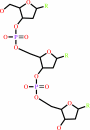 DNA(n)
|
+
|
2'-deoxyribonucleoside 5'-triphosphate
|
=
|
DNA(n+1)
|
+
|
 diphosphate
|
|
|
|
|
|
|
|
|
|
|
|
|
Molecule diagrams generated from .mol files obtained from the
KEGG ftp site
|
|
|
|
|
|
|
|
|
|
|
|
|
|
 |
|
|
|
|
|
|
| |
|
|
| |
|
DOI no:
|
J Mol Biol
299:447-462
(2000)
|
|
PubMed id:
|
|
|
|
|
|
| |
|
Crystal structure of a pol alpha family DNA polymerase from the hyperthermophilic archaeon Thermococcus sp. 9 degrees N-7.
|
|
A.C.Rodriguez,
H.W.Park,
C.Mao,
L.S.Beese.
|
|
|
|
|
| |
ABSTRACT
|
|
|
|
| |
|
|
The 2.25 A resolution crystal structure of a pol alpha family (family B) DNA
polymerase from the hyperthermophilic marine archaeon Thermococcus sp. 9 degrees
N-7 (9 degrees N-7 pol) provides new insight into the mechanism of pol alpha
family polymerases that include essentially all of the eukaryotic replicative
and viral DNA polymerases. The structure is folded into NH(2)- terminal, editing
3'-5' exonuclease, and polymerase domains that are topologically similar to the
two other known pol alpha family structures (bacteriophage RB69 and the recently
determined Thermococcus gorgonarius), but differ in their relative orientation
and conformation.The 9 degrees N-7 polymerase domain structure is reminiscent of
the "closed" conformation characteristic of ternary complexes of the
pol I polymerase family obtained in the presence of their dNTP and DNA
substrates. In the apo-9 degrees N-7 structure, this conformation appears to be
stabilized by an ion pair. Thus far, the other apo-pol alpha structures that
have been determined adopt open conformations. These results therefore suggest
that the pol alpha polymerases undergo a series of conformational transitions
during the catalytic cycle similar to those proposed for the pol I family.
Furthermore, comparison of the orientations of the fingers and exonuclease
(sub)domains relative to the palm subdomain that contains the pol active site
suggests that the exonuclease domain and the fingers subdomain of the polymerase
can move as a unit and may do so as part of the catalytic cycle. This provides a
possible structural explanation for the interdependence of polymerization and
editing exonuclease activities unique to pol alpha family polymerases.We suggest
that the NH(2)-terminal domain of 9 degrees N-7 pol may be structurally related
to an RNA-binding motif, which appears to be conserved among archaeal
polymerases. The presence of such a putative RNA- binding domain suggests a
mechanism for the observed autoregulation of bacteriophage T4 DNA polymerase
synthesis by binding to its own mRNA. Furthermore, conservation of this domain
could indicate that such regulation of pol expression may be a characteristic of
archaea. Comparion of the 9 degrees N-7 pol structure to its mesostable homolog
from bacteriophage RB69 suggests that thermostability is achieved by shortening
loops, forming two disulfide bridges, and increasing electrostatic interactions
at subdomain interfaces.
|
|
|
|
|
|
| |
Selected figure(s)
|
|
|
|
| |
|
|

|
|

|
|
Figure 4.
Figure 4. Comparisons of 9°N-7 and RB69 pols in
different (sub)domains to indicate loop segments that are
shorter in 9°N-7 pol. Least-squares C^a superposition was
performed over the region in blue, and the domains were
separated for side-by-side comparison. Loop regions are shown in
magenta and their residue endpoints are labeled. (a) Comparison
of the exonuclease domains. Indicated with purple asterisks are
the active site carboxylates (mutated to Ala in the case of the
9°N-7exo - pol used in this study). (b) Comparison of the
palm domains. The three active-site carboxylate groups are
depicted with side-chains.
|
|
Figure 5.
Figure 5. Least-squares C^a superpositions of 9°N-7 and
RB69 pols in the (a) palm subdomain or (b) exonuclease domain.
The 9°N-7 pol backbone is shown in yellow, and its
active-site carboxylate groups in gold. The RB69 pol backbone is
drawn in green, and its active-site residues in magenta. The
central b-sheet of the exonuclease domain is light blue
(9°N-7 pol) or dark blue (RB69 pol) to allow tracking of the
domain motion. The precise regions used in the palm and
exonuclease superpositions are shown in Figure 4. The
NH[2]-terminal domain has been omitted for clarity. Arrows in
(a) indicate the direction of fingers and exonuclease movement
when moving from (a) to (b).
|
|
|
|
|
|
| |
The above figures are
reprinted
by permission from Elsevier:
J Mol Biol
(2000,
299,
447-462)
copyright 2000.
|
|
| |
Figures were
selected
by an automated process.
|
|
|
|
|
|
|
|
|
|
|
|
|
|
|
|
 |
 |
 |
|
Literature references that cite this PDB file's key reference
|
|
|
| |
PubMed id
|
|
Reference
|
|
|
|
|
|
C.J.Hansen,
L.Wu,
J.D.Fox,
B.Arezi,
and
H.H.Hogrefe
(2011).
Engineered split in Pfu DNA polymerase fingers domain improves incorporation of nucleotide gamma-phosphate derivative.
|
| |
Nucleic Acids Res,
39,
1801-1810.
|
|
|
|
|
|
|
K.Mayanagi,
S.Kiyonari,
H.Nishida,
M.Saito,
D.Kohda,
Y.Ishino,
T.Shirai,
and
K.Morikawa
(2011).
Architecture of the DNA polymerase B-proliferating cell nuclear antigen (PCNA)-DNA ternary complex.
|
| |
Proc Natl Acad Sci U S A,
108,
1845-1849.
|
|
|
|
|
|
|
E.Johansson,
and
S.A.Macneill
(2010).
The eukaryotic replicative DNA polymerases take shape.
|
| |
Trends Biochem Sci,
35,
339-347.
|
|
|
|
|
|
|
J.G.Song,
E.J.Kil,
S.S.Cho,
I.H.Kim,
and
S.T.Kwon
(2010).
An amino acid residue in the middle of the fingers subdomain is involved in Neq DNA polymerase processivity: enhanced processivity of engineered Neq DNA polymerase and its PCR application.
|
| |
Protein Eng Des Sel,
23,
835-842.
|
|
|
|
|
|
|
T.Ogino,
K.Sato,
and
A.Matsuda
(2010).
Incorporation of 2'-deoxy-2'-isonucleoside 5'-triphosphates (iNTPs) into DNA by A- and B-family DNA polymerases with different recognition mechanisms.
|
| |
Chembiochem,
11,
2597-2605.
|
|
|
|
|
|
|
E.O.McCullum,
and
J.C.Chaput
(2009).
Transcription of an RNA aptamer by a DNA polymerase.
|
| |
Chem Commun (Camb),
(),
2938-2940.
|
|
|
|
|
|
|
H.Matsukawa,
T.Yamagami,
Y.Kawarabayasi,
Y.Miyashita,
M.Takahashi,
and
Y.Ishino
(2009).
A useful strategy to construct DNA polymerases with different properties by using genetic resources from environmental DNA.
|
| |
Genes Genet Syst,
84,
3.
|
|
|
|
|
|
|
R.N.Veedu,
B.Vester,
and
J.Wengel
(2009).
Efficient enzymatic synthesis of LNA-modified DNA duplexes using KOD DNA polymerase.
|
| |
Org Biomol Chem,
7,
1404-1409.
|
|
|
|
|
|
|
G.T.Hwang,
and
F.E.Romesberg
(2008).
Unnatural substrate repertoire of A, B, and X family DNA polymerases.
|
| |
J Am Chem Soc,
130,
14872-14882.
|
|
|
|
|
|
|
J.G.Williams,
D.L.Steffens,
J.P.Anderson,
T.M.Urlacher,
D.T.Lamb,
D.L.Grone,
and
J.C.Egelhoff
(2008).
An artificial processivity clamp made with streptavidin facilitates oriented attachment of polymerase-DNA complexes to surfaces.
|
| |
Nucleic Acids Res,
36,
e121.
|
|
|
|
|
|
|
K.F.Bryant,
and
D.M.Coen
(2008).
Inhibition of translation by a short element in the 5' leader of the herpes simplex virus 1 DNA polymerase transcript.
|
| |
J Virol,
82,
77-85.
|
|
|
|
|
|
|
X.Ding,
Z.M.Lv,
Y.Zhao,
H.Min,
and
W.J.Yang
(2008).
MTH1745, a protein disulfide isomerase-like protein from thermophilic archaea, Methanothermobacter thermoautotrophicum involving in stress response.
|
| |
Cell Stress Chaperones,
13,
239-246.
|
|
|
|
|
|
|
M.Hogg,
P.Aller,
W.Konigsberg,
S.S.Wallace,
and
S.Doublié
(2007).
Structural and biochemical investigation of the role in proofreading of a beta hairpin loop found in the exonuclease domain of a replicative DNA polymerase of the B family.
|
| |
J Biol Chem,
282,
1432-1444.
|
|
|
PDB code:
|
|
|
|
|
|
|
|
M.H.Lamers,
R.E.Georgescu,
S.G.Lee,
M.O'Donnell,
and
J.Kuriyan
(2006).
Crystal structure of the catalytic alpha subunit of E. coli replicative DNA polymerase III.
|
| |
Cell,
126,
881-892.
|
|
|
PDB codes:
|
|
|
|
|
|
|
|
P.Pérez-Arnaiz,
J.M.Lázaro,
M.Salas,
and
M.de Vega
(2006).
Involvement of phi29 DNA polymerase thumb subdomain in the proper coordination of synthesis and degradation during DNA replication.
|
| |
Nucleic Acids Res,
34,
3107-3115.
|
|
|
|
|
|
|
R.Shi,
A.Azzi,
C.Gilbert,
G.Boivin,
and
S.X.Lin
(2006).
Three-dimensional modeling of cytomegalovirus DNA polymerase and preliminary analysis of drug resistance.
|
| |
Proteins,
64,
301-307.
|
|
|
|
|
|
|
S.Liu,
J.D.Knafels,
J.S.Chang,
G.A.Waszak,
E.T.Baldwin,
M.R.Deibel,
D.R.Thomsen,
F.L.Homa,
P.A.Wells,
M.C.Tory,
R.A.Poorman,
H.Gao,
X.Qiu,
and
A.P.Seddon
(2006).
Crystal structure of the herpes simplex virus 1 DNA polymerase.
|
| |
J Biol Chem,
281,
18193-18200.
|
|
|
PDB code:
|
|
|
|
|
|
|
|
I.Rodríguez,
J.M.Lázaro,
L.Blanco,
S.Kamtekar,
A.J.Berman,
J.Wang,
T.A.Steitz,
M.Salas,
and
M.de Vega
(2005).
A specific subdomain in phi29 DNA polymerase confers both processivity and strand-displacement capacity.
|
| |
Proc Natl Acad Sci U S A,
102,
6407-6412.
|
|
|
|
|
|
|
J.Eichler,
and
M.W.Adams
(2005).
Posttranslational protein modification in Archaea.
|
| |
Microbiol Mol Biol Rev,
69,
393-425.
|
|
|
|
|
|
|
A.F.Gardner,
C.M.Joyce,
and
W.E.Jack
(2004).
Comparative kinetics of nucleotide analog incorporation by vent DNA polymerase.
|
| |
J Biol Chem,
279,
11834-11842.
|
|
|
|
|
|
|
B.D.Biles,
and
B.A.Connolly
(2004).
Low-fidelity Pyrococcus furiosus DNA polymerase mutants useful in error-prone PCR.
|
| |
Nucleic Acids Res,
32,
e176.
|
|
|
|
|
|
|
E.Freisinger,
A.P.Grollman,
H.Miller,
and
C.Kisker
(2004).
Lesion (in)tolerance reveals insights into DNA replication fidelity.
|
| |
EMBO J,
23,
1494-1505.
|
|
|
PDB codes:
|
|
|
|
|
|
|
|
K.Arora,
and
T.Schlick
(2004).
In silico evidence for DNA polymerase-beta's substrate-induced conformational change.
|
| |
Biophys J,
87,
3088-3099.
|
|
|
|
|
|
|
L.S.Kaguni
(2004).
DNA polymerase gamma, the mitochondrial replicase.
|
| |
Annu Rev Biochem,
73,
293-320.
|
|
|
|
|
|
|
M.Hogg,
S.S.Wallace,
and
S.Doublié
(2004).
Crystallographic snapshots of a replicative DNA polymerase encountering an abasic site.
|
| |
EMBO J,
23,
1483-1493.
|
|
|
PDB codes:
|
|
|
|
|
|
|
|
V.M.Petrov,
and
J.D.Karam
(2004).
Diversity of structure and function of DNA polymerase (gp43) of T4-related bacteriophages.
|
| |
Biochemistry (Mosc),
69,
1213-1218.
|
|
|
|
|
|
|
V.Truniger,
J.M.Lázaro,
and
M.Salas
(2004).
Function of the C-terminus of phi29 DNA polymerase in DNA and terminal protein binding.
|
| |
Nucleic Acids Res,
32,
361-370.
|
|
|
|
|
|
|
Y.Shen,
X.F.Tang,
H.Yokoyama,
E.Matsui,
and
I.Matsui
(2004).
A 21-amino acid peptide from the cysteine cluster II of the family D DNA polymerase from Pyrococcus horikoshii stimulates its nuclease activity which is Mre11-like and prefers manganese ion as the cofactor.
|
| |
Nucleic Acids Res,
32,
158-168.
|
|
|
|
|
|
|
B.Grabowski,
and
Z.Kelman
(2003).
Archeal DNA replication: eukaryal proteins in a bacterial context.
|
| |
Annu Rev Microbiol,
57,
487-516.
|
|
|
|
|
|
|
M.Ogawa,
S.Limsirichaikul,
A.Niimi,
S.Iwai,
S.Yoshida,
and
M.Suzuki
(2003).
Distinct function of conserved amino acids in the fingers of Saccharomyces cerevisiae DNA polymerase alpha.
|
| |
J Biol Chem,
278,
19071-19078.
|
|
|
|
|
|
|
S.J.Johnson,
J.S.Taylor,
and
L.S.Beese
(2003).
Processive DNA synthesis observed in a polymerase crystal suggests a mechanism for the prevention of frameshift mutations.
|
| |
Proc Natl Acad Sci U S A,
100,
3895-3900.
|
|
|
PDB codes:
|
|
|
|
|
|
|
|
W.Yang
(2003).
Damage repair DNA polymerases Y.
|
| |
Curr Opin Struct Biol,
13,
23-30.
|
|
|
|
|
|
|
A.Bebenek,
G.T.Carver,
H.K.Dressman,
F.A.Kadyrov,
J.K.Haseman,
V.Petrov,
W.H.Konigsberg,
J.D.Karam,
and
J.W.Drake
(2002).
Dissecting the fidelity of bacteriophage RB69 DNA polymerase: site-specific modulation of fidelity by polymerase accessory proteins.
|
| |
Genetics,
162,
1003-1018.
|
|
|
|
|
|
|
A.F.Gardner,
and
W.E.Jack
(2002).
Acyclic and dideoxy terminator preferences denote divergent sugar recognition by archaeon and Taq DNA polymerases.
|
| |
Nucleic Acids Res,
30,
605-613.
|
|
|
|
|
|
|
G.Villani,
N.Tanguy Le Gac,
L.Wasungu,
D.Burnouf,
R.P.Fuchs,
and
P.E.Boehmer
(2002).
Effect of manganese on in vitro replication of damaged DNA catalyzed by the herpes simplex virus type-1 DNA polymerase.
|
| |
Nucleic Acids Res,
30,
3323-3332.
|
|
|
|
|
|
|
H.A.Held,
and
S.A.Benner
(2002).
Challenging artificial genetic systems: thymidine analogs with 5-position sulfur functionality.
|
| |
Nucleic Acids Res,
30,
3857-3869.
|
|
|
|
|
|
|
M.J.Fogg,
L.H.Pearl,
and
B.A.Connolly
(2002).
Structural basis for uracil recognition by archaeal family B DNA polymerases.
|
| |
Nat Struct Biol,
9,
922-927.
|
|
|
|
|
|
|
R.Eisenbrandt,
J.M.Lázaro,
M.Salas,
and
M.de Vega
(2002).
Phi29 DNA polymerase residues Tyr59, His61 and Phe69 of the highly conserved ExoII motif are essential for interaction with the terminal protein.
|
| |
Nucleic Acids Res,
30,
1379-1386.
|
|
|
|
|
|
|
V.M.Petrov,
and
J.D.Karam
(2002).
RNA determinants of translational operator recognition by the DNA polymerases of bacteriophages T4 and RB69.
|
| |
Nucleic Acids Res,
30,
3341-3348.
|
|
|
|
|
|
|
V.M.Petrov,
S.S.Ng,
and
J.D.Karam
(2002).
Protein determinants of RNA binding by DNA polymerase of the T4-related bacteriophage RB69.
|
| |
J Biol Chem,
277,
33041-33048.
|
|
|
|
|
|
|
V.Truniger,
J.M.Lázaro,
F.J.Esteban,
L.Blanco,
and
M.Salas
(2002).
A positively charged residue of phi29 DNA polymerase, highly conserved in DNA polymerases from families A and B, is involved in binding the incoming nucleotide.
|
| |
Nucleic Acids Res,
30,
1483-1492.
|
|
|
|
|
|
|
S.A.MacNeill
(2001).
Understanding the enzymology of archaeal DNA replication: progress in form and function.
|
| |
Mol Microbiol,
40,
520-529.
|
|
|
|
|
|
|
A.R.Pavlov,
and
J.D.Karam
(2000).
Nucleotide-sequence-specific and non-specific interactions of T4 DNA polymerase with its own mRNA.
|
| |
Nucleic Acids Res,
28,
4657-4664.
|
|
|
|
|
|
The most recent references are shown first.
Citation data come partly from CiteXplore and partly
from an automated harvesting procedure. Note that this is likely to be
only a partial list as not all journals are covered by
either method. However, we are continually building up the citation data
so more and more references will be included with time.
Where a reference describes a PDB structure, the PDB
code is
shown on the right.
|
|


 Links
Links


