 |
PDBsum entry 1ok7

|
|
|
|
|
 |
Contents |
 |
|
|
|
|
|
|
|
|
|
|
|
|
* Residue conservation analysis
|
|
|
|
|
|
PDB id:
|
|
|
|
| Name: |
|
Transferase
|
|
|
Title:
|
|
A conserved protein binding-site on bacterial sliding clamps
|
|
Structure:
|
|
DNA polymerase iii. Chain: a, b. Synonym: polymerase, dnan, b3701, c4623, z5192, ecs4636. Engineered: yes. DNA polymerase iv. Chain: c. Fragment: c-terminus of DNA pol iv residues 336-351. Synonym: pol iv. Engineered: yes.
|
|
Source:
|
|
Escherichia coli. Organism_taxid: 562. Expressed in: escherichia coli. Expression_system_taxid: 469008. Other_details: dnan gene. Synthetic: yes. Organism_taxid: 562
|
|
Biol. unit:
|
|
 Trimer (from PDB file)
|
|
Resolution:
|
|
|
1.65Å
|
R-factor:
|
0.203
|
R-free:
|
0.229
|
|
|
Authors:
|
|
D.Y.Burnouf,V.Olieric,J.Wagner,S.Fujii,J.Reinbolt,R.P.P.Fuchs,P.Dumas
|
Key ref:

|
|
D.Y.Burnouf
et al.
(2004).
Structural and biochemical analysis of sliding clamp/ligand interactions suggest a competition between replicative and translesion DNA polymerases.
J Mol Biol,
335,
1187-1197.
PubMed id:
DOI:

|
|
|
Date:
|
|
|
18-Jul-03
|
Release date:
|
15-Jul-04
|
|
|
|
|
|
|
PROCHECK
|

|
|
|
|
|
Headers
|
|
|
|
References
|
|
|
|
|
|

|
|
P0A988
(DPO3B_ECOLI) -
Beta sliding clamp from Escherichia coli (strain K12)
|
|
|
|
Seq:
Struc:
|
|
|
|
366 a.a.
366 a.a.
|
|

|

|

|
|
|
|
|
|
|
|
|
|
|
Key: |
 |
PfamA domain |
|
|
 |
Secondary structure |
|
 |
CATH domain |
|
|
|
|
|
|
|
|
|
|
|
|
|
Enzyme class:
|
|
E.C.2.7.7.7
- DNA-directed Dna polymerase.
|
|
|
|
|
|
|
Reaction:
|
|
DNA(n) + a 2'-deoxyribonucleoside 5'-triphosphate = DNA(n+1) + diphosphate
|
|
|
|
|
|
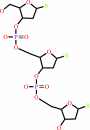 DNA(n)
|
+
|
2'-deoxyribonucleoside 5'-triphosphate
|
=
|
DNA(n+1)
|
+
|
 diphosphate
|
|
|
|
|
|
|
|
|
|
|
|
|
Molecule diagrams generated from .mol files obtained from the
KEGG ftp site
|
|
|
|
|
|
|
|
|
|
|
|
|
|
 |
|
|
|
|
|
|
| |
|
|
| |
|
DOI no:
|
J Mol Biol
335:1187-1197
(2004)
|
|
PubMed id:
|
|
|
|
|
|
| |
|
Structural and biochemical analysis of sliding clamp/ligand interactions suggest a competition between replicative and translesion DNA polymerases.
|
|
D.Y.Burnouf,
V.Olieric,
J.Wagner,
S.Fujii,
J.Reinbolt,
R.P.Fuchs,
P.Dumas.
|
|
|
|
|
| |
ABSTRACT
|
|
|
|
| |
|
|
Most DNA polymerases interact with their cognate processive replication factor
through a small peptide, this interaction being absolutely required for their
function in vivo. We have solved the crystal structure of a complex between the
beta sliding clamp of Escherichia coli and the 16 residue C-terminal peptide of
Pol IV (P16). The seven C-terminal residues bind to a pocket located at the
surface of one beta monomer. This region was previously identified as the
binding site of another beta clamp binding protein, the delta subunit of the
gamma complex. We show that peptide P16 competitively prevents
beta-clamp-mediated stimulation of both Pol IV and alpha subunit DNA polymerase
activities, suggesting that the site of interaction of the alpha subunit with
beta is identical with, or overlaps that of Pol IV. This common binding site for
delta, Pol IV and alpha subunit is shown to be formed by residues that are
highly conserved among many bacterial beta homologs, thus defining an
evolutionarily conserved hydrophobic crevice for sliding clamp ligands and a new
target for antibiotic drug design.
|
|
|
|
|
|
| |
Selected figure(s)
|
|
|
|
| |
|
|

|
|

|
|
Figure 1.
Figure 1. A, Ribbon representation of the b-ring with one
bound P16 peptide. Only the seven C-terminal residues of the
peptide were structured and modelled into the density map
(coloured in yellow). B, Fourier difference maps around the
visible part of P16 with (F[o] -F[c]) coefficients in red, and
with (2F[o] -F[c]) coefficients in blue.
|
|
Figure 3.
Figure 3. A, Sequence alignment of the d subunit of g
complex and of DNA polymerase IV b-binding peptides with the
corresponding consensus sequence.[12.] The most conserved
residues are highlighted in blue and the red lines delimit
sub-sites 1 and 2 (see Results and Discussion). B, Schematic
representation of the b-binding pocket. Peptide P16 is drawn in
red, highly conserved b residues are boxed in green and less
conserved residues in open boxes. Green, black and open circles
identify b residues interacting with the most conserved residues
of peptide P16, i.e. residues L16, L14 and Q11, respectively.
Green and white bars on the right identify the conserved and
less conserved parts within the two sub-sites, respectively.
|
|
|
|
|
|
| |
The above figures are
reprinted
by permission from Elsevier:
J Mol Biol
(2004,
335,
1187-1197)
copyright 2004.
|
|
| |
Figures were
selected
by an automated process.
|
|
|
|
|
|
|
|
|
|
|
|
|
|
|
|
 |
 |
 |
|
Literature references that cite this PDB file's key reference
|
|
|
| |
PubMed id
|
|
Reference
|
|
|
|
|
|
J.N.Ollivierre,
J.Fang,
and
P.J.Beuning
(2010).
The Roles of UmuD in Regulating Mutagenesis.
|
| |
J Nucleic Acids,
2010,
0.
|
|
|
|
|
|
|
M.D.Sutton
(2010).
Coordinating DNA polymerase traffic during high and low fidelity synthesis.
|
| |
Biochim Biophys Acta,
1804,
1167-1179.
|
|
|
|
|
|
|
F.J.López de Saro
(2009).
Regulation of interactions with sliding clamps during DNA replication and repair.
|
| |
Curr Genomics,
10,
206-215.
|
|
|
|
|
|
|
J.M.Heltzel,
S.K.Scouten Ponticelli,
L.H.Sanders,
J.M.Duzen,
V.Cody,
J.Pace,
E.H.Snell,
and
M.D.Sutton
(2009).
Sliding clamp-DNA interactions are required for viability and contribute to DNA polymerase management in Escherichia coli.
|
| |
J Mol Biol,
387,
74-91.
|
|
|
PDB code:
|
|
|
|
|
|
|
|
J.Wagner,
H.Etienne,
R.P.Fuchs,
A.Cordonnier,
and
D.Burnouf
(2009).
Distinct beta-clamp interactions govern the activities of the Y family PolIV DNA polymerase.
|
| |
Mol Microbiol,
74,
1143-1151.
|
|
|
|
|
|
|
K.Murayama,
S.Nakayama,
M.Kato-Murayama,
R.Akasaka,
N.Ohbayashi,
Y.Kamewari-Hayami,
T.Terada,
M.Shirouzu,
T.Tsurumi,
and
S.Yokoyama
(2009).
Crystal structure of epstein-barr virus DNA polymerase processivity factor BMRF1.
|
| |
J Biol Chem,
284,
35896-35905.
|
|
|
PDB code:
|
|
|
|
|
|
|
|
H.Yang,
and
J.H.Miller
(2008).
Deletion of dnaN1 generates a mutator phenotype in Bacillus anthracis.
|
| |
DNA Repair (Amst),
7,
507-514.
|
|
|
|
|
|
|
R.E.Georgescu,
O.Yurieva,
S.S.Kim,
J.Kuriyan,
X.P.Kong,
and
M.O'Donnell
(2008).
Structure of a small-molecule inhibitor of a DNA polymerase sliding clamp.
|
| |
Proc Natl Acad Sci U S A,
105,
11116-11121.
|
|
|
PDB codes:
|
|
|
|
|
|
|
|
R.E.Georgescu,
S.S.Kim,
O.Yurieva,
J.Kuriyan,
X.P.Kong,
and
M.O'Donnell
(2008).
Structure of a sliding clamp on DNA.
|
| |
Cell,
132,
43-54.
|
|
|
PDB code:
|
|
|
|
|
|
|
|
P.McInerney,
and
M.O'Donnell
(2007).
Replisome fate upon encountering a leading strand block and clearance from DNA by recombination proteins.
|
| |
J Biol Chem,
282,
25903-25916.
|
|
|
|
|
|
|
R.W.Maul,
S.K.Ponticelli,
J.M.Duzen,
and
M.D.Sutton
(2007).
Differential binding of Escherichia coli DNA polymerases to the beta-sliding clamp.
|
| |
Mol Microbiol,
65,
811-827.
|
|
|
|
|
|
|
W.Yang,
and
R.Woodgate
(2007).
What a difference a decade makes: insights into translesion DNA synthesis.
|
| |
Proc Natl Acad Sci U S A,
104,
15591-15598.
|
|
|
|
|
|
|
B.A.Appleton,
J.Brooks,
A.Loregian,
D.J.Filman,
D.M.Coen,
and
J.M.Hogle
(2006).
Crystal structure of the cytomegalovirus DNA polymerase subunit UL44 in complex with the C terminus from the catalytic subunit. Differences in structure and function relative to unliganded UL44.
|
| |
J Biol Chem,
281,
5224-5232.
|
|
|
PDB code:
|
|
|
|
|
|
|
|
C.Indiani,
and
M.O'Donnell
(2006).
The replication clamp-loading machine at work in the three domains of life.
|
| |
Nat Rev Mol Cell Biol,
7,
751-761.
|
|
|
|
|
|
|
P.J.Beuning,
D.Sawicka,
D.Barsky,
and
G.C.Walker
(2006).
Two processivity clamp interactions differentially alter the dual activities of UmuC.
|
| |
Mol Microbiol,
59,
460-474.
|
|
|
|
|
|
|
S.Delmas,
and
I.Matic
(2006).
Interplay between replication and recombination in Escherichia coli: impact of the alternative DNA polymerases.
|
| |
Proc Natl Acad Sci U S A,
103,
4564-4569.
|
|
|
|
|
|
|
T.Nohmi
(2006).
Environmental stress and lesion-bypass DNA polymerases.
|
| |
Annu Rev Microbiol,
60,
231-253.
|
|
|
|
|
|
|
A.Johnson,
and
M.O'Donnell
(2005).
Cellular DNA replicases: components and dynamics at the replication fork.
|
| |
Annu Rev Biochem,
74,
283-315.
|
|
|
|
|
|
|
C.Indiani,
P.McInerney,
R.Georgescu,
M.F.Goodman,
and
M.O'Donnell
(2005).
A sliding-clamp toolbelt binds high- and low-fidelity DNA polymerases simultaneously.
|
| |
Mol Cell,
19,
805-815.
|
|
|
|
|
|
|
M.Bienko,
C.M.Green,
N.Crosetto,
F.Rudolf,
G.Zapart,
B.Coull,
P.Kannouche,
G.Wider,
M.Peter,
A.R.Lehmann,
K.Hofmann,
and
I.Dikic
(2005).
Ubiquitin-binding domains in Y-family polymerases regulate translesion synthesis.
|
| |
Science,
310,
1821-1824.
|
|
|
|
|
|
|
M.D.Sutton,
J.M.Duzen,
and
R.W.Maul
(2005).
Mutant forms of the Escherichia colibeta sliding clamp that distinguish between its roles in replication and DNA polymerase V-dependent translesion DNA synthesis.
|
| |
Mol Microbiol,
55,
1751-1766.
|
|
|
|
|
|
|
S.Duigou,
S.D.Ehrlich,
P.Noirot,
and
M.F.Noirot-Gros
(2005).
DNA polymerase I acts in translesion synthesis mediated by the Y-polymerases in Bacillus subtilis.
|
| |
Mol Microbiol,
57,
678-690.
|
|
|
|
|
|
|
A.E.Vidal,
P.Kannouche,
V.N.Podust,
W.Yang,
A.R.Lehmann,
and
R.Woodgate
(2004).
Proliferating cell nuclear antigen-dependent coordination of the biological functions of human DNA polymerase iota.
|
| |
J Biol Chem,
279,
48360-48368.
|
|
|
|
|
|
|
M.D.Sutton
(2004).
The Escherichia coli dnaN159 mutant displays altered DNA polymerase usage and chronic SOS induction.
|
| |
J Bacteriol,
186,
6738-6748.
|
|
|
|
|
|
|
M.Kurz,
B.Dalrymple,
G.Wijffels,
and
K.Kongsuwan
(2004).
Interaction of the sliding clamp beta-subunit and Hda, a DnaA-related protein.
|
| |
J Bacteriol,
186,
3508-3515.
|
|
|
|
|
|
The most recent references are shown first.
Citation data come partly from CiteXplore and partly
from an automated harvesting procedure. Note that this is likely to be
only a partial list as not all journals are covered by
either method. However, we are continually building up the citation data
so more and more references will be included with time.
Where a reference describes a PDB structure, the PDB
code is
shown on the right.
|
|


 Links
Links


