 |
PDBsum entry 3d1f

|
|
|
|
|
|

|

|

|

|
|

|
|

|
|

|
|

|
|
|
 |

|

|
|
|
|
|
|
|
|
|
|
|
|
|
|
|
|
|
|
|
|
|
|
|
|
|
|
|
|
|
|
|
|
|
Transferase, transcription
|
PDB id
|
|
|
|
3d1f
|
|
|
|
|
|
|
|
|
|
|
|
|
|
|

|

|

|
|
|
|
|
|
|
|
 |
Contents |
 |
|
|
|
|
|
|
|
|
|
|
|
|
* Residue conservation analysis
|
|
|
|
|
|
PDB id:
|
|
|
|
| Name: |
|
Transferase, transcription
|
|
|
Title:
|
|
Crystal structure of e. Coli sliding clamp (beta) bound to a polymerase iii peptide
|
|
Structure:
|
|
DNA polymerase iii subunit beta. Chain: a, b. Engineered: yes. Nonapeptide from polymerase iii c-terminal. Chain: p, q. Engineered: yes. Other_details: n-terminal of the peptide is labeled with a rhodamine 6g (dye)
|
|
Source:
|
|
Escherichia coli. Strain: k12. Gene: dnan. Expressed in: escherichia coli. Synthetic: yes. Other_details: the sequence occurs naturally in e. Coli
|
|
Resolution:
|
|
|
2.00Å
|
R-factor:
|
0.217
|
R-free:
|
0.255
|
|
|
Authors:
|
|
R.E.Georgescu,O.Yurieva,K.Seung-Sup,J.Kuriyan,X.-P.Kong,M.O'Donnell
|
Key ref:

|
|
R.E.Georgescu
et al.
(2008).
Structure of a small-molecule inhibitor of a DNA polymerase sliding clamp.
Proc Natl Acad Sci U S A,
105,
11116-11121.
PubMed id:
DOI:

|
|
|
Date:
|
|
|
05-May-08
|
Release date:
|
29-Jul-08
|
|
|
|
|
|
|
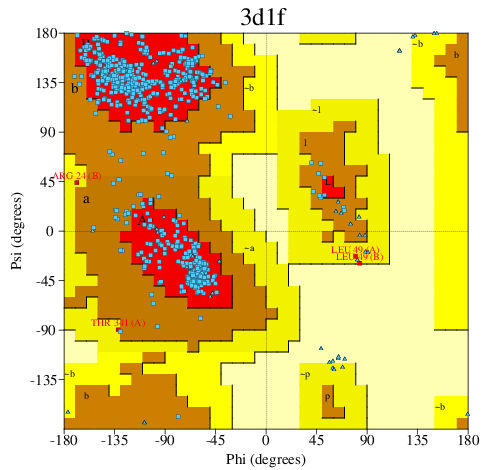
PROCHECK
|
|
|
|
|
|
Headers
|
|
|
|
References
|
|
|
|
|
|

|
|
P0A988
(DPO3B_ECOLI) -
Beta sliding clamp from Escherichia coli (strain K12)
|
|
|
|
Seq:
Struc:
|
|
|
|
366 a.a.
366 a.a.
|
|

|

|

|
|
|
|
|
|
|
|
|
|
|
Key: |
 |
PfamA domain |
|
|
 |
Secondary structure |
|
 |
CATH domain |
|
|
|
|
|
|
|
|
|
|
|
|
|
Enzyme class:
|
|
E.C.2.7.7.7
- DNA-directed Dna polymerase.
|
|
|
|
|
|
|
Reaction:
|
|
DNA(n) + a 2'-deoxyribonucleoside 5'-triphosphate = DNA(n+1) + diphosphate
|
|
|
|
|
|
 DNA(n)
|
+
|
2'-deoxyribonucleoside 5'-triphosphate
|
=
|
DNA(n+1)
|
+
|
 diphosphate
|
|
|
|
|
|
|
|
|
|
|
|
|
Molecule diagrams generated from .mol files obtained from the
KEGG ftp site
|
|
|
|
|
|
|
|
|
|
|
|
|
|
 |
|
|
|
|
|
|
| |
|
|
| |
|
DOI no:
|
Proc Natl Acad Sci U S A
105:11116-11121
(2008)
|
|
PubMed id:
|
|
|
|
|
|
| |
|
Structure of a small-molecule inhibitor of a DNA polymerase sliding clamp.
|
|
R.E.Georgescu,
O.Yurieva,
S.S.Kim,
J.Kuriyan,
X.P.Kong,
M.O'Donnell.
|
|
|
|
|
| |
ABSTRACT
|
|
|
|
| |
|
|
DNA polymerases attach to the DNA sliding clamp through a common overlapping
binding site. We identify a small-molecule compound that binds the
protein-binding site in the Escherichia coli beta-clamp and differentially
affects the activity of DNA polymerases II, III, and IV. To understand the
molecular basis of this discrimination, the cocrystal structure of the chemical
inhibitor is solved in complex with beta and is compared with the structures of
Pol II, Pol III, and Pol IV peptides bound to beta. The analysis reveals that
the small molecule localizes in a region of the clamp to which the DNA
polymerases attach in different ways. The results suggest that the small
molecule may be useful in the future to probe polymerase function with beta, and
that the beta-clamp may represent an antibiotic target.
|
|
|
|
|
|
| |
Selected figure(s)
|
|
|
|
| |
|
|

|
|

|
|
Figure 3.
Structure of a small-molecule inhibitor bound to the
β-clamp. (A) The RU7 compound. (B) Distances between RU7 and
the β-clamp. Side-chain movements upon binding RU7 are
indicated. Yellow and white are residues of β in the absence or
presence of RU7, respectively. Distances between RU7 and protein
residues are marked in black; the distances 3.73, 3.41, and 3.03
Å are marked a, b, and c, respectively.
|
|
Figure 5.
Superposition of Pol II, III, and IV peptides and RU7
compound bound to β. (A) Superposition of the Pol III peptide
(green), Pol II peptide (blue), and Pol IV peptide (purple; PDB
ID code 1OK7) (10). (B) Superposition of Pol III peptide (green)
and the RU7 compound (orange). The surface of the β-clamp is
colored white, and the protein-binding pocket of β is colored
according to sequence conservation of an alignment of 42
bacterial subunits; the color scale proceeds from red (90%
conservation) to yellow (50% conservation). Circled regions in
the peptide-binding pocket indicate subsites 1 and 2. Figures
were prepared by using Pymol (27).
|
|
|
|
| |
Figures were
selected
by an automated process.
|
|
|
|
|
|
|
|
|
|
|
|
|
|
|
|
 |
 |
 |
|
Literature references that cite this PDB file's key reference
|
|
|
| |
PubMed id
|
|
Reference
|
|
|
|
|
|
C.S.McHenry
(2011).
Breaking the rules: bacteria that use several DNA polymerase IIIs.
|
| |
EMBO Rep,
12,
408-414.
|
|
|
|
|
|
|
E.P.Geiduschek,
and
G.A.Kassavetis
(2010).
Transcription of the T4 late genes.
|
| |
Virol J,
7,
288.
|
|
|
|
|
|
|
H.G.Dallmann,
O.J.Fackelmayer,
G.Tomer,
J.Chen,
A.Wiktor-Becker,
T.Ferrara,
C.Pope,
M.T.Oliveira,
P.M.Burgers,
L.S.Kaguni,
and
C.S.McHenry
(2010).
Parallel multiplicative target screening against divergent bacterial replicases: identification of specific inhibitors with broad spectrum potential.
|
| |
Biochemistry,
49,
2551-2562.
|
|
|
|
|
|
|
T.Tomasić,
N.Zidar,
A.Kovac,
S.Turk,
M.Simcic,
D.Blanot,
M.Müller-Premru,
M.Filipic,
S.G.Grdadolnik,
A.Zega,
M.Anderluh,
S.Gobec,
D.Kikelj,
and
L.Peterlin Masic
(2010).
5-Benzylidenethiazolidin-4-ones as multitarget inhibitors of bacterial Mur ligases.
|
| |
ChemMedChem,
5,
286-295.
|
|
|
|
|
|
|
Y.Yamaichi,
S.Duigou,
E.A.Shakhnovich,
and
M.K.Waldor
(2009).
Targeting the replication initiator of the second Vibrio chromosome: towards generation of vibrionaceae-specific antimicrobial agents.
|
| |
PLoS Pathog,
5,
e1000663.
|
|
|
|
|
|
The most recent references are shown first.
Citation data come partly from CiteXplore and partly
from an automated harvesting procedure. Note that this is likely to be
only a partial list as not all journals are covered by
either method. However, we are continually building up the citation data
so more and more references will be included with time.
|
|


 Links
Links


