 |
PDBsum entry 7lm2

|
|
|
|
|
|

|

|

|

|
|

|
|

|
|

|
|

|
|

|
|

|
|
|
 |

|

|
|
|
|
|
|
|
|
|
|
|
|
|
|
|
|
|
|
|
|
|
|
|
|
|
|
|
|
|
|
|
|
|
|
|
Transferase/transferase inhibitor
|
PDB id
|
|
|
|
7lm2
|
|
|
|
|
|
|
|
|
|
|
|
|
|
|

|

|

|
|
|
|
|
|
|
|
|
|
|
Enzyme class 2:
|
|
Chain A:
E.C.2.7.1.137
- phosphatidylinositol 3-kinase.
|
|
|
|
|
|
|
Pathway:
|
|
1-Phosphatidyl-myo-inositol Metabolism
|
|
|
|
|
|
Reaction:
|
|
a 1,2-diacyl-sn-glycero-3-phospho-(1D-myo-inositol) + ATP = a 1,2-diacyl- sn-glycero-3-phospho-(1D-myo-inositol-3-phosphate) + ADP + H+
|
|
|
|
|
|
1,2-diacyl-sn-glycero-3-phospho-(1D-myo-inositol)
|
+
|
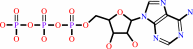 ATP
ATP
|
=
|
1,2-diacyl- sn-glycero-3-phospho-(1D-myo-inositol-3-phosphate)
|
+
|
 ADP
ADP
|
+
|
H(+)
|
|
|
|
|
|
|
|
|
|
Enzyme class 3:
|
|
Chain A:
E.C.2.7.1.153
- phosphatidylinositol-4,5-bisphosphate 3-kinase.
|
|
|
|
|
|
|
Pathway:
|
|
|
|
|
|
|
|
Reaction:
|
|
a 1,2-diacyl-sn-glycero-3-phospho-(1D-myo-inositol-4,5-bisphosphate) + ATP = a 1,2-diacyl-sn-glycero-3-phospho-(1D-myo-inositol-3,4,5- trisphosphate) + ADP + H+
|
|
|
|
|
|
1,2-diacyl-sn-glycero-3-phospho-(1D-myo-inositol-4,5-bisphosphate)
|
+
|
ATP
|
=
|
1,2-diacyl-sn-glycero-3-phospho-(1D-myo-inositol-3,4,5- trisphosphate)
|
+
|
ADP
|
+
|
H(+)
|
|
|
|
|
|
|
|
|
|
|
|
|
Note, where more than one E.C. class is given (as above), each may
correspond to a different protein domain or, in the case of polyprotein
precursors, to a different mature protein.
|
|
|
|
Molecule diagrams generated from .mol files obtained from the
KEGG ftp site
|
|
|
|
|
|
|
|
|
|
|
|
|
|
 |
|
|
|
|
|
|
| |
|
|
| |
|
DOI no:
|
J Med Chem
64:5137-5156
(2021)
|
|
PubMed id:
|
|
|
|
|
|
| |
|
Projected Dose Optimization of Amino- and Hydroxypyrrolidine Purine PI3Kδ Immunomodulators.
|
|
J.L.Methot,
H.Zhou,
M.A.McGowan,
N.J.Anthony,
M.Christopher,
Y.Garcia,
A.Achab,
K.Lipford,
B.W.Trotter,
M.D.Altman,
X.Fradera,
C.A.Lesburg,
C.Li,
S.Alves,
C.P.Chappell,
R.Jain,
R.Mangado,
E.Pinheiro,
S.M.G.Williams,
P.Goldenblatt,
A.Hill,
L.Shaffer,
D.Chen,
V.Tong,
R.L.McLeod,
H.H.Lee,
H.Yu,
S.Shah,
J.D.Katz.
|
|
|
|
|
| |
ABSTRACT
|
|
|
|
| |
|
|
The approvals of idelalisib and duvelisib have validated PI3Kδ inhibitors for
the treatment for hematological malignancies driven by the PI3K/AKT pathway. Our
program led to the identification of structurally distinct heterocycloalkyl
purine inhibitors with excellent isoform and kinome selectivity; however, they
had high projected human doses. Improved ligand contacts gave potency
enhancements, while replacement of metabolic liabilities led to extended
half-lives in preclinical species, affording PI3Kδ inhibitors with low
once-daily predicted human doses. Treatment of C57BL/6-Foxp3-GDL reporter mice
with 30 and 100 mg/kg/day of 3c (MSD-496486311) led to a 70% reduction in
Foxp3-expressing regulatory T cells as observed through bioluminescence imaging
with luciferin, consistent with the role of PI3K/AKT signaling in Treg cell
proliferation. As a model for allergic rhinitis and asthma, treatment of
ovalbumin-challenged Brown Norway rats with 0.3 to 30 mg/kg/day of 3c
gave a dose-dependent reduction in pulmonary bronchoalveolar lavage inflammation
eosinophil cell count.
|
|
|
|
|
|
|
|
|
|
|
|
|
|
|
|
|
|
 |
 |
 |
|
|


 Links
Links


