 |
PDBsum entry 6g0a

|
|
|
|
|
|

|

|

|

|
|

|
|

|
|

|
|

|
|

|
|

|
|
|
 |

|

|
|
|
|
|
|
|
|
|
|
|
|
|
|
|
|
|
|
|
|
|
|
|
|
|
|
|
|
|
|
|
|
|
|
|
DNA binding protein
|
PDB id
|
|
|
|
6g0a
|
|
|
|
|
|
|
|
|
|
|
|
|
|
|

|

|

|
|
|
|
|
|
|
|
|
Enzyme class 2:
|
|
E.C.2.7.7.7
- DNA-directed Dna polymerase.
|
|
|
|
|
|
|
Reaction:
|
|
DNA(n) + a 2'-deoxyribonucleoside 5'-triphosphate = DNA(n+1) + diphosphate
|
|
|
|
|
|
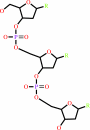 DNA(n)
|
+
|
2'-deoxyribonucleoside 5'-triphosphate
|
=
|
DNA(n+1)
|
+
|
 diphosphate
|
|
|
|
|
|
|
|
|
|
Enzyme class 3:
|
|
E.C.3.1.11.-
- ?????
|
|
|
|
|
|
|
|
|
|
Note, where more than one E.C. class is given (as above), each may
correspond to a different protein domain or, in the case of polyprotein
precursors, to a different mature protein.
|
|
|
|
Molecule diagrams generated from .mol files obtained from the
KEGG ftp site
|
|
|
|
|
|
|
|
|
|
|
|
|
|
 |
|
|
|
|
|
|
| |
|
|
| |
|
DOI no:
|
Nat Commun
10:373
(2019)
|
|
PubMed id:
|
|
|
|
|
|
| |
|
Structural consequence of the most frequently recurring cancer-associated substitution in DNA polymerase ε.
|
|
V.Parkash,
Y.Kulkarni,
J.Ter Beek,
P.V.Shcherbakova,
S.C.L.Kamerlin,
E.Johansson.
|
|
|
|
|
| |
ABSTRACT
|
|
|
|
| |
|
|
The most frequently recurring cancer-associated DNA polymerase ε (Pol ε)
mutation is a P286R substitution in the exonuclease domain. While originally
proposed to increase genome instability by disrupting exonucleolytic
proofreading, the P286R variant was later found to be significantly more
pathogenic than Pol ε proofreading deficiency per se. The mechanisms underlying
its stronger impact remained unclear. Here we report the crystal structure of
the yeast orthologue, Pol ε-P301R, complexed with DNA and an incoming dNTP.
Structural changes in the protein are confined to the exonuclease domain, with
R301 pointing towards the exonuclease site. Molecular dynamics simulations
suggest that R301 interferes with DNA binding to the exonuclease site, an
outcome not observed with the exonuclease-inactive Pol ε-D290A,E292A variant
lacking the catalytic residues. These results reveal a distinct mechanism of
exonuclease inactivation by the P301R substitution and a likely basis for its
dramatically higher mutagenic and tumorigenic effects.
|
|
|
|
|
|
|
|
|
|
|
|
|
|
|
|
|
|
 |
 |
 |
|


 Links
Links


